

TL;DR:
- Knowing key sailing terms enhances safety, communication, and enjoyment aboard a vessel.
- Tacking involves turning the bow through the wind, while gybing turns the stern through the wind.
- Learning basic vocabulary like bow, stern, port, and starboard helps new sailors participate confidently.
Stepping aboard a sailing yacht for the first time can feel like arriving in a foreign country where everyone speaks a language you haven’t yet learnt. Words fly between crew members, commands are shouted across the deck, and ropes seem to have names that bear no relation to anything you’ve encountered before. The truth is, sailing terminology isn’t reserved for seasoned professionals or competitive racers. Whether you’re booking a private charter along the Mediterranean coast or simply curious about life at sea, knowing the right words makes every moment aboard safer, more enjoyable, and considerably more impressive to anyone watching from the dock.
Table of Contents
- Core sailing boat terms every sailor should know
- Navigating boat manoeuvres: Tacking vs gybing explained
- Broader nautical language: Expanding your sailing vocabulary
- Using sailing boat terms in real-life scenarios
- Why embracing sailing terminology unlocks the full on-water experience
- Discover luxury sailing experiences with Sphynx BCN
- Frequently asked questions
Key Takeaways
| Point | Details |
|---|---|
| Know the basics | Learning core sailing terms builds confidence and prevents confusion on board. |
| Safety first | Recognising manoeuvre terms like gybing helps you avoid accidents, especially with the boom. |
| Expand your vocabulary | Broadening your nautical language lets you participate fully in advanced sailing activities. |
| Apply terms practically | Using sailing boat words in real scenarios enhances both teamwork and enjoyment. |
| Access luxury experiences | Having expert terminology opens doors to premium yacht charters and professional-led tours. |
Core sailing boat terms every sailor should know
Before you set foot on any vessel, a working knowledge of the boat’s anatomy is essential. These aren’t obscure technical phrases; they’re the everyday words that crew members use from the moment the lines are cast off. Familiarising yourself with luxury sailing terminology before your first charter can genuinely transform your experience on board.
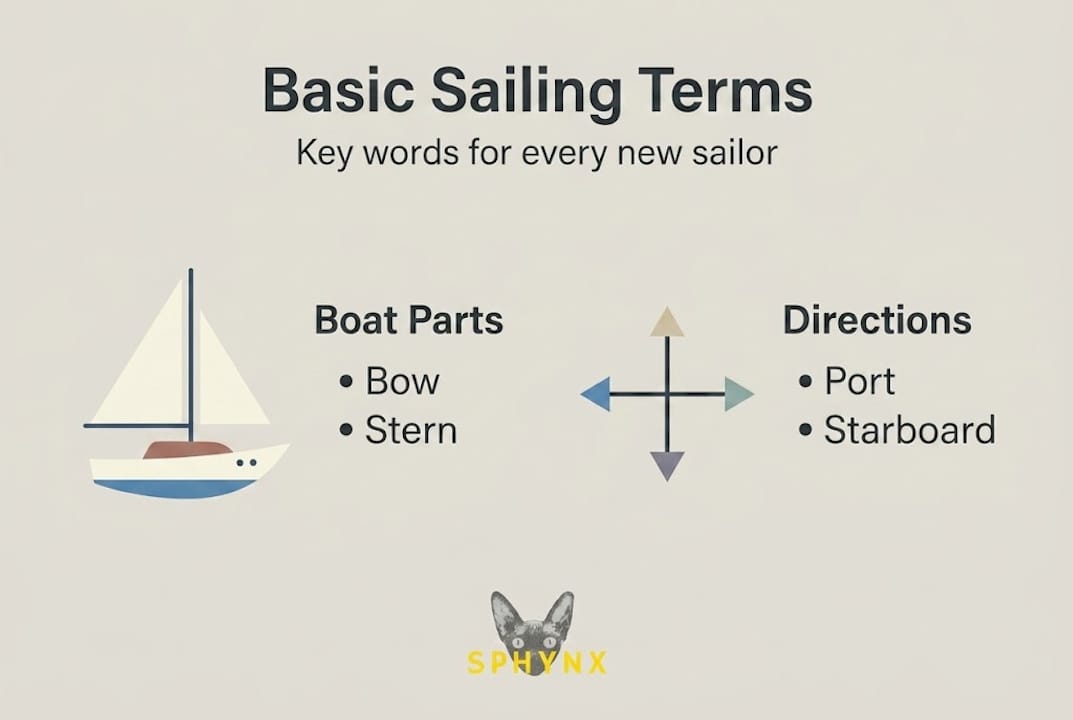
Let’s start with the most fundamental orientation terms. Bow refers to the front of the boat, and stern refers to the rear. Simple enough. But here’s where sailors part ways with the rest of the world: left and right are replaced by port (left when facing forward) and starboard (right when facing forward). These terms never change regardless of which direction you’re facing, which makes them far more reliable for giving directions on a moving vessel.
Next come the sails. The mainsail is the primary sail, typically the largest one, attached to the mast and the boom. The jib is the smaller triangular sail at the front of the boat, set forward of the mast. The boom is the horizontal pole that extends from the base of the mast, holding the bottom edge of the mainsail. Understanding the boom is particularly important for safety, as it can swing across the cockpit during certain manoeuvres. The helm refers to the steering mechanism, whether a tiller or a wheel, and the person at the helm is responsible for the boat’s direction.
Here is a quick reference of the most essential terms:
- Bow: the front of the boat
- Stern: the rear of the boat
- Port: the left side when facing forward
- Starboard: the right side when facing forward
- Mainsail: the principal sail, attached to the mast
- Jib: the forward triangular sail
- Boom: the horizontal spar beneath the mainsail
- Helm: the steering mechanism
- Cockpit: the recessed area from which the boat is steered
- Keel: the weighted fin beneath the hull that prevents sideways drift
You can explore even more foundational definitions via this nautical glossary A–L) for reference.
Pro Tip: A classic trick for remembering port versus starboard: the word “port” has four letters, and so does “left.” Once that clicks, it never leaves you.
These core terms relate directly to how you interact with the boat. When a skipper says, “Move to the port side,” they need an instant response, not a moment of hesitation. Knowing these words instinctively frees your attention for actually enjoying the experience.
Navigating boat manoeuvres: Tacking vs gybing explained
With core terms defined, let’s see how they’re applied in manoeuvres. Two of the most commonly used sailing manoeuvres are tacking und gybing, and confusing the two is one of the most frequent mistakes made by newcomers aboard. Both manoeuvres involve changing the boat’s direction relative to the wind, but they are fundamentally different actions with very different risk profiles.
Tacking means turning the bow of the boat through the wind. As the boat turns, the wind crosses the bow from one side to the other, and the sails shift from one side to the opposite. This is generally considered the safer and more controlled manoeuvre. The boat slows momentarily as it passes through the wind’s eye, giving crew members time to adjust and reposition.
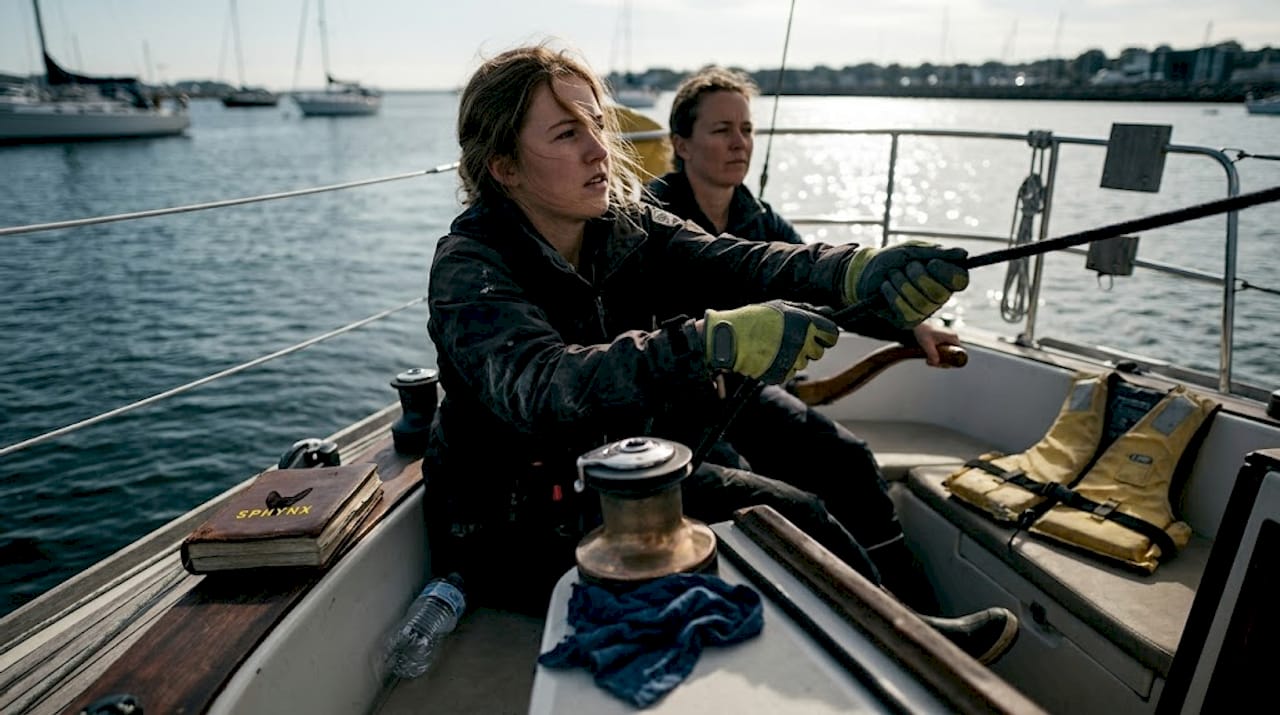
Gybing, on the other hand, turns the stern through the wind. The sails remain full for longer during this manoeuvre and then switch sides suddenly as the wind crosses the stern. This is where the real danger lies. An uncontrolled gybe is hazardous because the boom can swing across the cockpit with significant force, posing a serious risk to anyone in its path. This is why gybing requires clear communication, coordinated crew action, and often a skipper’s explicit instruction.
| Feature | Tacking | Gybing |
|---|---|---|
| Part of boat crossing wind | Bow | Stern |
| Sail movement | Gradual | Sudden |
| Boom swing | Controlled | Can be forceful |
| Beginner-friendly | Yes | Requires caution |
| Wind condition preference | Any | Best in light wind |
| Common use | Upwind sailing | Downwind sailing |
In practice, before a tack, you’ll hear commands such as “Ready about?” followed by “Tacking!” or “Lee-oh!” These phrases signal the crew to prepare and then execute the manoeuvre. With gybing, the command sequence is typically “Ready to gybe?” followed by “Gybe-oh!” Understanding these verbal cues is part of what makes nautical tourism explained such a rich subject; the language is entirely functional.
Pro Tip: As a passenger or first-time crew member, if you hear “gybe-oh,” duck immediately and move away from the centreline. The boom swings at head height, and hesitation is not your friend.
It’s also worth noting that professional skippers on luxury charters manage gybing conditions very carefully. On a calm Mediterranean afternoon, a controlled gybe is graceful. In stronger winds without preparation, it becomes hazardous. Understanding the difference helps you trust your skipper’s decisions and follow their instructions confidently. Brushing up on yacht charter terms can also help you communicate more fluently when arranging your next sailing experience.
Broader nautical language: Expanding your sailing vocabulary
Ready for more? Once you’ve mastered the fundamentals, a wider vocabulary opens up the full richness of life at sea. The nautical lexicon is vast, and experienced sailors draw on dozens of additional terms during every outing. Glossary coverage across A–L) illustrates just how extensive nautical language truly is, with terms spanning navigation, rigging, weather, and seamanship.
Here are some of the most practically useful terms beyond the basics:
- Sheet: Not a sail itself, but the rope used to control the angle of a sail. “Ease the sheet” means let the rope out; “trim the sheet” means pull it in.
- Cleat: A metal fitting used to secure a rope. Knowing how to cleat off a line quickly is a genuinely useful skill.
- Winch: A mechanical drum used to pull in ropes under load. On larger yachts, these are motorised and extremely powerful.
- Head-to-wind: The point at which the bow is directly into the wind. Sails flap and lose power; the boat stalls momentarily.
- Luff: The forward edge of a sail, or the flapping that occurs when the sail isn’t properly trimmed. “The sail is luffing” means it needs adjustment.
- Halyard: The rope used to raise and lower sails.
- Clew: The lower corner of a sail where the sheet attaches.
- Reef: To reduce the size of the mainsail, typically done in stronger winds to maintain control.
The table below summarises these terms and their practical function on board:
| Term | What it refers to | Practical use |
|---|---|---|
| Sheet | Rope controlling sail angle | “Ease the jib sheet” |
| Cleat | Rope-securing fitting | Cleating off the mainsheet |
| Winch | Mechanical rope-pulling device | Trimming sails under load |
| Halyard | Rope for raising sails | “Hoist the mainsail” |
| Luff | Forward sail edge or flapping | Indicates poor trim |
| Reef | Reducing sail area | Used in stronger winds |
| Head-to-wind | Bow directly into wind | Used when raising/lowering sails |
For those planning a sailing holiday, knowing these terms allows you to participate meaningfully in the activity rather than simply observe it. A guest who can assist with sheeting in the jib or cleating off a line becomes a valued part of the crew rather than cargo. This participation elevates the entire experience, especially on a luxury Mediterranean guide type of trip where personalised interaction with the boat and sea is central to the offering.
Understanding these additional terms also helps you decode the instructions you’ll encounter during a sailing briefing. Skippers tend to move quickly through safety demonstrations, so the more you already know, the more you retain and act upon effectively.
Using sailing boat terms in real-life scenarios
Now that you’ve learnt the language, let’s see how it’s applied during a day at sea. Vocabulary becomes truly meaningful when it’s embedded in a real scenario. Consider a typical crew briefing on a Barcelona charter morning:
“We’ll be heading north out of port. Wind is coming from the west, so we’ll be on a port tack initially. Once we clear the headland, we’ll prepare to tack onto starboard and sheet in the jib. Keep clear of the boom at all times and stay seated in the cockpit unless instructed otherwise.”
That single briefing uses at least eight distinct sailing terms. A guest who understands them immediately knows where the wind is coming from, which side the sails will be on, what manoeuvre is coming, and where to position themselves. A guest who doesn’t understand those terms is left guessing, which creates both confusion and potential risk.
Here is a step-by-step example of how a tacking sequence plays out in real life:
- The skipper calls, “Ready about?” This is a question to the crew, checking that everyone is prepared.
- Crew members confirm readiness, either verbally or with a thumbs-up.
- The skipper announces, “Tacking!” and begins turning the helm to windward.
- The jib sheet on the windward side is released as the bow crosses through the wind.
- The jib sheet on the new leeward side is pulled in and trimmed using the winch.
- The boat settles on the new tack; the skipper confirms heading and sail trim.
Each step depends on clear, shared language. If a crew member doesn’t know what a “jib sheet” is or which side is now “leeward,” the manoeuvre becomes slow and potentially unsafe. On a Barcelona luxury sailing tour, professional skippers manage these sequences smoothly, but they rely on guests understanding at least the basics to keep things moving safely.
Common mistakes that arise from terminology confusion include releasing the wrong sheet at the wrong moment, moving to the wrong side of the boat during a tack, and failing to duck at the right time during a gybe. None of these are dramatic errors in calm conditions, but they can become serious in stronger wind or confined waters. Language, in this sense, is a direct safety tool.
Why embracing sailing terminology unlocks the full on-water experience
Here is an opinion that might surprise you: learning sailing terminology isn’t primarily about sailing competence. It’s about belonging. When you step onto a vessel and speak the language, something shifts. The skipper relaxes slightly. Fellow crew members engage more openly. The experience stops feeling like a performance and starts feeling like participation.
At Sphynx BCN, we’ve seen this transformation happen repeatedly on our Mediterranean charters. Guests who arrive with even a basic knowledge of sailing terms enjoy their experience more measurably. They ask better questions, make bolder decisions, and leave with stories rather than just photographs. There’s a kind of confidence that comes from knowing the right word at the right moment, and it extends far beyond the boat.
The conventional wisdom is that sailing terminology is something you acquire gradually, over years of practice. We’d challenge that. A focused hour reading about bow, stern, tacking, and gybing before a charter produces real results. You don’t need to be fluent; you just need enough to be present. Explore master luxury terminology as a starting point and you’ll arrive aboard already ahead of the curve.
Sailing is one of the few leisure activities where language and safety are genuinely inseparable. Every term exists because it prevents a misunderstanding that could, in the wrong conditions, cause harm. Embracing that vocabulary isn’t pedantry. It’s respect for the sea and the people you share it with.
Discover luxury sailing experiences with Sphynx BCN
Mastering sailing boat terms is the first step. The next is putting them to use somewhere truly extraordinary.
At Sphynx BCN, we design every charter to be immersive, safe, and genuinely memorable along the stunning Mediterranean coast from Barcelona. Whether you’re booking a Yacht Privatrundfahrt for a special occasion, exploring our luxury yacht rentals, or browsing Mediterranean yacht experiences for inspiration, our expert skippers will guide you through everything you need to know on board. Your new vocabulary belongs on the open water.
Frequently asked questions
What is the difference between tacking and gybing?
Tacking turns the bow through the wind and is generally the safer manoeuvre for beginners; gybing turns the stern through the wind, which can cause the boom to swing across forcefully and poses greater risk if uncontrolled.
Why is it important to know sailing boat terms?
Understanding sailing terminology helps you follow crew instructions accurately, improves communication during manoeuvres, and keeps everyone aboard safer, especially in challenging conditions.
Which sailing terms should beginners learn first?
Beginners should prioritise bow, stern, port, starboard, mainsail, jib, boom, and helm, as these cover the boat’s basic orientation and key equipment referenced in the nautical terms glossary).
What should I do if a command uses an unfamiliar sailing term?
Ask the skipper or a crew member for clarification immediately; it’s always safer to pause and confirm than to act on a misunderstood instruction.