

TL;DR:
- Choosing a yacht solely based on stunning photos often leads to costly mismatches with your travel needs and itinerary.
- A structured, evidence-based approach that considers platform type, layout, crew, and operational constraints ensures a seamless and satisfying charter experience.
Picking a luxury yacht based on stunning photography is one of the most common and costly mistakes affluent travellers make when planning a Mediterranean charter. The gleaming deck shots and sun-drenched saloon photos are compelling, but they tell you almost nothing about whether a particular vessel will actually suit your group, your preferred destinations, or the level of service you expect. The right selection comes from a structured, evidence-based workflow that separates true operational fit from surface-level appeal. This guide walks you through every stage of that process, so your next charter exceeds expectations rather than merely looks good on a mood board.
Table of Contents
- Identifying what you need: goals and prerequisites
- Step 1: Matching itinerary to yacht type and platform
- Step 2: Digging deeper — layout, friction factors, and crew fit
- Step 3: Budgeting, contracts, and transparency — avoiding costly surprises
- Step 4: Testing the fit — operational constraints and real-world scenarios
- Why the best-looking yacht isn’t always the best choice
- Explore Mediterranean yacht journeys with Sphynx BCN
- Frequently asked questions
Key Takeaways
| Point | Details |
|---|---|
| Separate itinerary and platform fit | Choosing the right vessel requires matching itinerary and yachting platform before considering individual yacht profiles. |
| Go beyond surface comparisons | Aesthetic appeal is rarely a reliable guide—evaluate layout, friction factors, and crew expertise for true comfort. |
| Demand clarity and transparency | Insist on line-item budgeting and reputable contract practices to avoid hidden financial or legal risks. |
| Test fit before booking | Simulate the charter week with your shortlisted yacht to confirm operational compatibility and avoid unwelcome surprises. |
Identifying what you need: goals and prerequisites
Before you open a single yacht listing or browse a charter catalogue, you need to do something most travellers skip entirely: define what a successful charter actually looks like for you. Not in vague terms, but specifically. How many guests? What mix of couples, families, or colleagues? Are you prioritising remote anchorages, vibrant port towns, or a combination of both?
Understanding these foundations matters because, as industry selection mechanics confirm, choosing purely by appearance is a common failure mode. The correct approach separates destination and itinerary fit, yacht platform fit, and onboard friction factors like layout flow and crew service style.
Here is what to clarify before comparing any vessels:
- Travel party profile: ages, physical mobility, lifestyle preferences, and whether children are included
- Destination priorities: open ocean crossings, coastal hopping, secluded coves, or access to specific ports
- Amenity requirements: water toys, a gym, a chef-prepared tasting menu, or a fully equipped business suite
- Service style: do you want a formal, attentive crew or a relaxed, low-key presence?
- Embarkation flexibility: can you fly into alternative airports or are you fixed to a single port?
- Privacy level: some guests want complete seclusion; others enjoy social marina life
Pro Tip: Write a brief travel brief, no longer than one page, before approaching any charter broker. This document forces clarity and gives brokers a precise basis for matching vessels rather than simply presenting whatever is available at your target price point.
The table below illustrates how different guest profiles translate into charter priorities:
| Guest profile | Top priority | Platform preference | Service style |
|---|---|---|---|
| Couples’ retreat | Privacy and intimacy | Sailing yacht or gulet | Understated, personal |
| Multi-family group | Space and water activities | Catamaran or large motor | Relaxed, child-friendly |
| Corporate incentive | Presentation and technology | Motor superyacht | Formal, highly attentive |
| Adventure travellers | Range and remote access | Explorer or catamaran | Flexible, knowledgeable |
You can explore how luxury experiences are structured to understand the full spectrum of what is available before finalising your brief. For destination inspiration, reviewing Mediterranean yacht experience ideas will help you crystallise your itinerary ambitions before the selection process begins.
Step 1: Matching itinerary to yacht type and platform
Once your goals are clear, the next filter is platform type. This step comes before evaluating any individual yacht. It is the single decision that eliminates the widest range of unsuitable options, and yet it is consistently rushed or skipped by inexperienced charterers.
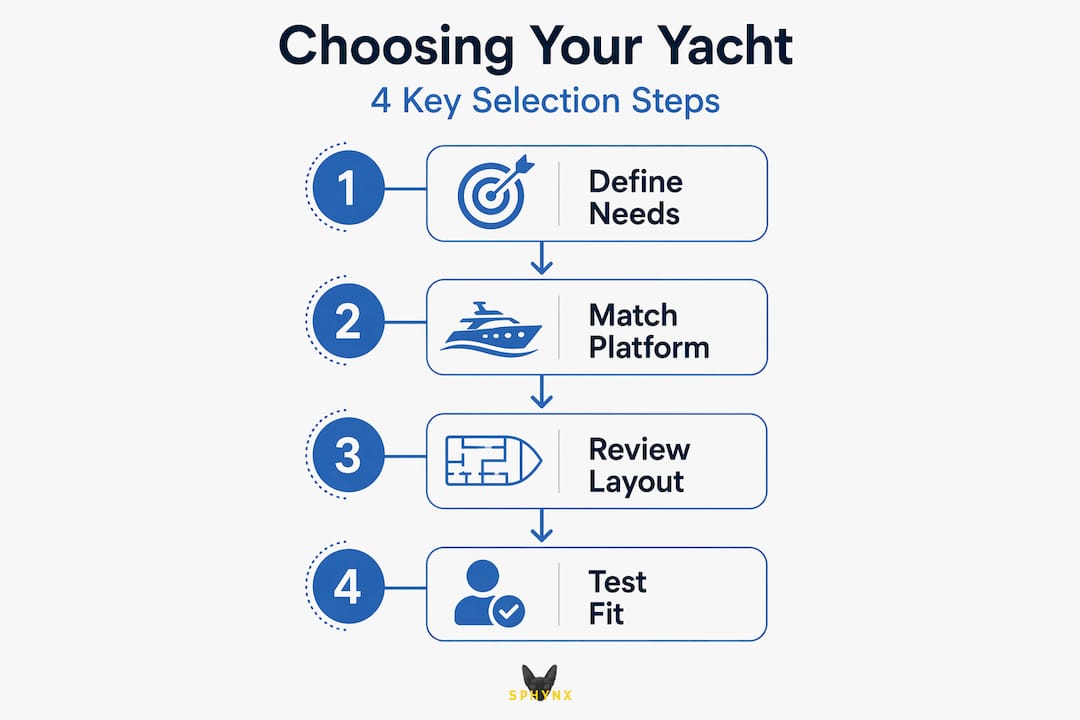
Different vessel categories exist for good reason. Each has distinct strengths, operational characteristics, and constraints that either support or undermine specific itineraries. Treat yacht charter types as a foundational reference at this stage.
Here is a structured comparison of the main platforms:
| Platform | Ideal conditions | Key strengths | Limitations |
|---|---|---|---|
| Motor superyacht | Open sea, fast transits | Speed, range, stability | Higher fuel costs |
| Sailing yacht | Coastal and offshore | Authenticity, silence, efficiency | Speed and space constraints |
| Catamaran | Shallow bays, families | Stability, deck space, shallower draft | Marinas may charge double |
| Explorer/expedition | Remote destinations | Extreme range, robustness | Less social, utilitarian interiors |
The process for matching platform to itinerary should follow these steps:
- List your must-visit destinations and calculate the approximate distances between them.
- Estimate daily transit requirements and determine whether speed matters or whether slow sailing between stops is the appeal.
- Identify any shallow anchorages, small harbours, or restricted access zones on your route.
- Cross-reference those operational demands against each platform’s capabilities.
- Eliminate platforms that create compromises on more than two key requirements.
As hidden friction in charter comparisons reveals, you should not treat vessels as a set of marketing metrics such as length. Compare layout, refit recency, range, speed, and port access constraints as part of the platform filtering process.
Pro Tip: Avoid the trap of assuming a longer yacht is automatically better. A 35-metre sailing yacht may offer a far more appropriate experience for a Costa Brava coastal tour than a 50-metre motor superyacht that cannot access the most scenic, shallow anchorages. Understanding charter appeal to affluent travellers reinforces why fit always outweighs size.
Step 2: Digging deeper — layout, friction factors, and crew fit
With your platform shortlist in hand, you move into the layer that most directly defines onboard quality of life: layout, flow, and crew character. This is where many charters quietly disappoint despite ticking every brochure box.
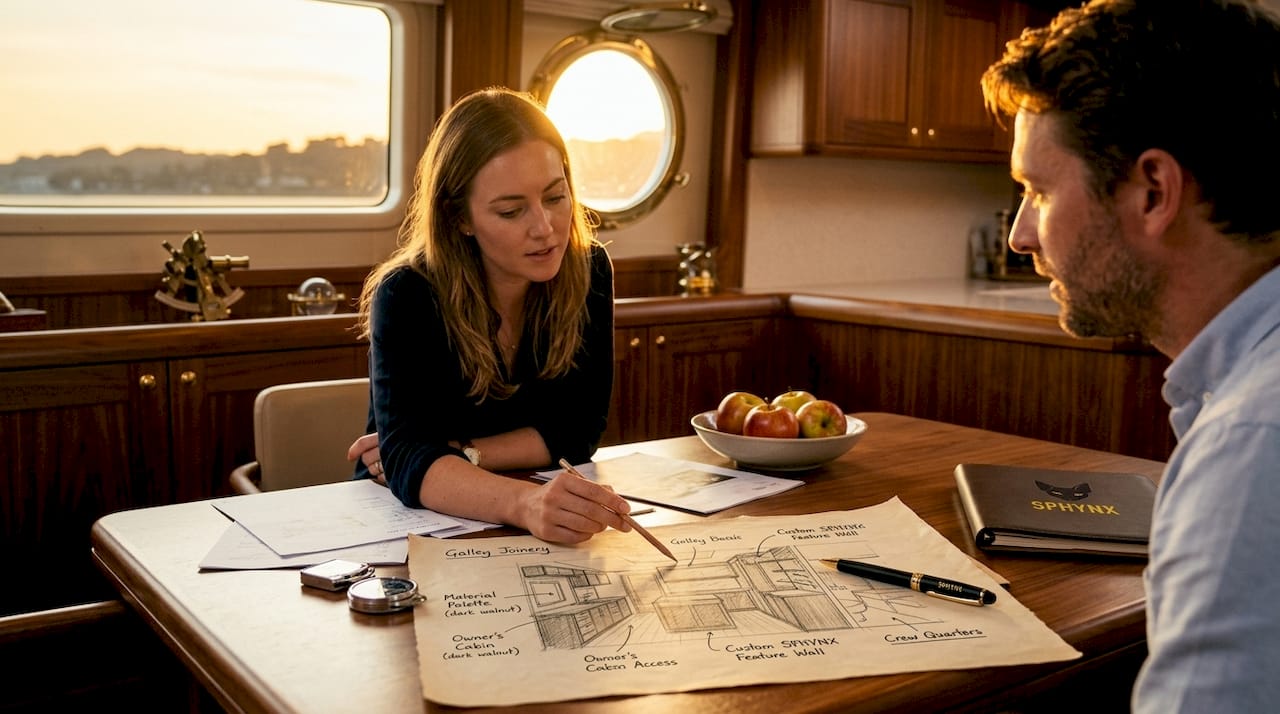
Layout is not about square footage. It is about how the yacht feels when your group moves through it. Can guests gather comfortably on the aft deck without crowding? Is the master cabin genuinely private, or does it sit directly above the engine room? Are the guest cabins symmetrical and well-proportioned, or does one end up noticeably smaller than the others?
Common friction factors to investigate before committing:
- Cabin arrangement asymmetry: one cabin significantly smaller or less well-appointed than others creates hierarchy within guest groups
- Dated refits: a yacht built in 2010 but not refitted since 2017 may show its age in ways photos will never reveal
- Crew-to-guest ratio: under-crewed yachts, even beautiful ones, deliver noticeably reduced service
- Connectivity: unreliable WiFi is a non-issue on a remote Aegean crossing but genuinely problematic for a corporate retreat
- Crew service style incompatibility: a highly formal, white-gloved crew on a family holiday can feel oppressive rather than impressive
The best hospitality practices in the industry stress that service style alignment matters as much as the physical vessel. Evaluating crew profiles and reading recent guest testimonials, not marketing descriptions, is an essential part of shortlisting.
“Don’t treat the yacht as a set of marketing metrics. Compare layout, refit recency, range, speed, and port access constraints so the week requires minimal compromise.” — How to Compare Yacht Charters, 2026
For corporate clients in particular, the stakes around crew professionalism and onboard ambience are especially high. The onboard corporate hospitality standards expected by executive groups demand an entirely different crew profile compared to leisure charters, and shortlisting should reflect that.
| Evaluation criterion | What to ask | Red flag |
|---|---|---|
| Refit history | Year and scope of last refit | More than 5 years with no update |
| Crew tenure | How long has the captain served on this yacht? | Crew turnover in past 12 months |
| Guest reviews | Recent feedback from comparable groups | Reviews older than 2 seasons |
| WiFi and AV | System specifications and reliability | Vague “internet available” descriptions |
Step 3: Budgeting, contracts, and transparency — avoiding costly surprises
Budget transparency is not a luxury concern, it is a baseline requirement. Sophisticated travellers should never accept a headline charter fee without demanding a fully itemised cost breakdown. The gap between a quoted charter rate and the final invoice can easily reach 30 to 40 per cent when variable costs are not disclosed upfront.
As charter budgeting guidance makes clear, charterers should treat APA, VAT, taxes, fuel, docking fees, provisioning, and gratuities as separate line items, and insist that the broker’s proposal quantifies each one rather than hiding them behind vague “all-inclusive” language.
A representative line-item charter cost breakdown for a week-long Mediterranean charter might look like this:
| Cost component | Typical range | Notes |
|---|---|---|
| Base charter fee | £40,000 to £120,000 | Vessel size and season dependent |
| APA (Advance Provisioning Allowance) | 25 to 35% of base fee | Refundable if unspent |
| VAT | 10 to 21% | Varies by flag state and charter zone |
| Fuel | £3,000 to £15,000 | Highly itinerary dependent |
| Marina fees and port taxes | £1,000 to £8,000 | Peak season marinas command premiums |
| Crew gratuity | 10 to 15% of base fee | Standard industry practice |
Follow these steps when comparing broker proposals:
- Request a fully itemised estimate, not a ballpark or a “from” figure.
- Confirm whether VAT is included or excluded from the base rate.
- Clarify the APA structure and what happens to unspent funds.
- Ask specifically about peak-season port surcharges for your intended destinations.
- Verify the contract format: reputable brokers use MYBA or CYBA frameworks, which provide documented legal protections for both parties.
Pro Tip: Always insist on an MYBA or CYBA contract. These industry-standard agreements protect you on cancellation terms, force majeure conditions, and dispute resolution. Any operator unwilling to work within this framework is a genuine warning sign.
Reviewing options for itinerary planning and cost control at this stage can help you adjust routing to manage variable costs, particularly fuel. If you are weighing up private versus shared charter formats, those cost structures differ significantly and should be understood before finalising your budget model.
Step 4: Testing the fit — operational constraints and real-world scenarios
The final verification step is one that even well-prepared charterers often skip: simulating the actual week before you sign anything. A yacht can pass every earlier filter and still fail you in practice if the operational realities of your itinerary have not been pressure-tested against the vessel’s genuine capabilities.
Consider this worked example. You have selected a 42-metre motor yacht for a seven-day journey from Barcelona to Menorca, including stops at Tarragona, the Ebro Delta anchorage, and several ports along the Menorcan coastline. On paper, this looks straightforward. In reality, the Ebro Delta approach requires a draft of under two metres, the Menorcan north coast harbours impose size restrictions, and the round trip fuel consumption at cruising speed substantially exceeds the APA estimate prepared for calm summer conditions. None of this appears in the brochure.
As end-to-end fit testing confirms, selection should be a dynamic assessment rather than a static brochure comparison, accounting for the vessel’s real operational constraints throughout the intended route.
Use these steps to run a proper fit test:
- Map the full itinerary with distances, and calculate realistic transit times at the yacht’s cruising speed, not maximum speed.
- Check each planned harbour or anchorage against the vessel’s draft, beam, and length.
- Obtain port availability and booking requirements for peak season dates.
- Calculate fuel burn across the entire route and validate against the APA estimate.
- Identify any leg where operational constraints would force a compromise, and discuss alternatives with your broker before signing.
Pro Tip: Ask your broker to produce a written itinerary feasibility note before contract finalisation. Any broker who resists this request is either unfamiliar with the vessel or indifferent to your experience once the contract is signed.
“Selection should be an end-to-end fit test, not a static brochure comparison — operational constraints and real-world fuel and transit realities must be validated against the itinerary before commitment.” — How to Compare Yacht Charters, 2026
For corporate retreat scenarios, this operational fit testing is especially important. Reviewing guidance on hosting executive retreats at sea provides a clear framework for validating that a vessel and itinerary combination can support a high-stakes professional programme without logistical compromise.
Why the best-looking yacht isn’t always the best choice
There is an uncomfortable truth in the luxury charter industry that most marketing materials will never tell you: the most photographed yachts are not necessarily the best chartered yachts. They are the best marketed ones. Those are entirely different things.
The charters that generate genuine satisfaction, the ones guests describe as life-changing rather than merely pleasant, consistently share the same characteristics. The vessel fits the group precisely. The crew understands and anticipates the guests’ preferences. The itinerary has been operationally validated rather than aspirationally assembled. The contract is clear, the billing is transparent, and there are no surprises on the final invoice.
In our experience, the greatest source of charter disappointment is not the quality of a sunset or the weather on a particular day. It is the accumulated friction of small mismatches: a cabin that felt spacious in photos but cramped for three adults, a crew whose formality felt out of place for a relaxed family holiday, a day lost because the planned anchorage was inaccessible to the vessel’s draft.
As guidance on booking structures highlights, booking direct may appear more economical, but it frequently reduces both legal protection and cost transparency compared to experienced broker-mediated arrangements. Saving a few thousand pounds on a £100,000 charter by cutting out a reputable broker is rarely the bargain it appears.
Seamlessness is the real luxury. It is invisible when present and painfully obvious when absent. Prioritising best practices for hospitality at every stage of the selection workflow is what separates a memorable charter from a merely expensive one.
Explore Mediterranean yacht journeys with Sphynx BCN
You now have the framework. Putting it into practice is where Sphynx BCN makes the difference.
Sphynx BCN curates every charter to match your precise guest profile, itinerary requirements, and service expectations. Our team handles platform selection, crew briefing, operational fit testing, and full contract transparency so that none of the friction points described in this guide ever reach you. Whether you are planning an intimate private yacht tour along the Costa Brava or a bespoke multi-day journey drawing from our curated luxury Mediterranean experiences, we bring the same rigorous selection standard to every booking. Browse our full range of yacht tour formats and speak with our team to begin planning your next charter with complete confidence.
Frequently asked questions
What is the APA in a yacht charter budget?
The APA, or Advance Provisioning Allowance, is a separate fund for variable expenses such as food, fuel, and docking fees, managed directly by the yacht captain and reconciled at the end of the charter with any unspent balance refunded.
Why shouldn’t I choose a yacht based only on photos?
Choosing purely by appearance is a well-documented failure mode because photos cannot convey layout flow, crew quality, refit condition, or the operational fit between the vessel and your intended itinerary.
How can I check if a yacht fits my itinerary?
Verify that the vessel’s speed, draft, and range are compatible with your planned route, and ask your broker to produce a written end-to-end fit test confirming harbour access, transit times, and fuel estimates before you commit.
What contract terms should I expect with a reputable luxury charter broker?
Reputable brokers work within MYBA or CYBA contract frameworks, which provide itemised cost estimates, clear cancellation terms, and documented legal protections for both the charterer and the vessel owner.
Is booking direct with an owner better than using a broker?
Booking direct may appear cheaper but typically reduces both legal protection and budget transparency, making a reputable broker the more prudent choice for high-value Mediterranean charters.