

TL;DR:
- The mast on a sailboat is the primary structural element that supports the rig and transfers wind loads into the hull. Different materials like aluminum and carbon fiber influence boat performance, handling, and maintenance needs; aluminum is durable and forgiving, while carbon fiber offers precision and speed. Proper rigging tension, mast type, and regular maintenance are essential for safety, efficiency, and optimal sailing experience.
Every sailor knows the mast on a sailboat does more than hold the sails up. It is the structural spine of the entire rig, transferring the raw force of wind through sails, lines, and stays directly into the hull. Yet most people who step aboard a yacht for the first time see it as little more than a tall aluminium pole. That misreading leads to surprises: why does the rigging need tuning? Why does mast material change how a boat handles? This article pulls apart every layer of the mast, from its physical structure and materials to standing rigging, maintenance, and the different rig configurations you will encounter on the water.
Tabla de Contenidos
- Key takeaways
- What a mast on a sailboat actually does
- Mast materials and how they shape performance
- Standing rigging: how the mast stays up
- Raising, lowering and maintaining the mast
- Types of sailboat masts and rig configurations
- My honest view on what most sailors misunderstand
- See the rig in action on the Mediterranean
- FAQ
Key takeaways
| Point | Details |
|---|---|
| Mast is structural, not decorative | The mast transfers wind loads into the hull and is the primary load-bearing component of the rig. |
| Material choice affects performance | Carbon fibre offers stiffness and precision; aluminium offers durability and predictable flex for recreational use. |
| Rigging tension is safety-critical | Standing rigging should be tensioned at 10 to 25% of wire breaking load to prevent dangerous mast movement. |
| Keel-stepped masts are more stable | Masts stepped to the keel offer greater structural integrity than deck-stepped versions, particularly offshore. |
| Maintenance prevents failure | Regular internal checks, rigging inspections, and debris clearing stop small problems becoming expensive ones. |
What a mast on a sailboat actually does
The mast is the primary structural component of a sailboat, supporting the rig and channelling enormous loads down into the hull. Think of it less like a flagpole and more like the main beam of a building. When wind fills a sail, the force does not simply disappear into the cloth. It travels through the sail into the mast, then through the standing rigging into the deck and keel structure below.
Two fundamental configurations exist. A deck-stepped mast sits on a plate at deck level, making it easier to raise and lower but placing its load directly onto the deck. A keel-stepped mast passes through the deck and rests on the keel, distributing loads more efficiently through the hull. The keel-stepped version is generally preferred for bluewater sailing because it retains some ability to stand even if a stay parts.
Several components connect directly to the mast and are worth understanding from the start:
- Boom. The horizontal spar attached at the mast base, controlling the foot of the mainsail and directing its angle to the wind.
- Spreaders. Short horizontal struts positioned partway up the mast that push the shrouds outward, increasing their effective angle and improving lateral support.
- Gooseneck. The fitting that attaches the boom to the mast, allowing it to swivel in multiple directions.
- Masthead. The very top of the mast, where the forestay attaches and instruments like wind vanes or VHF antennas are mounted.
Pro Tip: If you are new to luxury Mediterranean sailing, spend a few minutes on deck before casting off and trace each piece of rigging back to its attachment point on the mast. You will understand the whole rig within ten minutes.
Mast materials and how they shape performance
The material a mast is made from is not simply an engineering choice. It shapes how the boat feels under sail, how it responds to gusts, and how much maintenance you will face over the years.
| Material | Weight | Flex | Cost | Best for |
|---|---|---|---|---|
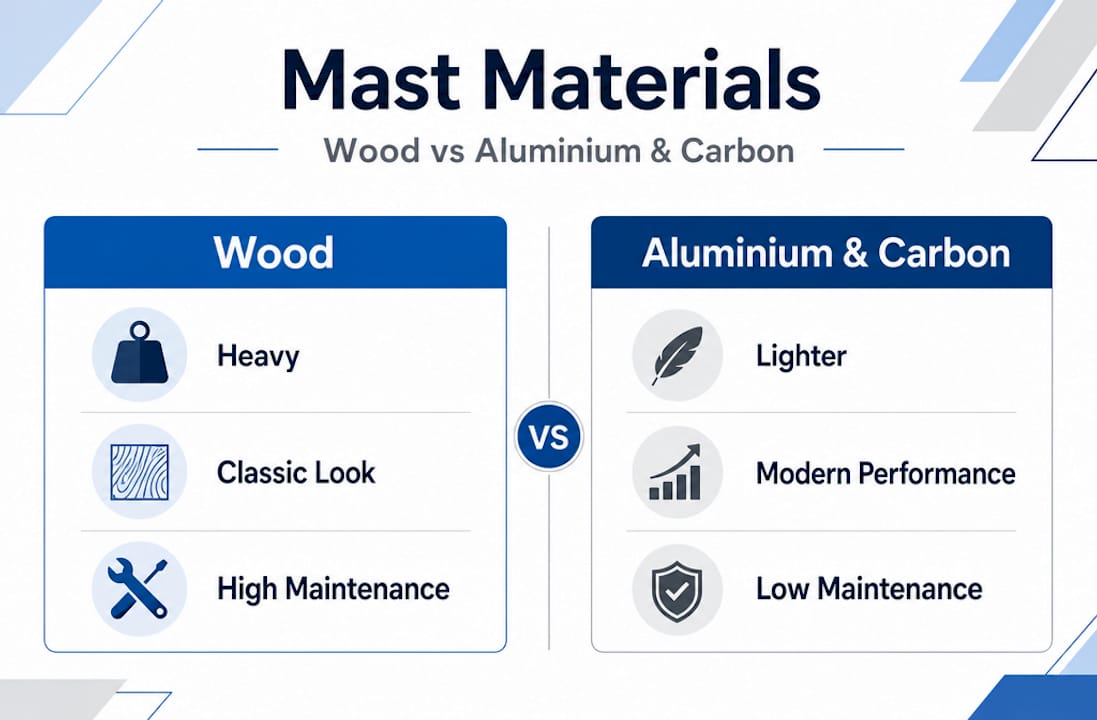
| Wood | High | High | Variable | Classic and traditional vessels |
| Aluminium | Medium | Moderate | Low to medium | Recreational and cruising sailors |
| Carbon fibre | Low | Very low | High | Racing and performance yachts |
Aluminium became the standard for recreational masts in the second half of the twentieth century and remains so today. Aluminium masts remain popular for recreational use because of their durability and predictable bend characteristics. That forgiving flex is actually useful. When a gust hits, an aluminium mast absorbs some of the shock rather than transmitting every spike of force into the hull and rigging. Sailors who have grown up on aluminium rigs often find the feedback intuitive.
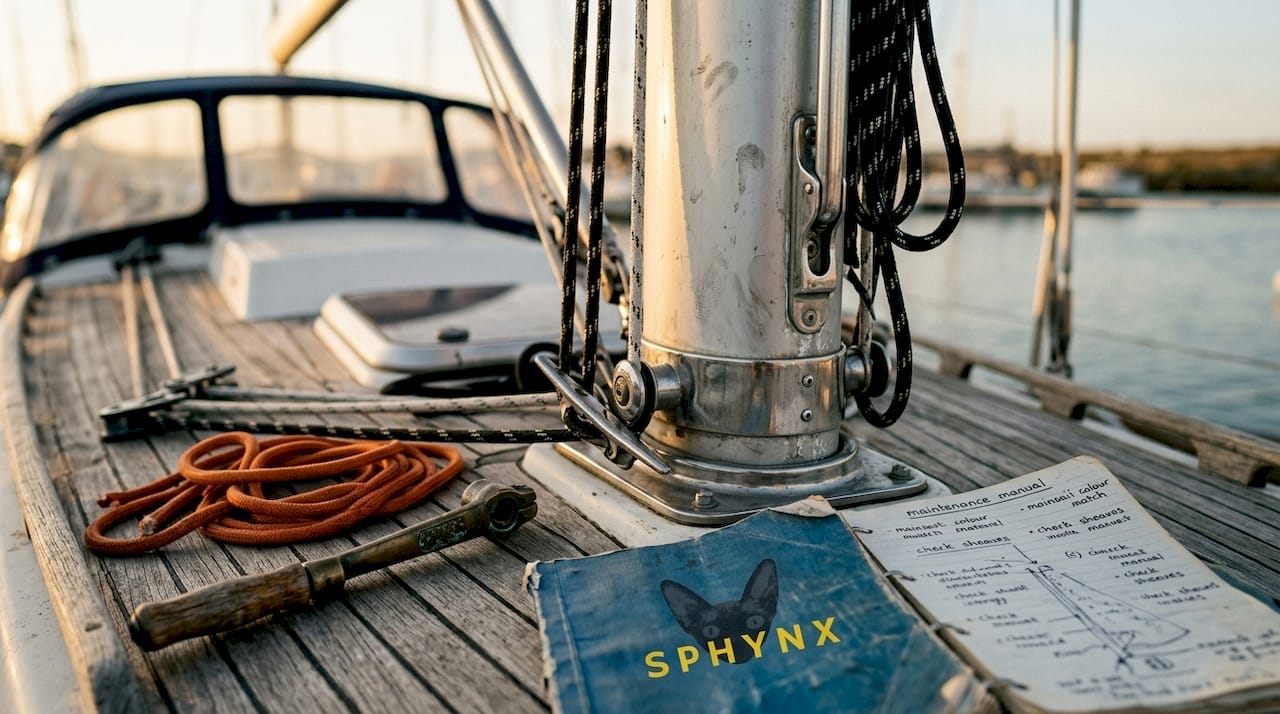
Carbon fibre sits at the other end of the spectrum. Carbon fibre masts offer higher stiffness and less flex, providing quicker, more precise responses to sail adjustments. A carbon mast does not dampen a gust. It transmits it. That responsiveness is an advantage in racing, where fractions of a second matter, but it demands a more attentive sailor and more precise rigging tension. The cost is also significantly higher, both to buy and to repair after damage.
Wooden masts are largely historical but are still found on classic yachts. They are heavier and require more maintenance, but many owners of traditional vessels prize their aesthetics and the craftsmanship involved.
Pro Tip: For your first sailing experiences, aluminium is forgiving and well-understood. If you ever charter a performance yacht and notice how immediately it responds to trim changes, you are likely feeling the influence of a carbon rig at work.
Standing rigging: how the mast stays up
A mast standing 15 or 20 metres above the waterline does not support itself. Sailboat rigging, specifically the standing rigging, does the work. This is the system of wires and rods that holds the mast in place and transfers its loads safely into the boat structure.
The main components are:
- Forestay. Runs from the masthead (or a point near it) to the bow, preventing the mast from falling backwards and providing the luff for the headsail.
- Backstay. Runs from the masthead to the stern, countering the forward pull of the forestay and controlling mast bend.
- Shrouds. Run from the mast down to the chainplates on either side of the hull, resisting lateral forces and preventing the mast from toppling sideways.
- Spreaders. Increase the effective angle of the shrouds, improving athwartships support without lengthening the shrouds themselves.
Tension is where many sailors get into trouble. Standing rigging tension should be maintained at roughly 10 to 25% of wire breaking load. Too loose, and the mast pumps in a seaway. Too tight, and you over-stress the chainplates, deck fittings, and the mast itself. Excessive mast pumping can ultimately lead to catastrophic rig failure, which is why experienced sailors check rigging tension at the start of each season and after any heavy weather.
Precise measurements for mast positioning and rigging attachment points are genuinely critical. Professional mast makers work down to millimetres, accounting for hull asymmetry, to produce a rig that sets up straight and performs as designed. Even a modest misalignment creates uneven loading across the shrouds, wearing out one side faster than the other.
Raising, lowering and maintaining the mast
On larger yachts, the mast stays up permanently and steps into the keel. On smaller and trailerable sailboats, the mast comes down regularly. Understanding how this works prevents damage and injury.
- Prepare the gin pole. An A-frame or single gin pole attached to the mast base creates a mechanical advantage that allows one person to raise or lower the mast safely. Single-handed mast raising systems using an A-frame gin pole and brake winch can complete the operation within 15 minutes.
- Secure the rigging before lifting. All shrouds and stays must be attached and loose enough to not bind, but organised so nothing catches. Use bungee cords to hold turnbuckles upright during the raising process, preventing them fouling or bending the shrouds.
- Use a brake winch. A controlled raise is everything. A brake winch holds the mast at any angle during the process, preventing it dropping suddenly if you lose grip. Purpose-built models like the Dutton-Lainson DLB350A are well regarded for this purpose.
- Step carefully and check alignment. Once the mast is upright, confirm it is centred athwartships before tensioning the shrouds. A mast even slightly off-centre changes how the boat sails.
- Inspect before every season. Check every swage fitting, turnbuckle, and pin for corrosion or cracking. Replace anything questionable. Rigging is inexpensive compared to a dismasting.
For internal maintenance, clearing internal mast debris such as old wiring or bird nests is something many owners overlook until they need to run new cables. A length of PVC pipe used as a ramrod clears obstructions before pulling new wiring through, which is a simple technique that saves hours of frustration.
Pro Tip: Photograph every step of your mast-unstepping process. When you re-step six months later, that photo record of which wire attaches where is worth more than any diagram.
Types of sailboat masts and rig configurations
The mast on a sailboat comes in several configurations depending on the vessel’s design and intended use. Understanding these helps you interpret what you see on the water and why certain yachts look and handle the way they do.
| Rig type | Number of masts | Typical use | Key characteristic |
|---|---|---|---|
| Sloop | One | Most common, day sailing to offshore | Single mast carries mainsail and one headsail |
| Cutter | One | Offshore cruising | Single mast set further aft; two headsails |
| Ketch | Two | Ocean cruising | Mizzen mast forward of the rudder post |
| Schooner | Two or more | Cruising and classic racing | Aft mast taller than forward mast |
| Full-rigged ship | Three or more | Historical; tall ship events | Square sails on three or more masts with yards for horizontal sail support |
The sloop is the most familiar rig in modern sailing and dominates the Mediterranean charter fleet. Its single mast is positioned for efficiency upwind and simplicity of sail handling. The ketch adds a smaller mizzen mast behind the main, giving more sail area options and a more balanced helm in stronger winds. This makes it popular with long-distance cruisers.
A full-rigged ship, with its foremast, mainmast, and mizzenmast each carrying square sails, excels off the wind but struggles to point close to it. You will occasionally see these vessels at tall ship events or in historic harbours.
Some performance rigs also use flying backstays: temporary stays tensioned on the windward side when tacking, used on fractional rigs to control mast bend and support the top section under load. These are found on racing yachts and require active crew management throughout a sail.
My honest view on what most sailors misunderstand
I have stood next to dozens of first-time sailors who look at the mast and say, confidently, “So that’s just to hold the sails.” In my experience, that assumption leads directly to under-maintained rigs, improperly tuned shrouds, and the occasional expensive surprise offshore.
The most persistent myth I encounter is that a heavier, thicker mast is automatically safer. It is not. An over-dimensioned mast raises the centre of gravity, reduces stability, and can actually stress the hull more than a correctly sized, well-tuned rig. The importance of a mast lies not in its raw bulk but in how precisely it is dimensioned and supported. Ill-dimensioned or weak masts compromise all sail performance and safety.
What I have learned from years around performance and cruising rigs is that rig tuning is not a seasonal chore. It is an ongoing conversation between you and the boat. Rigging tension changes with temperature. Fittings work loose. Spreader tips wear. The sailors I respect most treat a rig inspection as routine as checking the engine before departure.
For anyone new to sailing: do not be intimidated by the technical detail. Once you understand the logic behind how a mast stands and how it transfers load, every other element of the boat starts to make more sense. The mast is not complicated. It is just precise.
— Sphynxbcn
See the rig in action on the Mediterranean
There is only so much a diagram can teach you. Standing on the deck of a well-rigged yacht as the mainsail fills and the boat heels into the breeze tells you more in ten minutes than an hour of reading.

Sphynxbcn offers private yacht tours along the Barcelona coastline where guests frequently find themselves genuinely curious about the rig above them. The crew are happy to explain what they are looking at. For those who want a broader sense of what different vessels and configurations feel like, the Mediterranean yacht tour options from Sphynxbcn cover everything from leisurely coastal sails to performance-oriented experiences. Whether you are planning a private celebration, a corporate event at sea, or simply your first taste of Mediterranean sailing, there is a format to suit you.
FAQ
What is the purpose of a mast on a sailboat?
The mast supports the sails and transfers the force of wind through the rigging into the hull, driving the boat forward. Without it, there is no structure to carry the rig.
What is the difference between deck-stepped and keel-stepped masts?
A deck-stepped mast rests on a fitting at deck level and is easier to raise and lower. A keel-stepped mast passes through the deck and seats on the keel, offering greater structural integrity, particularly offshore.
What materials are sailboat masts made from?
Modern sailboat masts are most commonly made from aluminium, which offers durability and predictable flex, or carbon fibre, which is lighter and stiffer but more expensive. Wooden masts are found on traditional and classic vessels.
How often should sailboat rigging be inspected?
Standing rigging should be checked at the start of every sailing season and after any heavy weather. Fittings, swage terminals, and pins should be inspected for corrosion, cracking, or movement and replaced at the first sign of wear.
What are the main types of sailboat rig configurations?
The most common types include the sloop (one mast, one headsail), cutter (one mast set further aft, two headsails), ketch (two masts, mizzen forward of the rudder post), and schooner (two or more masts with the aft mast tallest). Each suits different sailing styles and passage lengths.