

TL;DR:
- Yacht photography requires extensive preparation, appropriate equipment, and understanding maritime conditions.
- Safety protocols and coordination with crew are crucial to protect both people and equipment during shoots.
- Professional experience and technical skill are essential for capturing high-quality images in challenging oceanic environments.
Photographing a luxury yacht celebration off the coast of Barcelona sounds effortless when you scroll through polished Instagram feeds. The reality is considerably more demanding. Decks tilt, Mediterranean light shifts within minutes, guests move unpredictably, and confined interiors test even seasoned photographers. The gap between a blurry snapshot and a genuinely show-stopping event image comes down to preparation, technical skill, and an intimate understanding of maritime conditions. This guide walks you through every stage, from packing the right kit to delivering a refined final collection worthy of your client’s expectations.
Table of Contents
- Essential equipment and preparation
- Setting up for safety and success
- Capturing stunning shots: technical and creative approaches
- Overcoming environmental and technical challenges
- Polishing images: post-production essentials
- Expert perspective: the value of true expertise in yacht event photography
- Elevate your next Barcelona yacht event with expert photography
- Frequently asked questions
Key Takeaways
| Point | Details |
|---|---|
| Preparation is key | Premium yacht event photography starts with the right gear, weather checks, and coordination. |
| Safety comes first | Secure equipment and communicate with crew to avoid accidents and lost shots. |
| Master technical challenges | Use fast shutter speeds, adapt for light, and employ stabilisation to capture sharp images at sea. |
| Post-production matters | Editing in RAW and thoughtful colour correction elevate results for luxury clients. |
| Hire true experts | Experienced maritime photographers consistently deliver memorable, high-quality event imagery. |
Essential equipment and preparation
With the promise of capturing spectacular moments set, let’s break down the essential tools and groundwork.
Yacht photography is an unforgiving discipline, and the Mediterranean setting adds a layer of complexity that ordinary event photographers rarely encounter. Nautical photography in Barcelona requires ultra-wide lenses for interiors without distortion, flash for low light, and constant adaptation to movement and changing light. Understanding that reality before you even step aboard is half the battle.
Camera bodies should be professional-grade DSLRs or mirrorless systems with weather sealing. Look for models with dual card slots so every image saves simultaneously to two cards, providing instant redundancy. Lenses should include at minimum an ultra-wide zoom (14–24mm equivalent), a fast prime such as a 35mm or 50mm f/1.4 for low-light portraits, and a short telephoto for candid guest moments from a distance. High-quality speedlights and at least one compact strobe round out the lighting kit.
Stabilisation matters enormously on a moving vessel. A gimbal stabiliser or a fluid-head tripod that can be weighted down will reduce the motion blur that ruins otherwise perfect frames. If aerial coverage is part of the brief, a drone capable of shooting in 4K with obstacle avoidance is essential. Bear in mind that yacht photography tips consistently emphasise researching drone permit requirements well in advance of the event date.
Ancillary kit is easy to overlook but equally critical:
- Weatherproof camera bags and rain covers for each body
- Lens cleaning cloths and a blower for salt spray
- A minimum of eight high-speed memory cards per body
- Portable hard drives and a laptop for on-site backups
- Spare batteries and a charging hub rated for marine environments
Your preparation checklist should include a full gear inspection 48 hours before the event, a weather forecast review the morning of the shoot, a briefing with the yacht crew on shooting zones and restricted areas, and confirmation that all drone permits are in order.
Pro Tip: Prioritise camera bodies with continuous burst shooting of at least ten frames per second and full weather sealing. Saltwater spray is relentless, and the moment you cannot afford to lose is precisely when it will appear.
| Gear category | Essential items | Nice to have |
|---|---|---|
| Camera bodies | Mirrorless/DSLR, weather-sealed | Second identical body as backup |
| Lenses | Ultra-wide, fast prime, short telephoto | Macro for detail shots |
| Lighting | Speedlights, compact strobe | Portable LED panel |
| Stabilisation | Gimbal or weighted tripod | Shoulder rig |
| Storage & backup | Multiple cards, portable drive | Cloud upload device |
| Protection | Weatherproof bags, rain covers | Silica gel packs |
Setting up for safety and success
Once your kit is ready and plan in hand, safety and coordination must come first.
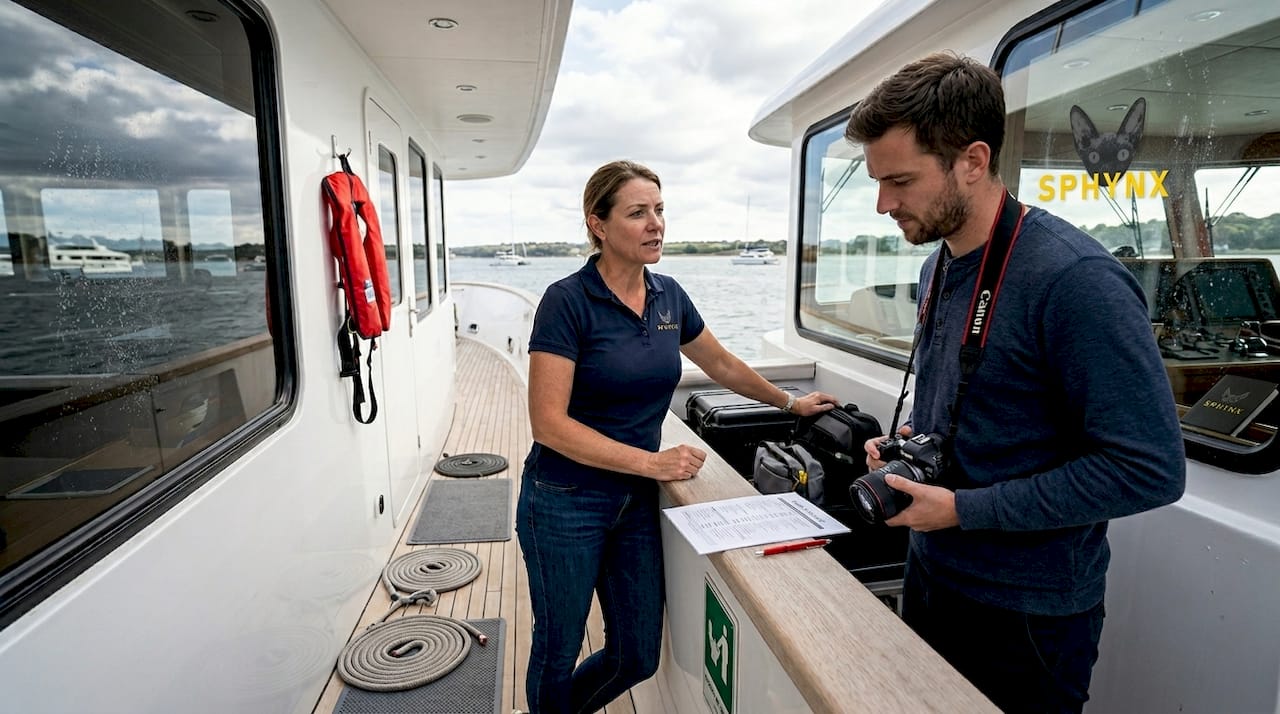
Wet decks, sudden gusts, and crowded guest areas create genuine physical hazards. Safety first: securing equipment, using life jackets, monitoring weather, and briefing crew on protocols for yacht shoots is not optional guidance; it is professional standard practice. A camera dropped overboard is a financial loss. A photographer who slips on a wet deck during a high-energy event is a crisis.
Every camera body and lens should be tethered to your body or bag with a secure strap rated for the equipment’s weight. Backup gear stays in sealed dry storage below deck until needed. Run a briefing with both the event manager and the yacht crew so everyone knows your planned movement zones, which areas are restricted, and how you will communicate if conditions deteriorate.
“A single moment of carelessness on deck can end a shoot entirely. The best photographers treat safety protocols as a creative asset, not a constraint. When you’re confident in your surroundings, your instincts are free to capture the extraordinary.”
Drone operations deserve particular attention. Beyond onboard corporate hospitality logistics, drone pilots must account for airspace restrictions around Barcelona’s coastline, the unpredictable movement of the yacht itself, and the safety of guests below. Never fly a drone below five metres altitude when guests are on deck. Always have a designated spotter watching for obstacles and alerting you to course changes.
Practical safety checklist for the shoot day:
- Confirm all photographers and key crew are wearing or have immediate access to life jackets
- Identify the location of emergency equipment on board before departure
- Establish a communication signal with the captain for weather warnings
- Keep all loose equipment stowed when not actively shooting
- Coordinate with the event schedule so you are never in a guest area during high-traffic moments without clear purpose
Understanding yacht hospitality best practices also helps you work with the crew rather than against them, ensuring your presence enhances the event rather than disrupting it.
Capturing stunning shots: technical and creative approaches
With logistics and safety under control, you’re ready to create iconic images.
The Mediterranean off Barcelona is one of the world’s most photogenic backdrops, but that beauty can overwhelm a photographer who has not prepared specific shot strategies. A structured approach ensures you leave with a complete visual story rather than a random collection of pretty frames.
Here is a five-step sequence that professional yacht event photographers use consistently:
- Set your baseline exposure before guests arrive, accounting for the dominant light direction and the reflective quality of the water.
- Begin shooting environmental context shots: the yacht’s exterior, the Barcelona skyline, table settings, and details that establish the event’s tone.
- Adjust continuously as natural light shifts, particularly during the golden hour before sunset when colour temperature changes rapidly.
- Review a sample of images every 30 to 40 minutes to catch any exposure drift or focus issues before they affect an entire sequence.
- Back up to a portable drive during any natural break, such as a meal or a speech, so no images are ever more than an hour from being secured.
For action and candid shots, use fast shutter speeds (1/500s+) and burst mode to handle boat motion and capture sharp images during energetic moments like dancing or toasting. Interior portraits call for ultra-wide lenses with careful distortion control and bounce flash to fill shadows without creating harsh highlights. Frame guests against portholes or the sea view whenever possible for an image that immediately communicates the luxury setting.
Drones provide unique aerial perspectives for yacht events, revealing the layout of the deck, the scale of the vessel against the coastline, and the scenic interplay between the boat and the Mediterranean. These images are almost impossible to replicate from deck level and frequently become the hero shots for event albums and social media. For corporate yacht events, aerial views also serve a practical purpose, showing the scope of the gathering for post-event reports and future client presentations.
Creative shot ideas worth planning for deliberately:
- Silhouettes of guests against a Barcelona sunset
- Reflections of fairy lights or stars on calm water
- Close-up details of champagne glasses, floral arrangements, and bespoke table settings
- Candid laughter and toasting moments captured with a short telephoto from a respectful distance
- Wide establishing shots that show the full guest group with the coastline behind them
Pro Tip: Attach a gimbal stabiliser to your camera when shooting on deck during higher sea states. Even a modest swell introduces enough vibration to soften images shot below 1/250s, and a stabiliser can recover two to three stops of effective sharpness. When hosting an unforgettable corporate event on the water, the investment in a stabilised system is always justified by the results.
Overcoming environmental and technical challenges
Even with the best gear and creative touch, the Mediterranean can throw a curveball. Here’s how to stay ahead.
Studies suggest that up to 80% of images from amateur yacht shoots are lost to motion blur or poor lighting management, a figure that underscores just how demanding the environment truly is. Professional solutions exist for every challenge, but only if you anticipate them.
| Condition | Main challenge | Solution | Recommended kit |
|---|---|---|---|
| Midday sun | Harsh shadows, glare on water | Shoot in shade, use diffusers | Collapsible reflector, polarising filter |
| Golden hour | Rapid colour shift | Lock exposure manually, shoot RAW | Fast prime, spare batteries |
| Night event | Insufficient ambient light | Use onboard lighting, bounce flash | LED panel, fast prime f/1.4 |
| Rough sea | Motion blur, unstable framing | Higher shutter speed, gimbal | Gimbal, weather-sealed body |
| Overcast sky | Flat, grey images | Boost contrast in post, use foreground interest | Wide lens, RAW format |
Reflections and glare are constant companions on open water. A circular polarising filter cuts through surface glare and deepens the blue of the sea without affecting the natural colour of guests or décor. It is one of the most cost-effective investments a yacht event photographer can make.
For low-light and night events, use onboard lighting, reflectors, and low ISO with stabilisation to maintain image quality. Pushing ISO beyond 3200 on most camera sensors introduces visible noise that undermines the polished look luxury clients expect. Work with the event’s existing lighting design rather than fighting it. Coordinate with the lighting team beforehand to understand which areas will be well lit and where you will need supplemental flash. Consulting a luxury yacht rental guide can also help you understand what onboard lighting infrastructure different vessels offer before you commit to a specific approach.
Mediterranean weather shifts faster than most event planners expect. A flat calm morning can give way to a 20-knot breeze by early afternoon. Watch the forecast obsessively and build a contingency plan: know which shots require calm conditions (drone work, reflective water images) and prioritise them early in the schedule.
Polishing images: post-production essentials
With an event’s most memorable moments captured, attention turns to crafting a flawless final collection.
Post-production enhances images through colour grading the blues of sea and sky, boosting clarity on fine details, and correcting perspectives to give professional yacht event photos their characteristic polish. Shooting in RAW format is non-negotiable for this level of work. RAW files retain far more tonal information than JPEGs, giving you the latitude to recover highlights blown out by sea glare and lift shadows in dark interior shots without introducing colour casts.
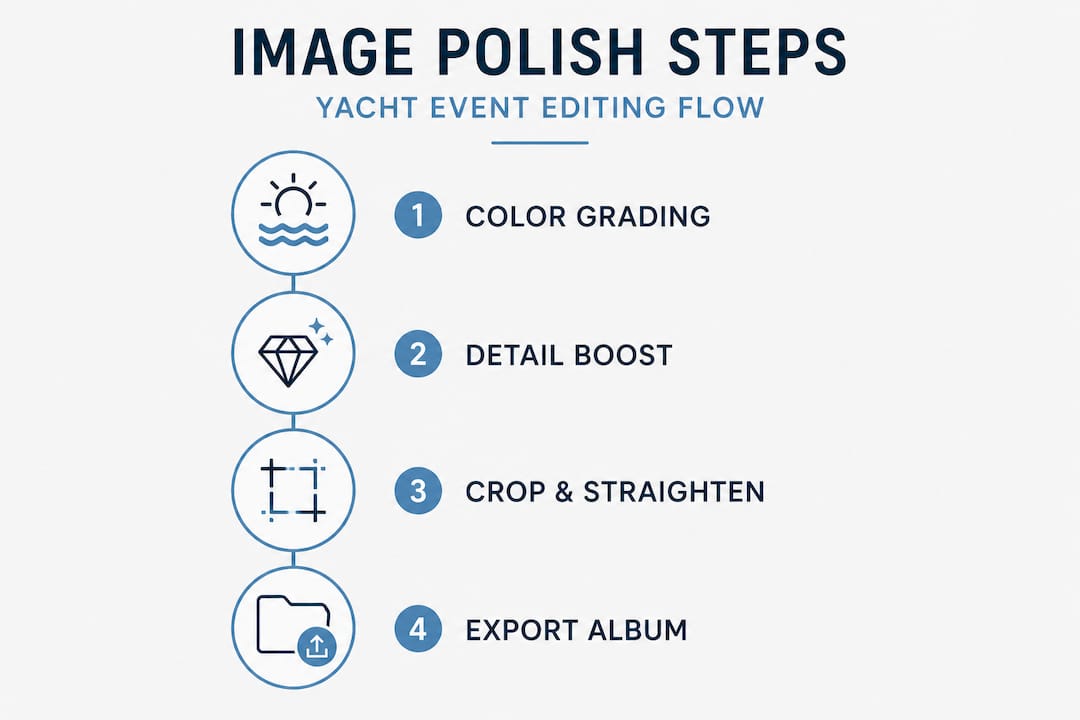
Batch editing tools such as Lightroom’s sync function allow you to apply a consistent grade across an entire event’s worth of images, ensuring that the album feels cohesive rather than like a collection of isolated shots taken by different photographers. Establish your base grade from five or six representative images from each part of the event (arrival, cocktails, dinner, dancing) and then sync across each group.
Essential editing checklist for luxury yacht events:
- Straighten horizons — even a one-degree tilt is immediately noticeable against a flat sea horizon and reads as unprofessional
- Remove distractions — rogue life jackets, cables, or unwanted background guests can be cloned out carefully
- Correct lens distortion — ultra-wide shots of interiors benefit enormously from the lens correction profiles built into Lightroom and Capture One
- Apply subtle skin retouching — consistent, light-handed retouching maintains authenticity while flattering guests
- Colour grade for warmth — a gentle warm grade in the shadows and cool highlights in the sky complements the Mediterranean palette beautifully
For final delivery, prepare both a high-resolution digital album optimised for screen viewing and a selection of print-ready files at 300 DPI minimum. Luxury clients increasingly expect both: the digital set for immediate social sharing and the print files for framed artwork or bespoke photobooks.
Expert perspective: the value of true expertise in yacht event photography
There is a widely held assumption that photography has been democratised by smartphones and that professional photographers are a luxury rather than a necessity. For a mid-range birthday party in a hotel ballroom, that argument might hold some water. For a luxury yacht celebration on the Mediterranean, it collapses entirely.
The reason is not purely technical, although the technical gap is real. Prioritise professional photographers experienced in maritime settings for affluent Barcelona events to manage challenges like motion blur and glare on the Mediterranean. The more important reason is experiential intuition. A seasoned maritime photographer reads the sea’s movement and adjusts their stance a fraction of a second before a wave rocks the deck. They notice that a guest is about to share a genuinely emotional moment and are already in position before it happens. They know that the light will be extraordinary for exactly eleven minutes after the sun drops below the headland, and they have planned their shooting position accordingly.
Amateur photographers, even technically capable ones, tend to react. Professionals anticipate. That distinction is the difference between an acceptable photograph and one that makes a client catch their breath when they open their album for the first time. The Barcelona yacht photography expertise that genuinely experienced maritime photographers bring is built over hundreds of shoots in similar conditions, not borrowed from a YouTube tutorial the night before.
“The images that define an event are rarely the posed group shots. They are the unguarded moments, the light catching a glass at precisely the right angle, the laughter that nobody staged. Capturing those requires a photographer who is simultaneously invisible and completely present.”
Instagram filters and phone editing apps can produce attractive images in forgiving conditions. They cannot compensate for the missed focus, the motion blur, or the flat exposure that results from not truly understanding the maritime environment. Luxury events deserve photography that reflects their quality, and that standard is only achievable with genuine expertise.
Elevate your next Barcelona yacht event with expert photography
Ready to apply these insights to your next event? Discover seamless solutions and partnerships.
At Sphynx BCN, we understand that extraordinary events deserve extraordinary documentation. Every visite privée d'un yacht and exclusive celebration we host is designed with the full sensory experience in mind, including the images that will be shared, framed, and remembered for years afterwards. We work with professional maritime photographers who know Barcelona’s coastline intimately and understand the technical demands of shooting at sea.
Whether you are planning intimate group sailing experiences or large-scale corporate yacht event solutions, early booking secures the best talent and ensures your photographer has time to prepare properly. Reach out to our team today to discuss how we can make your next Barcelona yacht event both unforgettable and beautifully documented.
Frequently asked questions
Do I need a permit for drone photography at yacht events in Barcelona?
Yes, drone operations in Barcelona’s coastal airspace require prior authorisation, and regulations for yacht events at sea mean you should begin the application process at least two weeks before your event date.
How do I prevent motion blur in photos on a moving yacht?
Use fast shutter speeds of at least 1/500s combined with burst mode, and consider a gimbal stabiliser for shooting during higher sea states.
What are the best camera settings for night yacht event photography?
Use onboard lighting and reflectors, keep ISO as low as the conditions allow, and stabilise your camera on a tripod or gimbal to maintain image quality without introducing noise.
Why is professional photographic experience so important for luxury yacht events?
Luxury clients expect consistently flawless images, and only specialists who are experienced in maritime settings can reliably manage the combined challenges of motion, glare, and rapidly changing Mediterranean light.