

TL;DR:
- Couples should verify the captain’s Merchant Mariner Credential and vessel’s safety certificates to ensure legal compliance.
- Understanding layered costs like the APA, taxes, and gratuities prevents unexpected expenses during the yacht charter.
- Clear communication and early booking are essential for securing a personalized, stress-free romantic yacht experience.
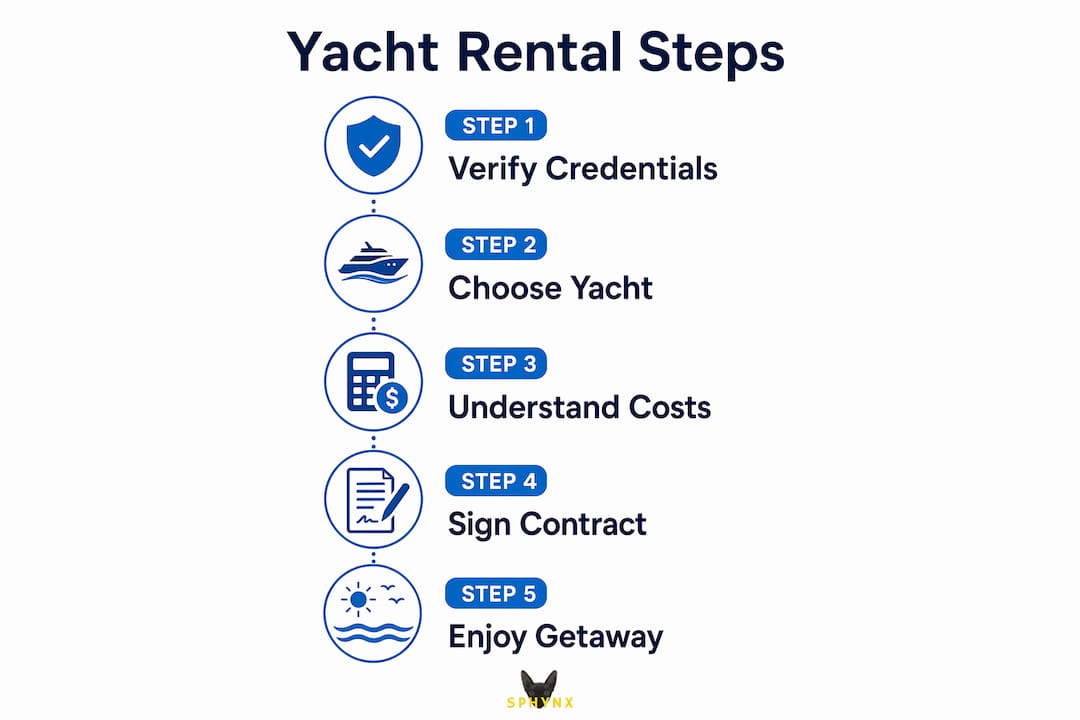
The couples getaway yacht rental process is a defined sequence of steps covering safety verification, yacht selection, budgeting, and contract signing that transforms a romantic idea into a legally sound, memorable sailing experience. The industry term for this process is yacht chartering, and understanding both the informal and formal vocabulary helps you communicate clearly with brokers and operators. This guide covers everything from verifying a captain’s Merchant Mariner Credential to decoding the Advance Provisioning Allowance on your invoice, so you board with confidence rather than crossed fingers. Whether you are eyeing a sunset cruise along the Barcelona coastline or a week-long Mediterranean escape, the steps are the same.
What credentials and safety checks should couples verify before renting a yacht?
Verifying operator credentials is the single most important step in the yacht charter process, and skipping it carries consequences far beyond a ruined holiday. The U.S. Coast Guard advises that illegal charter operations can attract civil penalties starting from $69,000. That figure signals how seriously maritime authorities treat unlicensed operations, and it should signal the same to you as a passenger.
Two documents matter most before you step aboard. The first is the captain’s Merchant Mariner Credential, which confirms professional training and licensing. The second is the vessel’s Certificate of Inspection for passenger vessels, which confirms the boat has passed a formal safety review. Both are public records, and any reputable operator will produce them without hesitation.
Beyond paperwork, ask to see the vessel’s safety plan. A proper safety plan details emergency procedures, life-saving equipment locations, and maximum passenger capacity. Operators who verify safety plans as standard practice are signalling that they take compliance seriously, which directly protects your romantic getaway from being cut short by a Coast Guard intervention.
Here is a practical pre-boarding checklist:
- Request the captain’s Merchant Mariner Credential and photograph it
- Confirm the vessel holds a valid Certificate of Inspection
- Ask for the safety plan and check that life jackets and flares are accessible
- Cross-reference the operator’s name against your national maritime authority’s public register
- Confirm that the charter agreement names the licensed captain explicitly
Never board a vessel whose operator cannot produce both the captain’s credential and the vessel’s inspection certificate on request. No romantic itinerary is worth the legal and physical risk of an unlicensed charter.
The premium yacht rental standards guide from Sphynxbcn outlines exactly what a compliant operator should provide before departure, which is a useful reference when comparing providers.
How to budget for a romantic yacht getaway: understanding pricing and hidden costs
Yacht charter pricing is not a single number. It is a structure of layered costs that, if misunderstood, can make a seemingly affordable booking feel expensive by departure day. The base charter fee covers the vessel itself, but it rarely covers everything you will actually spend.

The most common additional cost is the Advance Provisioning Allowance, known as the APA. This is a deposit, typically 25 to 35 per cent of the base fee, paid upfront to cover fuel, food, port fees, and provisioning during the trip. At the end of the charter, the crew provides a full accounting and either refunds the balance or invoices the shortfall. Gratuity for the crew is separate again, conventionally running at 10 to 20 per cent of the base charter fee.
To illustrate the range, a week-long charter on the Maltese Falcon starts around $7,000, though that figure represents the entry point for one of the most recognisable sailing yachts in the world. More accessible crewed yachts in the Mediterranean can be chartered for considerably less, depending on size, season, and itinerary. The point is that pricing varies drastically, and itemised quotes are the only way to compare operators fairly.
| Cost component | What it covers |
|---|---|
| Base charter fee | Vessel hire for the agreed duration |
| Advance Provisioning Allowance (APA) | Fuel, food, port fees, and provisioning |
| Crew gratuity | Typically 10 to 20 per cent of the base fee |
| Local taxes and port dues | Varies by destination and marina |
| Optional extras | Water sports equipment, special décor, transfers |
Pro Tip: Always request a fully itemised quote before signing anything. Ask the operator to separate the base fee, APA estimate, taxes, and any optional extras into distinct line items. This prevents the common situation where a couple agrees to a headline price and then discovers the true cost is 40 per cent higher.
Using a trusted broker or specialist provider reduces the risk of hidden fees considerably, because reputable companies build transparent pricing into their standard contracts.
What are the key steps in the yacht rental booking process for couples?
The yacht charter booking process follows a logical sequence, and couples who follow it in order avoid the majority of problems that arise from rushed or incomplete planning.
Define your destination and style. The Mediterranean offers dramatically different experiences depending on whether you choose the Costa Brava, the Balearic Islands, or the Amalfi Coast. Decide whether you want a sailing yacht for the romance of wind-powered travel or a motor yacht for speed and stability. Your choice of vessel shapes every subsequent decision.
Contact brokers or operators and request proposals. A charter broker acts as an intermediary between you and the vessel owner, presenting options that match your budget, dates, and preferences. Operators like Sphynxbcn offer direct booking for curated routes, which suits couples who want a more personal planning experience. Luxury amenities and crew expertise vary significantly between vessels, so request detailed descriptions of what is included.
Review and sign the charter contract carefully. The contract defines the charter period, the base fee, payment schedule, cancellation terms, and the responsibilities of both parties. Pay particular attention to the clause covering captain engagement. In a bareboat charter, the charterer hires the captain independently, which carries distinct legal responsibilities compared to a crewed charter where the operator provides the captain as part of the package.
Confirm the itinerary, crew, and onboard arrangements. Once the contract is signed, work with the operator or broker to finalise the route, meal preferences, any special romantic touches such as flowers or a private dinner setup, and any water sports or excursion requests. Clear communication at this stage is what separates a good charter from a genuinely memorable one.
Book well in advance. Booking several months ahead secures your preferred vessel and itinerary, particularly during peak Mediterranean season from June to September. Last-minute bookings often mean settling for a second-choice yacht at a premium price.
Pro Tip: Ask the operator directly whether the charter is crewed or bareboat before reviewing the contract. The distinction determines who is legally responsible for the captain’s conduct, the vessel’s compliance, and any incidents at sea. Couples with no sailing experience should always choose a fully crewed charter.
What common mistakes should couples avoid during the yacht rental process?
Most problems in the yacht charter process are predictable and preventable. These are the mistakes that consistently turn romantic sailing experiences into stressful ones.
Skipping credential verification. Trusting an operator’s word without seeing the Merchant Mariner Credential and Certificate of Inspection is the highest-risk mistake couples make. The U.S. Coast Guard’s enforcement record shows that illegal charters are terminated mid-voyage, leaving passengers stranded.
Accepting a headline price without an itemised breakdown. A base charter fee that looks affordable can double once APA, taxes, gratuity, and extras are added. Always request a full cost breakdown before committing.
Confusing bareboat and crewed charters. In a bareboat arrangement, contracts must clearly delineate who hires the captain, who pays port fees, and who bears liability. Couples who sign bareboat contracts without understanding these distinctions can find themselves personally liable for compliance failures.
Leaving communication vague. Failing to specify dietary requirements, preferred anchorages, or romantic arrangements in writing means the crew cannot deliver what you imagined. Clear upfront communication with the crew and broker is what turns a standard charter into a personalised experience.
Booking too late. Waiting until four to six weeks before your preferred dates dramatically narrows your options and raises costs. The most sought-after yachts on popular Mediterranean routes are reserved months in advance.
Key takeaways
A successful couples sailing vacation depends on verifying credentials, understanding the full cost structure, and communicating expectations clearly before the charter begins.
| Point | Details |
|---|---|
| Verify credentials first | Always request the Merchant Mariner Credential and Certificate of Inspection before boarding. |
| Understand the full cost | Request itemised quotes covering the base fee, APA, taxes, gratuity, and extras. |
| Choose the right charter type | Crewed charters suit most couples; bareboat charters carry distinct legal responsibilities. |
| Communicate in writing | Confirm all romantic arrangements, dietary needs, and itinerary preferences in the contract or a written brief. |
| Book months in advance | Securing your preferred yacht early avoids premium pricing and limited availability during peak season. |
What I have learned from watching couples charter yachts
After years of observing how couples approach the yacht charter process, the pattern that stands out most is this: the couples who have the best experiences are not the ones who spend the most. They are the ones who ask the most questions before signing anything.
The instinct to focus on the romantic vision, the sunset, the champagne, the secluded cove, is completely understandable. But the couples who skip the credential check or skim the contract are the ones who end up dealing with avoidable problems at sea. I have seen a charter terminated by maritime authorities because the operator lacked the correct inspection certificate. The couple had done nothing wrong, but their holiday was over.
The other thing I would push back on is the assumption that a bigger yacht means a better romantic experience. Intimacy on the water comes from the itinerary, the crew’s attentiveness, and the quality of the planning, not the length of the vessel. A well-crewed 15-metre sailing yacht with a thoughtful captain and a personalised route along the Catalan coast will outperform a 30-metre motor yacht with a generic itinerary every time.
Transparent budgeting is also underrated as a source of romantic enjoyment. Couples who understand exactly what they are paying for arrive relaxed. Couples who discover unexpected costs mid-charter arrive stressed. The APA conversation is not glamorous, but having it before departure is one of the most genuinely useful things you can do for the experience.
The privacy and exclusivity that yacht charters offer are genuinely unmatched as a romantic format. The process to access that experience is not complicated. It just requires the same care you would apply to any significant purchase.
— YellowRock
Plan your romantic yacht getaway with Sphynxbcn
Sphynxbcn specialises in private yacht charters along the Barcelona coastline and the wider Mediterranean, with a focus on couples seeking a genuinely personalised experience. Every booking includes transparent pricing with no hidden fees, a fully credentialled crew, and a dedicated planning contact who handles itinerary details from the first enquiry to the moment you step aboard.
Whether you are planning a sunset cruise for two or a multi-day sailing escape, Sphynxbcn’s private yacht tours are designed to remove the complexity from the rental process and replace it with anticipation. Explore the full range of luxury yacht rentals in Barcelona and find the experience that fits your vision.
FAQ
What documents should I ask for before boarding a charter yacht?
Request the captain’s Merchant Mariner Credential and the vessel’s Certificate of Inspection before boarding. The U.S. Coast Guard confirms that operating without these documents constitutes an illegal charter, which can be terminated mid-voyage.
What is the difference between a bareboat and a crewed charter?
In a crewed charter, the operator provides the captain and crew as part of the package. In a bareboat charter, the charterer hires the captain independently, which carries distinct legal and compliance responsibilities that must be clearly stated in the contract.
How far in advance should couples book a yacht charter?
Booking several months ahead is recommended, particularly for peak Mediterranean season between June and September. Early booking secures your preferred vessel and avoids the premium pricing associated with last-minute availability.
What is an Advance Provisioning Allowance and do I have to pay it?
The Advance Provisioning Allowance (APA) is a prepaid deposit, typically 25 to 35 per cent of the base charter fee, used to cover fuel, food, port fees, and provisioning during the trip. Any unspent balance is refunded at the end of the charter.
How do I avoid hidden costs in the yacht rental booking process?
Request a fully itemised quote that separates the base charter fee, APA estimate, local taxes, crew gratuity, and any optional extras before signing the contract. Reputable operators and brokers provide this breakdown as standard practice.