

TL;DR:
- Proper certification verification and background checks are essential for legal safety and risk mitigation.
- Personality traits like discretion and resilience are crucial for delivering exceptional luxury service.
- Investing time in thorough crew selection prevents costly mistakes and ensures a flawless yacht experience.
The difference between a forgettable afternoon on the water and an extraordinary luxury sailing experience in Barcelona often comes down to one factor: the people on board. Your crew determines whether guests feel genuinely cared for or merely tolerated, whether safety is absolute or assumed, and whether every detail is executed with precision or improvised under pressure. Poor crew selection is one of the most expensive mistakes a yacht owner or corporate client can make, and it is far more common than the industry admits. This guide walks you through every stage of the selection process, from certifications to contracts, so you can make decisions with confidence.
Table of Contents
- Key certifications and legal requirements for yacht crew
- How to evaluate experience, temperament, and fit
- Sourcing talent: agencies, referrals and direct hires
- Background checks, trials and protecting your interests
- Understanding salary benchmarks and contract essentials
- What luxury yacht owners truly need to know
- Ensure your luxury yacht experience is flawless
- Frequently asked questions
Key Takeaways
| Point | Details |
|---|---|
| Check certifications | Always verify STCW, ENG1, and role-specific credentials before hiring any yacht crew. |
| Prioritise personality | Staff temperament and service mindset matter more than technical skills for luxury experiences. |
| Source wisely | Agencies and trusted referrals help reduce risk but agency fees can be high; referrals are invaluable. |
| Insist on background checks | Background screening is increasingly crucial for high net worth guests’ safety and privacy. |
| Know market rates | Understand salary ranges and contract essentials to retain skilled crew and avoid disputes. |
Key certifications and legal requirements for yacht crew
Before personality, before experience, before anything else, you need to verify that every crew member holds the correct legal qualifications. This is non-negotiable. Operating a private yacht in Spanish waters with unqualified crew exposes you to serious legal liability, insurance voidance, and in the worst cases, genuine danger to everyone on board.
The industry standards for yacht rental are clearly defined at an international level. Core certifications required for all yacht crew include STCW Basic Safety Training, an ENG1 medical certificate or equivalent, and position-specific Certificates of Competency (CoC). STCW stands for Standards of Training, Certification and Watchkeeping, the international framework governing maritime safety. Every professional crew member, regardless of their specific role, must hold a valid STCW Basic Safety certificate.
Beyond the baseline, each role carries its own regulatory requirements. A captain operating a vessel over 24 metres commercially in Spanish waters must hold a recognised Yacht Master Offshore or equivalent CoC. Engineers need STCW engineering endorsements. Stewardesses working on vessels carrying paying guests must increasingly hold STCW Personal Survival Techniques and basic first aid qualifications.
| Crew role | Required certification | Renewal frequency |
|---|---|---|
| Captain | CoC Yacht Master, STCW, ENG1 | ENG1 every 2 years |
| Chief Officer | OOW CoC, STCW, ENG1 | ENG1 every 2 years |
| Engineer | STCW Engineering, ENG1 | Every 5 years |
| Deckhand | STCW Basic Safety, ENG1 | Every 5 years |
| Steward/Stewardess | STCW Basic Safety, ENG1 | Every 5 years |
Key regulatory points to confirm before hiring:
- All STCW certificates must be current, not within a grace period
- ENG1 medical certificates must be issued by an approved medical examiner
- Crew working on commercially operated yachts must hold the correct endorsements for that vessel category
- Spanish maritime authority (Capitanía Marítima) requirements apply in Barcelona’s port jurisdiction
Pro Tip: Always request original certificates and cross-reference them against the issuing authority’s records. Fraudulent credentials do exist in the industry, and a quick verification call to the relevant maritime authority takes minutes but can save enormous consequences later.
Understanding the yacht crew roles specific to Mediterranean luxury charters also helps you identify exactly which certifications apply to each position you are filling.
How to evaluate experience, temperament, and fit
Qualifications confirm that someone is legally permitted to work on your vessel. They tell you almost nothing about whether that person will deliver the kind of seamless, intuitive service that defines a genuinely luxury experience. This is where most yacht owners make their most costly mistakes.

Trial periods mitigate personality risks in the confined environment of yacht living; skills are trainable, but temperament is not. This is one of the most important truths in crew selection. A technically brilliant engineer who creates tension in the crew dynamic will degrade every guest’s experience in ways that are impossible to quantify but immediately felt.
When evaluating candidates, look for these personality traits above all else:
- Discretion: The ability to be present without being intrusive, particularly important for high-profile guests
- Adaptability: Remaining composed when plans change at sea or guest preferences shift unexpectedly
- Proactive service mindset: Anticipating needs before they are voiced, not waiting to be asked
- Emotional resilience: Handling long hours, close quarters, and demanding guests without visible strain
- Collaborative instinct: Supporting team cohesion on yachts rather than competing for recognition
Reference checks are not optional. Speak directly to previous employers, not just the references a candidate supplies. Ask specific questions: How did this person handle a difficult guest situation? Did they ever cause friction with other crew? Would you hire them again without hesitation? The hesitation in someone’s voice often tells you more than their words.
Pitfall warning: Rushing hires and overemphasising technical skills over temperament, combined with inadequate reference checks, are the most common errors in yacht crew selection. A bad hire consistently costs more, financially and reputationally, than leaving a position vacant while you search for the right person.
The interview itself should include scenario-based questions. Ask a stewardess candidate how she would handle a guest who is dissatisfied with their cabin at 11pm. Ask a deckhand how he would respond if he noticed a safety issue that the captain had not yet spotted. The skipper’s role in luxury charters is particularly nuanced, requiring both technical authority and genuine hospitality instinct.
Sourcing talent: agencies, referrals and direct hires
Once you know precisely what you need in a crew member, the next question is where to find them. There are three main routes, each with distinct advantages and real limitations.
Agencies provide pre-vetted pools that reduce the owner’s vetting burden, but they charge 1 to 2 months of the hired crew member’s salary as a placement fee. Word-of-mouth recommendations remain the gold standard according to experienced yacht operators. The reason is straightforward: a personal referral from a trusted source carries accountability that no agency can replicate.
| Sourcing method | Advantages | Disadvantages |
|---|---|---|
| Specialist agency | Pre-screened candidates, legal support, replacement guarantees | High cost (1-2 months salary), variable quality control |
| Personal referral | Trusted accountability, genuine track record | Limited pool, may not suit your specific vessel |
| Direct hire | Full control, potentially lower cost | Maximum vetting burden, no replacement guarantee |
| Online platforms | Wide reach, fast response | Inconsistent quality, requires thorough independent vetting |
If you choose to work with an agency, ask these questions before committing:
- How do you verify the authenticity of crew certifications?
- What is your replacement policy if a hire does not work out within the first 90 days?
- Do you have crew with specific Mediterranean or Barcelona experience?
- Can you provide references from other yacht owners of similar vessel size?
- How do you handle confidentiality agreements for high-profile clients?
Local sourcing in Barcelona has genuine advantages. Crew familiar with the Mediterranean coast, Spanish port regulations, and the specific demands of sailing between Barcelona, the Balearic Islands, and the Costa Brava will require less onboarding time and fewer costly errors. Understanding luxury yacht etiquette specific to this region is a subtle but meaningful differentiator in service quality.
Background checks, trials and protecting your interests
This is the stage most yacht owners skip, and it is precisely where the greatest risks lie. For high net-worth individuals and corporate clients hosting sensitive events at sea, a crew member’s background is not a bureaucratic formality; it is a fundamental safeguard.
Background checks are not yet industry standard across the yachting sector, with calls for their adoption growing louder. Smaller vessels are less likely to implement them, but for high net-worth clients, they are increasingly considered essential. This gap in the industry creates a genuine vulnerability that sophisticated clients should address proactively.
Steps to implement a thorough trial and background check process:
- Request a criminal record check from the candidate’s country of residence, not just their country of origin
- Verify all certifications directly with the issuing maritime authority before the trial begins
- Conduct a structured trial period of at least one to two charters, ideally with lower-stakes guests initially
- Debrief with existing crew after the trial to gather honest assessments of team fit
- Review social media presence discreetly; public behaviour often reflects private attitudes
- Confirm confidentiality agreement is signed before any trial involving high-profile guests
Incidents that thorough background checks and trials help prevent include:
- Breaches of guest confidentiality and privacy
- Undisclosed criminal history involving fraud or violence
- Misrepresented qualifications discovered mid-season
- Personality conflicts that escalate in confined conditions
- Reputational damage from crew misconduct shared publicly
For corporate hospitality on yachts, where client relationships and brand reputation are directly at stake, these protections are not optional luxuries. They are baseline requirements.
Expert view: The cost of a single serious crew incident, whether a safety failure, a confidentiality breach, or a guest complaint that reaches the press, vastly exceeds the cost of thorough pre-hire due diligence. Invest in the process before you invest in the person.
Understanding salary benchmarks and contract essentials
Attracting and retaining excellent crew requires competitive compensation. Underpaying premium talent is a false economy; the best crew have options, and they will exercise them.
Current salary benchmarks for 2025 to 2026 in euros per month are as follows: Captains earn €6,000 to €14,000 depending on vessel size, Chief Officers €6,000 to €10,000, and Deckhands €3,000 to €5,000. Private yachts typically pay higher base salaries than charter vessels, where crew also benefit from guest gratuities.
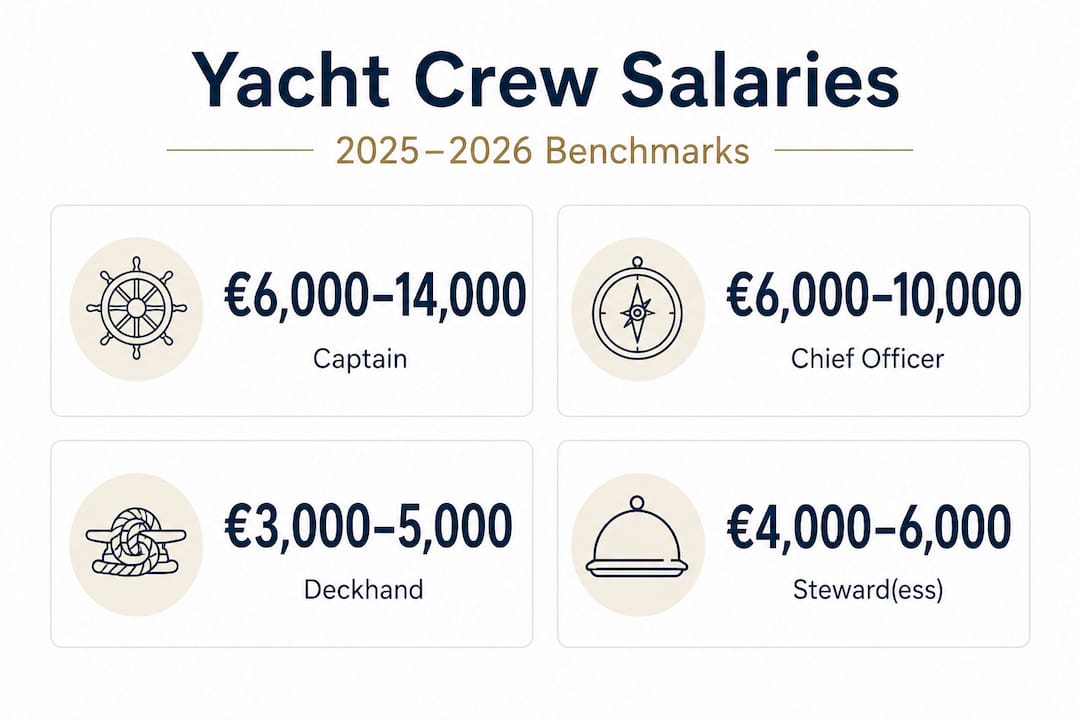
| Position | Monthly salary range (EUR) | Notes |
|---|---|---|
| Captain | €6,000 – €14,000 | Varies significantly by vessel size |
| Chief Officer | €6,000 – €10,000 | Mediterranean experience commands premium |
| Engineer | €4,500 – €9,000 | Technical complexity of vessel affects rate |
| Head Steward/Stewardess | €3,500 – €6,000 | Luxury service experience adds value |
| Deckhand | €3,000 – €5,000 | Entry to mid-level depending on certifications |
Beyond salary, a robust employment contract is your primary protection against disputes. Essential contract clauses include:
- Confidentiality clause: Explicit restrictions on discussing guests, itineraries, or onboard activities
- Performance review schedule: Agreed timelines for formal evaluation and salary review
- Bonus structure: Clear criteria for gratuity distribution and performance bonuses
- Grievance procedure: A defined process for raising concerns without disrupting operations
- Notice period: Adequate notice requirements on both sides to prevent mid-season departures
- Jurisdiction clause: Specifying which country’s employment law governs the contract
Premium crew retention is also influenced by the overall quality of the working environment. Crew who take pride in delivering exceptional experiences, from curated dining to seamless service, are more likely to remain loyal when the working conditions and compensation reflect that standard.
What luxury yacht owners truly need to know
Here is what the industry rarely says plainly: most yacht owners spend more time choosing their vessel’s interior upholstery than they spend evaluating the character of the people who will be living and working on it. That imbalance is the root cause of most crew-related problems we observe in the luxury sailing sector.
Technical competence is a threshold, not a differentiator. Once you have confirmed that a candidate holds the correct certifications and has relevant experience, you are essentially looking at a pool of similarly qualified people. What separates a genuinely exceptional crew member from an adequate one is almost entirely about attitude, emotional intelligence, and professional chemistry.
The real cost of a bad hire is rarely the severance payment or the agency replacement fee. It is the guest who had a mediocre experience and never returned. It is the corporate client who chose a competitor’s yacht for their next event. It is the reputation, built painstakingly over years, that can be damaged in a single charter by one crew member who was not quite right. Thinking about executive retreats at sea in these terms makes the investment in thorough selection feel not just reasonable but essential.
Our strongest advice, drawn from years of operating in Barcelona’s luxury sailing market: interview for attitude first, verify qualifications second, and never rush a hire because the season is approaching. The right crew member is worth waiting for. The wrong one will cost you far more than the delay.
Ensure your luxury yacht experience is flawless
Selecting, vetting, and managing a private yacht crew is a significant undertaking, and for many clients, the most sensible approach is to work with a premium provider who has already done it for you.
At Sphynx BCN, our crew are selected to the highest standards of both technical qualification and personal service excellence, so you can focus entirely on enjoying your time on the water. Whether you are planning a private celebration, a group yacht sailing in Barcelona for a corporate team, or a bespoke Mediterranean itinerary for discerning guests, every detail is handled by professionals who understand what luxury truly means. Explore our private yacht tours in Barcelona and discover how effortless a flawlessly crewed sailing experience can be.
Frequently asked questions
What certifications must every private yacht crew member have?
All crew must hold a valid STCW Basic Safety certificate, an ENG1 medical certificate, and position-specific Certificates of Competency relevant to their role on board.
How much do private yacht crew in Barcelona typically earn?
Captains earn €6,000–€14,000 per month, Chief Officers €6,000–€10,000, and Deckhands €3,000–€5,000, with private yachts generally offering higher base salaries than charter vessels.
Is it worth using an agency to recruit yacht crew?
Agencies reduce your vetting workload and provide replacement guarantees, but charge 1–2 months salary as a fee; trusted personal referrals remain the most reliable sourcing method.
Do most yacht owners run background checks on crew?
Background checks are not yet standard across the industry, particularly on smaller vessels, but high net-worth clients and corporate operators are increasingly making them a mandatory part of their hiring process.
What are the risks of poor crew selection?
Rushing hires and neglecting temperament during selection consistently produces worse outcomes than taking additional time to find the right candidate, with poor hires costing more financially and reputationally than a temporary vacancy.
Recommended
- Yacht crew roles in luxury Mediterranean charters
- Luxury yacht hospitality: Best practices for unforgettable charters
- The true role of a skipper on luxury yacht charters
- Exclusive sailing experience: luxury Mediterranean guide
- Greece’s ultimate luxury nightlife destinations 2026 – Longevity Travel
- Sunset Cruise in Cape Town