

TL;DR:
- Yacht culinary experiences offer personalized, route-based menus crafted by private chefs in a private, intimate setting. These meals are distinguished by their adaptability, local sourcing, and the chef’s expertise, providing a dining experience that surpasses land-based restaurants. Proper communication of preferences and understanding provisioning play essential roles in creating memorable, bespoke culinary journeys at sea.
Culinary experiences on yachts are defined by one thing that no land-based restaurant can replicate: a private chef crafting bespoke meals around you, your route, and your exact preferences, while the Mediterranean or Caribbean unfolds outside the window. The industry term for this service is yacht culinary service, and it spans everything from casual sharing platters on a sunset cruise to multi-course tasting menus aboard superyachts. Food enthusiasts who have only experienced fine dining at sea through hotel buffets or cruise ship restaurants are in for a genuine revelation. What Sphynxbcn and the wider luxury charter sector deliver is something far more personal, far more skilled, and far more memorable.
1. What makes gourmet meals on yachts unique compared to land-based dining?
Gourmet meals on yachts are produced in a galley that is typically a tenth the size of a land-based kitchen, mounted on gimbals to stabilise equipment as the vessel moves. That physical constraint forces a level of discipline and precision that most Michelin-starred kitchens never demand. The result, paradoxically, is food that feels more considered and more personal than almost anything you will eat ashore.
The key factors that distinguish yacht dining from a restaurant experience are:
- Galley design. Space optimisation is critical, with multifunctional equipment and strict mise en place enabling restaurant-quality speed in confined quarters.
- Route-based sourcing. A chef sailing the Aegean will build menus around local herbs, octopus, and sea bream. The same chef in the Balearics will pivot to Iberian charcuterie, local olive oil, and red prawns from Dénia. The menu literally changes with the coastline.
- No fixed menu. Unlike a restaurant where you choose from a printed card, the chef designs every meal around your preferences, dietary requirements, and what was available at the last port.
- Complete privacy. You are the only table. There is no ambient noise, no waiting for a waiter, and no strangers at the next seat.
Pro Tip: Before your charter, complete the preference sheet your charter company provides in as much detail as possible. Charter guest preference sheets are the single most powerful tool a yacht chef has for personalising your experience, covering everything from allergies to your preferred breakfast time.
2. Private chef bespoke menus: the foundation of yacht dining
The private chef bespoke menu is the centrepiece of any serious yacht culinary service. Rather than adapting a fixed offering to suit guests, the chef builds the entire menu from scratch around the group’s tastes, the season, and the ports of call on the itinerary.
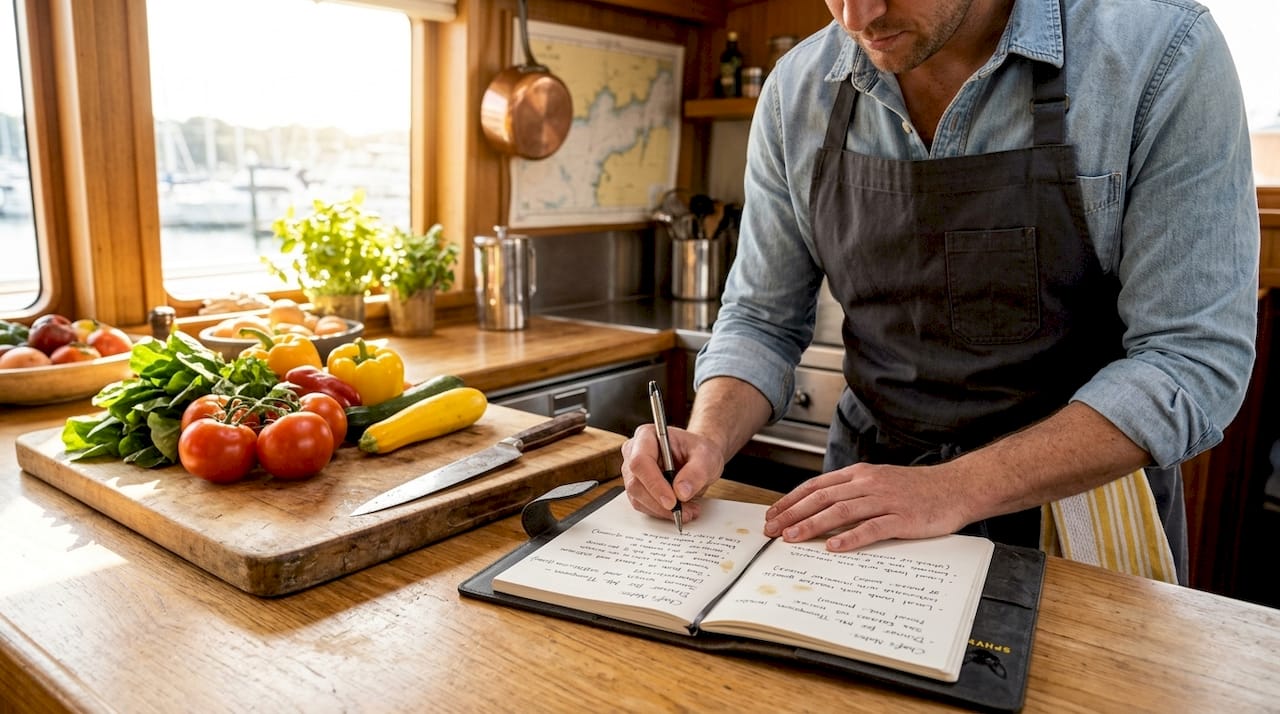
Yacht chefs avoid repetition by treating each meal as a unique, unrepeatable event tailored to that precise moment. A breakfast in a quiet Catalan cove will feel entirely different from a dinner anchored off Formentera, even if the chef is the same person using produce from the same region. This approach requires genuine culinary intelligence, not just technical skill. The best yacht chefs hold qualifications from institutions such as Le Cordon Bleu or Leiths School of Food and Wine, and many have worked in Michelin-starred kitchens before moving to sea.
3. Multi-course tasting menus with local ingredients
A multi-course tasting menu aboard a luxury yacht is the closest thing to a private restaurant experience that exists. Typically five to eight courses, these menus are built around the finest local produce the chef can source at each port, with wine pairings selected to complement each dish.
What separates this from a tasting menu ashore is the setting and the scale. You might eat a ceviche of locally caught sea bass as the sun drops behind a headland, followed by a slow-roasted lamb shoulder sourced from a farm the chef visited that morning. Food quality is frequently cited as the top experience highlight by charter guests, which tells you something important: the food is not a supporting act. It is the main event.
4. Interactive dining: teppanyaki, live-fire, and tableside theatre
Interactive dining formats have become one of the most requested yacht dining experiences among food enthusiasts. Onboard teppanyaki, where a chef cooks directly at the table on a flat iron griddle, works particularly well on larger yachts with open deck space. Live-fire cooking over charcoal on a beach barbecue, organised as a shore excursion from the yacht, is another format that combines the culinary with the theatrical.
These formats work because they dissolve the boundary between guest and chef. You watch the technique, ask questions, and eat in real time rather than waiting for a plate to arrive from a closed kitchen. Some charter operators now offer structured cooking demonstrations as part of the programme, where guests learn a regional dish before sitting down to eat it. Sphynxbcn’s Mediterranean yacht dining experiences include curated culinary moments of exactly this kind.
5. Casual family-style meals and sharing platters
Not every meal aboard a yacht needs to be a formal occasion. Family-style sharing platters, where large dishes of grilled fish, roasted vegetables, fresh bread, and local cheeses are placed at the centre of the table, are among the most popular formats for lunch at anchor.
This style suits the relaxed rhythm of a sailing day. Guests drift back from swimming or snorkelling, dry off on deck, and sit down to a spread that feels generous and unhurried. The chef still sources and prepares everything with care, but the format removes any sense of formality. For groups with children, or for guests who simply want to eat well without ceremony, sharing platters represent yacht catering services at their most enjoyable.
6. Special occasion dining: birthdays, anniversaries, and proposals
Personalised dining for a specific occasion is where yacht culinary services genuinely have no competition. A birthday dinner with a custom cake, a table set on the bow with candles and flowers, a menu built around a couple’s favourite dishes for an anniversary. These are not add-ons. They are the core of what private dining at sea is designed to deliver.
Exclusive ingredient requests such as lobster tails flown in by helicopter or two kilograms of baeri caviar for five guests illustrate just how far the personalisation can extend. The point is not extravagance for its own sake. The point is that the occasion is treated as genuinely important, and the food reflects that.
7. How yacht chefs manage menus and provisioning at sea
Menu planning on a yacht is not a static exercise. Chefs prepare flexible menu versions to handle supply disruptions, unexpected weather, or a port that simply does not have what was planned. A well-organised chef will carry a primary menu, a backup version using alternative proteins or vegetables, and a third option based entirely on what is already aboard.
Provisioning costs reflect location dramatically: a frozen whole chicken costs around $40 in Nassau compared to $10 in the UK, which means chefs in the Caribbean lean heavily on local fish to balance cost and freshness. In the Mediterranean, the calculus is different. Olive oil, tomatoes, and seafood are abundant and affordable. Specialty proteins and imported goods are where costs climb. Provisioning is an art as much as a science, and experienced chefs rely on trusted supplier networks built over years of sailing the same routes.
| Region | Strengths | Typical sourcing challenge |
|---|---|---|
| Mediterranean | Olive oil, seafood, fresh produce | Imported proteins and specialty items |
| Caribbean | Local fish, tropical fruit | Basic staples cost significantly more |
| Aegean | Herbs, octopus, local cheeses | Limited availability in smaller ports |
Pro Tip: Ask your charter company which ports on your route have the best markets. A morning visit to a local fish market with the chef is one of the most memorable culinary tour experiences you can have aboard.
8. A day in the life of a yacht chef
The daily routine of a yacht chef is structured and demanding. Crew dinner is served at 5pm, canapés go out at 6:30pm, and guest dinner is plated at 7:30pm. That compressed service window requires everything to be prepared, portioned, and sequenced before the first course leaves the galley.
A typical day looks like this:
- 7:00am. Breakfast prep begins. Fresh pastries, fruit plates, egg dishes, and coffee service for guests.
- 10:00am. Provisioning run ashore or delivery from a local supplier. Menu adjustments based on what is available.
- 12:30pm. Lunch service. Usually lighter: salads, grilled fish, sharing platters.
- 2:30pm. Galley clean-down, prep for dinner. Sauces, stocks, and components made in advance.
- 5:00pm. Crew meal.
- 6:30pm. Canapés served on deck.
- 7:30pm. Multi-course dinner service begins.
High turnover and rotation at sea challenge chefs to maintain consistency across different vessels and guest groups. The best ones treat every charter as a fresh brief, adapting quickly to the specific rhythm and preferences of each group.
9. All-inclusive versus plus-expenses charters: what it means for your food
The charter model you book directly shapes your dining experience. All-inclusive charters bundle food, drinks, and fuel into one price, which is the standard model in the Caribbean. Plus-expenses charters, common in the Mediterranean, charge food and beverages separately through an Advance Provisioning Allowance (APA).
| Charter type | Food billing | Typical region | Guest implication |
|---|---|---|---|
| All-inclusive | Bundled in charter fee | Caribbean | Fixed budget, no surprises |
| Plus-expenses (APA) | Billed against deposit | Mediterranean | More flexibility, premium requests easier |
The APA model gives guests more freedom to request premium ingredients without feeling constrained by a fixed budget. If you want that helicopter-delivered lobster or a specific vintage of Burgundy, the plus-expenses structure accommodates it more naturally. Gratuity is customary at 10 to 20 per cent of the charter fee in both models, and it is the most direct way to recognise exceptional culinary service.
Key takeaways
The finest culinary experiences on yachts combine expert chef skill, route-based provisioning, and bespoke menus to deliver dining that no restaurant can replicate.
| Point | Details |
|---|---|
| Bespoke menus define the experience | Chefs build every meal around guest preferences, dietary needs, and local produce at each port. |
| Galley constraints drive creativity | A galley a tenth the size of a land-based kitchen demands precision that produces more considered food. |
| Provisioning shapes the menu | Regional cost and availability, from Caribbean fish to Aegean herbs, directly influence what gets cooked. |
| Charter model affects dining scope | All-inclusive suits fixed budgets; APA models in the Mediterranean allow premium ingredient requests. |
| Preference sheets are non-negotiable | Completing your charter preference sheet in detail is the single most effective way to personalise your food. |
Why food is the true measure of a great charter
I have been aboard enough luxury yachts to know that guests remember the food long after they have forgotten the anchorages. A spectacular sunset fades from memory within a week. A perfectly executed bouillabaisse eaten at anchor in a Catalan bay, made from fish the chef bought that morning, stays with you for years.
What I find most underappreciated about yacht culinary service is the mental load the chef carries. They are not just cooking. They are managing a supply chain across multiple countries, adapting to weather that changes what is possible in the galley, reading the mood of the group, and doing all of this in a space smaller than most people’s bathroom. The chefs who thrive at sea are not simply good cooks. They are problem solvers with exceptional palates.
The practical implication for anyone booking a charter is this: treat the chef briefing as seriously as you treat the itinerary. Tell them about the meal you had in San Sebastián that you still think about. Tell them your partner cannot eat shellfish but loves spice. Tell them you want one genuinely theatrical dinner and the rest kept relaxed. That level of dialogue is what separates a good charter from an extraordinary one. You can explore what yacht hospitality best practices look like in practice to understand how the best operators structure this conversation.
— YellowRock
Discover exceptional yacht dining with Sphynxbcn
Sphynxbcn offers private yacht charters along the Mediterranean coast from Barcelona, with culinary experiences built around your group from the first meal to the last. Every charter includes access to expert chefs who source local produce, design personalised menus, and adapt to your preferences in real time. Whether you are planning a special occasion dinner at anchor, a corporate event with multi-course service, or a relaxed sailing week with exceptional food at its centre, Sphynxbcn crafts the experience around you. For food enthusiasts who want to combine the best of the Mediterranean table with the freedom of the sea, this is where to start.
For those curious about how luxury yacht catering in Barcelona translates into a full event experience, Sphynxbcn’s team is available to discuss bespoke options directly.
FAQ
What is included in a yacht culinary experience?
A yacht culinary experience typically includes all meals prepared by a private chef, with menus tailored to guest preferences, dietary requirements, and the local produce available along the route. On all-inclusive charters, food and drinks are bundled into the charter fee; on plus-expenses charters, food is billed against an advance provisioning allowance.
How do yacht chefs handle dietary restrictions?
Yacht chefs use detailed guest preference sheets completed before the charter to record all allergies, intolerances, and dietary preferences. This information shapes every menu from day one, and experienced chefs treat dietary restrictions as a design brief rather than a limitation.
Are gourmet meals on yachts comparable to restaurant quality?
Food quality aboard crewed luxury yachts is frequently rated by guests as comparable to high-end restaurants, with the added advantage of complete personalisation and privacy. Many yacht chefs hold formal culinary qualifications and have worked in professional restaurant kitchens before moving to sea.
What is an APA and how does it affect food costs?
An Advance Provisioning Allowance (APA) is a deposit, typically 25 to 35 per cent of the charter fee, held by the captain to cover food, drinks, fuel, and port fees on a plus-expenses charter. Any unspent amount is returned at the end of the trip, and premium ingredient requests are simply charged against the allowance.
Can I request specific dishes or cuisines aboard a yacht?
Yes. Communicating your preferred cuisines, specific dishes, or even restaurants you admire gives the chef a clear creative brief. Exclusive ingredient requests ranging from specific caviar to flown-in seafood are accommodated on premium charters, provided the request is communicated in advance.