

Stepping aboard a luxury yacht in the Mediterranean should feel effortless and exciting, yet many affluent guests find themselves bewildered by unfamiliar nautical jargon during their charter experience. Understanding key sailing terminology transforms confusion into confidence, allowing you to fully appreciate the skill and precision involved in navigating these magnificent vessels. This guide demystifies essential luxury sailing terms, with particular focus on complex manoeuvres like ‘bring alongside’, ensuring your next Mediterranean voyage is as seamless as it is sophisticated.
Table of Contents
- Understanding The Basics Of Luxury Sailing Terminology
- The Art And Science Of The ‘Bring Alongside’ Manoeuvre
- Pre-Manoeuvre Preparation And Environmental Assessment
- Mastering Communication And Precision During The Approach
- Experience Luxury Sailing With Confidence
- Frequently Asked Questions
Key takeaways
| Point | Details |
|---|---|
| Master fundamental yacht vocabulary | Understanding bow, stern, port, starboard, fenders, and lines enhances on-board communication and safety |
| The ‘bring alongside’ manoeuvre demands expertise | This complex docking procedure requires precise coordination, environmental assessment, and specialised terminology |
| Preparation determines success | Environmental factors like wind, current, and tidal streams must be assessed before any major yacht manoeuvre |
| Clear communication ensures smooth operations | Recognising crew signals and commands enriches your charter experience and builds appreciation for nautical skill |
Understanding the basics of luxury sailing terminology
Before delving into complex manoeuvres, mastering foundational yacht vocabulary creates a framework for understanding everything that happens aboard your Mediterranean charter. These terms form the language of luxury sailing, enabling clearer communication between guests and crew whilst deepening your appreciation for the artistry of yacht navigation.
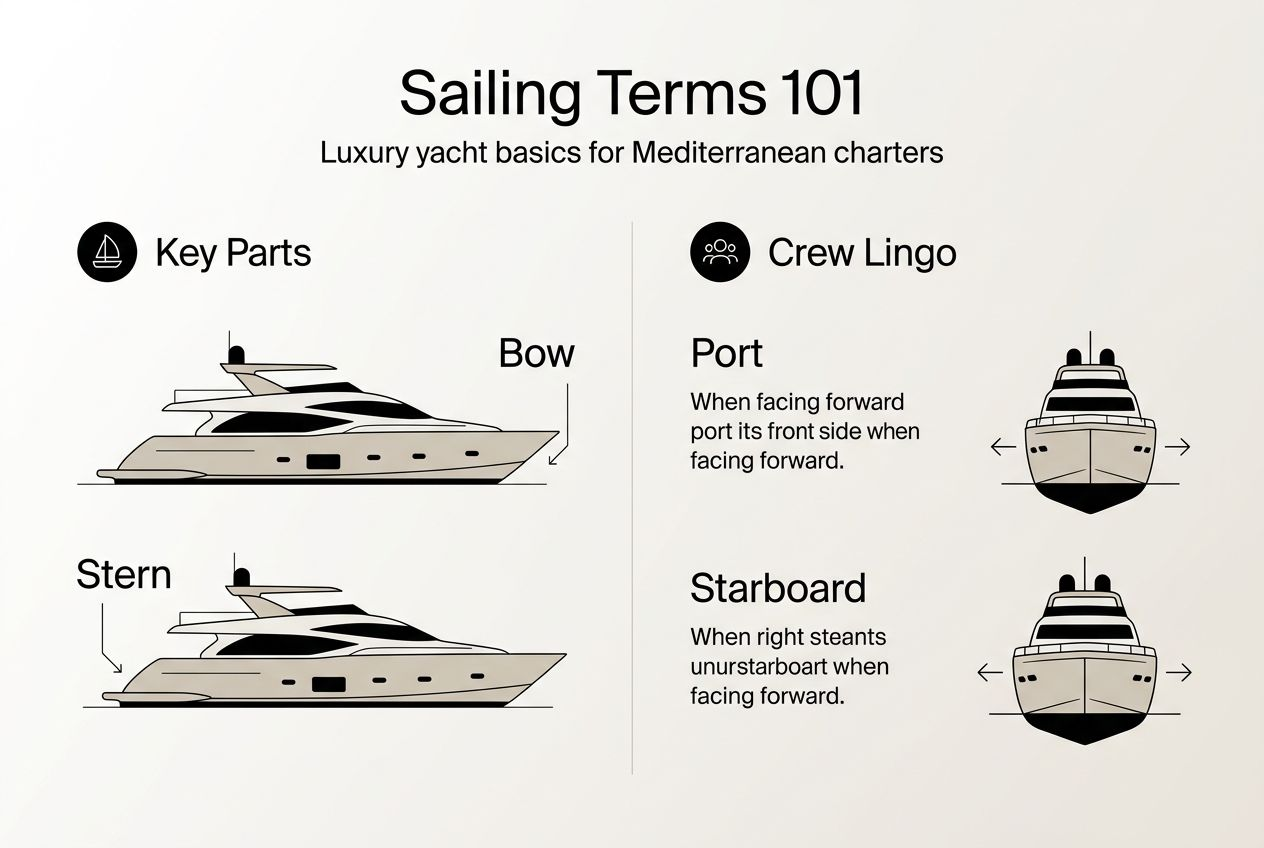
The bow refers to the front of the yacht, whilst the stern marks the rear. Port designates the left side when facing forward, and starboard indicates the right side. These directional terms remain constant regardless of your position on the vessel, providing universal reference points for navigation and communication.
Fenders are inflatable cushions deployed along the yacht’s sides to protect the hull when docking or mooring alongside other vessels or pontoons. Lines, often called ropes by those unfamiliar with yacht charter industry terms, secure the yacht to docks, buoys, or other vessels. Understanding these elements proves essential during berthing operations in crowded Mediterranean marinas.
Key foundational terms include:
- Helm: the steering mechanism controlling the yacht’s direction
- Cleat: a fitting used to secure lines without knots
- Berth: both a sleeping area below deck and a docking space at a marina
- Draft: the vertical distance between the waterline and the deepest point of the yacht’s hull
- Beam: the width of the yacht at its widest point
These terms appear constantly in crew communications, particularly when navigating the picturesque but often challenging harbours along the Spanish, French, and Italian coasts. Familiarity with this vocabulary allows you to anticipate crew actions, understand safety briefings more thoroughly, and engage meaningfully with the sailing experience rather than feeling like a passive observer.
The art and science of the ‘bring alongside’ manoeuvre
The bring alongside manoeuvre represents a critical skill for yacht skippers, involving a complex interplay of hydrodynamics, seamanship, communication, and judgement. This sophisticated procedure requires the captain to position the yacht parallel to a dock, pontoon, or another vessel with millimetre precision, often in challenging conditions with wind, current, and confined spaces.
Understanding the terminology surrounding this manoeuvre enhances your appreciation for the expertise required. Lines must be prepared in advance, with spring lines controlling fore and aft movement, whilst bow and stern lines secure the yacht’s position. Fenders are strategically positioned to prevent hull damage during the approach. Propulsion control involves subtle throttle adjustments and, on twin-engine yachts, differential power application to achieve precise positioning.
Windage, the effect of wind on the yacht’s above-water surfaces, significantly influences the approach angle and speed. Larger yachts with substantial superstructures experience greater windage, requiring yacht crew roles luxury charters to coordinate seamlessly. The skipper must calculate these forces whilst simultaneously managing propeller walk, the lateral thrust created by the propeller’s rotation that can push the stern sideways.
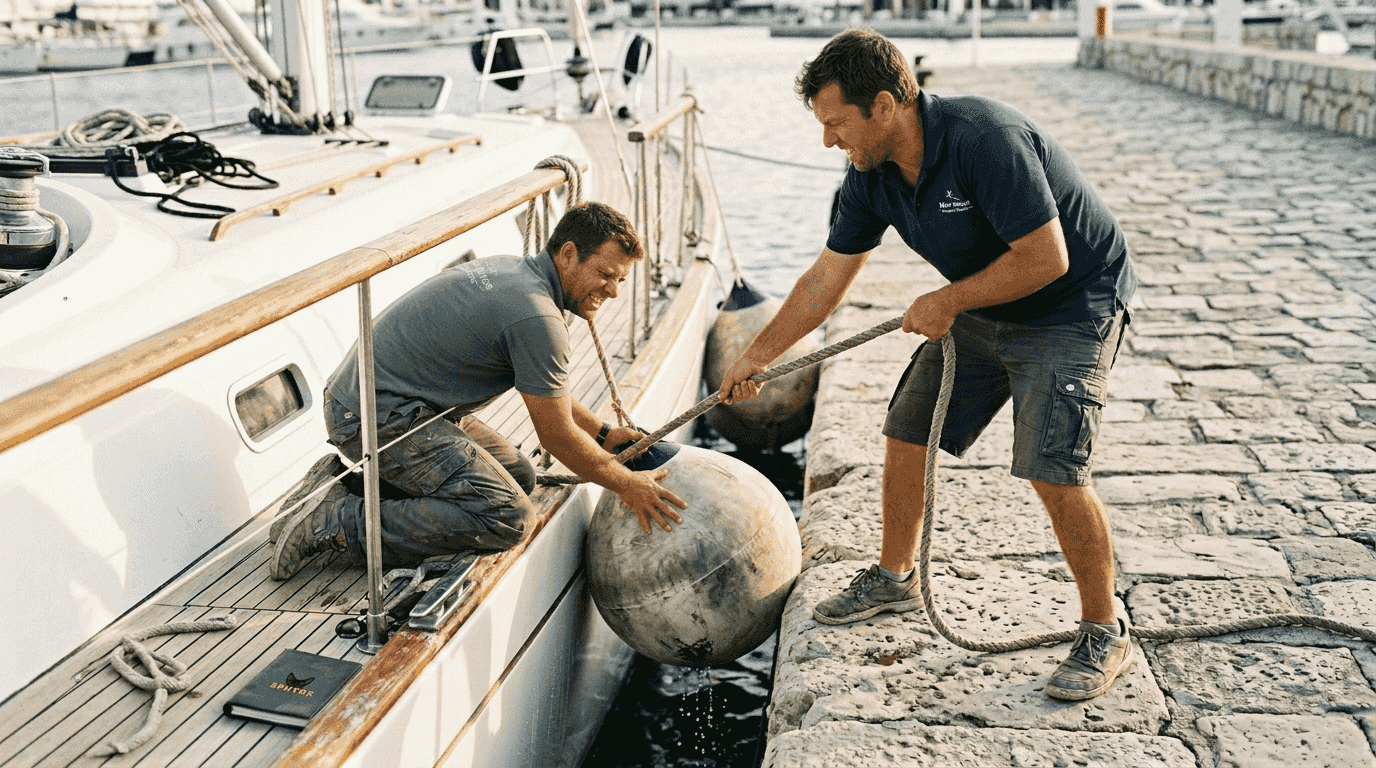
Pro Tip: Watch the crew’s preparation routine before docking. When you see fenders being positioned and lines laid out in specific patterns, you’re witnessing the preliminary choreography that determines whether the manoeuvre succeeds or requires multiple attempts.
Successful execution demands split-second decisions based on environmental conditions, yacht characteristics, and spatial awareness. As maritime experts emphasise, this manoeuvre showcases the intersection of theoretical knowledge and practical skill that defines professional yacht handling.
Key elements of the bring alongside procedure:
- Approach angle: typically 20 to 30 degrees to the berth, adjusted for wind and current
- Speed management: reducing to bare steerageway whilst maintaining control
- Crew positioning: strategic placement for line handling and fender adjustment
- Communication protocols: clear, concise commands between helm and deck crew
The complexity increases in Mediterranean settings where ancient harbours feature tight berths, stone quays, and unpredictable wind patterns funnelled between buildings. Mastering this terminology allows you to recognise the skill involved and understand why yacht team building cohesion boost programmes emphasise these coordinated manoeuvres.
Pre-manoeuvre preparation and environmental assessment
The manoeuvre begins before the yacht moves, with environmental assessment and yacht readiness being key preparatory steps. Understanding this preparatory phase and its associated terminology reveals the meticulous planning that precedes every seemingly effortless docking in Mediterranean marinas.
Tidal streams, the horizontal movement of water caused by tides, affect yacht handling significantly even in the relatively low-tide Mediterranean. Skippers must calculate current direction and strength, adjusting approach angles accordingly. Propeller walk, mentioned earlier, becomes particularly relevant during slow-speed manoeuvring when this lateral force exerts proportionally greater influence on the yacht’s path.
Windage assessment involves evaluating wind speed, direction, and consistency. Mediterranean conditions can shift rapidly, with thermal winds like the Mistral or Tramontana creating challenging docking scenarios. The skipper observes flags, smoke, and water surface patterns to gauge these forces before committing to the approach.
Pre-manoeuvre preparation follows a systematic sequence:
- Survey the berth for obstacles, depth, and neighbouring vessels
- Assess wind direction and strength at the berth location
- Evaluate current or tidal stream influence on the approach path
- Brief crew on their specific roles and anticipated challenges
- Prepare lines in the correct sequence for deployment
- Position fenders at appropriate heights and locations
- Test propulsion and steering systems for immediate response
- Establish clear communication signals between helm and deck crew
This systematic approach ensures nothing is left to chance. Skippers often conduct a preliminary pass near the berth, observing how environmental forces affect the yacht’s movement before committing to the final approach. This reconnaissance allows for strategy adjustment and demonstrates the difference between amateur and professional yacht handling.
Pro Tip: Notice when the captain makes a slow pass near your intended berth without docking. This reconnaissance reveals how seriously professional crews take environmental assessment, gathering real-time data that no amount of theoretical knowledge can replace.
Guests who understand these preparatory steps gain insight into why docking sometimes takes longer than expected and why crew members move with such deliberate purpose during the approach. The exclusive sailing experience guide emphasises these elements as hallmarks of professional yacht operations.
Mastering communication and precision during the approach
Bringing a yacht alongside requires clear communication, timely deployment of lines and fenders, correct use of propulsion and steering, accurate assessment of wind and current, and precise speed control. Each element demands specific terminology and coordinated execution that transforms individual crew members into a unified operational team.
Fenders must be deployed at precisely the right moment, neither so early that they drag in the water during approach nor so late that the hull risks contact with the berth. Lines require similar timing, with crew members positioned to throw or hand lines to shore handlers or cleats at the exact moment when the yacht achieves optimal position and minimal forward momentum.
Propulsion management involves subtle throttle adjustments, often using brief bursts of power rather than sustained thrust. Speed control becomes critical as the yacht approaches the berth, with the goal of achieving zero forward momentum precisely when the hull aligns with the intended position. Too much speed risks collision, whilst insufficient speed leaves the yacht vulnerable to wind and current pushing it off course.
| Environmental Factor | Effect on Manoeuvre | Crew Response |
|---|---|---|
| Strong beam wind | Pushes yacht sideways away from berth | Increased approach angle, higher initial speed, aggressive final correction |
| Following current | Accelerates yacht towards berth | Reduced engine power, earlier deceleration, extended approach distance |
| Opposing current | Slows yacht progress | Increased power to maintain steerage, shorter approach distance |
| Gusting conditions | Unpredictable lateral movement | Continuous power adjustments, crew ready for rapid fender repositioning |
Communication protocols vary between yachts but typically involve standardised commands that eliminate ambiguity. The helm might call “fenders out” when approaching the berth, signalling crew to deploy cushioning. “Lines ready” indicates preparation for securing, whilst “make fast” instructs crew to secure lines to cleats or bollards. Understanding these industry terms for yacht approaches allows guests to follow the action and appreciate the choreography.
Key communication elements include:
- Distance callouts: crew informing the helm of remaining distance to the berth
- Status updates: confirmation that fenders are positioned and lines are ready
- Environmental alerts: warnings about wind gusts or current changes
- Hand signals: visual communication when engine noise prevents verbal commands
Guests benefit from recognising these patterns, understanding that apparent chaos is actually carefully orchestrated precision. When crew members move rapidly or shout commands, they’re executing rehearsed procedures that ensure safety and protect the yacht’s pristine condition. This awareness transforms docking from a mysterious process into an impressive demonstration of professional competence.
Experience luxury sailing with confidence
Now that you’ve mastered essential luxury sailing terminology, you’re prepared to fully appreciate the sophistication and skill involved in Mediterranean yacht charters. Understanding these terms transforms you from a passive passenger into an engaged participant who recognises the artistry behind every manoeuvre.
Sphynx BCN specialises in delivering exceptional yacht private tour experiences along Barcelona’s stunning coastline, where your enhanced vocabulary allows deeper engagement with our expert crew. Our luxury charters cater to discerning travellers who appreciate the finer details that distinguish extraordinary experiences from merely pleasant ones. Discover why yacht charters appeal to affluent travellers seeking authentic nautical experiences combined with Mediterranean elegance. When you master yacht charter industry terms, every moment aboard becomes an opportunity to appreciate the seamanship, precision, and dedication that define premium yacht operations.
Frequently asked questions
What is the most important luxury sailing term to know?
The ‘bring alongside’ manoeuvre represents perhaps the most critical term, describing the complex process of positioning and securing a yacht to a dock or pontoon. Understanding this term helps you appreciate the skill involved in what appears to be a simple docking procedure. It encompasses environmental assessment, crew coordination, and precise boat handling that distinguishes professional yacht operations.
How can understanding sailing terms improve my charter experience?
Familiarity with nautical terminology enables clearer communication with crew members and eliminates the confusion that often accompanies luxury yacht charters. You’ll anticipate crew actions, understand safety briefings more thoroughly, and recognise the expertise required for complex manoeuvres. This knowledge transforms passive observation into active appreciation, enriching every aspect of your Mediterranean sailing experience.
What should guests know before a yacht approaches the dock?
Recognise that crew members preparing fenders and laying out lines are executing crucial preliminary steps that determine docking success. Understanding environmental factors like wind direction, current strength, and tidal streams helps you appreciate why approaches sometimes require multiple attempts or appear more cautious than expected. These preparations reflect professional standards rather than crew inexperience, ensuring your safety and the yacht’s pristine condition throughout the charter.