

TL;DR:
- Mediterranean yacht dining emphasizes fresh, local ingredients and menus that adapt to each port’s offerings. Simple, one-pan seafood dishes like Zarzuela de Pescado and plancha-seared fish are practical and flavorful options for moving kitchens. Sourcing fresh ingredients locally and adjusting for sea conditions create memorable, relaxed meals tailored to the voyage’s rhythm.
Mediterranean yacht dining is defined by fresh, hyper-local ingredients, light preparations, and menus that shift with every port of call. The best yacht meal inspiration comes not from a fixed recipe book but from the morning market at each harbour. Tuna landed near the Balearics, sea bream caught off the Greek islands, mussels pulled from Sicilian waters: these are the building blocks of a genuinely memorable meal at sea. What separates dining on a yacht from any restaurant experience is the combination of absolute freshness, a moving kitchen, and a view that no Michelin-starred room can replicate.
1. What are the best Mediterranean seafood dishes for a yacht kitchen?
The strongest Mediterranean seafood dishes for a yacht galley share one quality: they are built for simplicity without sacrificing depth of flavour. Yacht kitchens are compact, often with two or three burners and limited oven space. Dishes that demand multiple pots, long roasting times, or complex plating at the last minute are a liability when the vessel is moving.
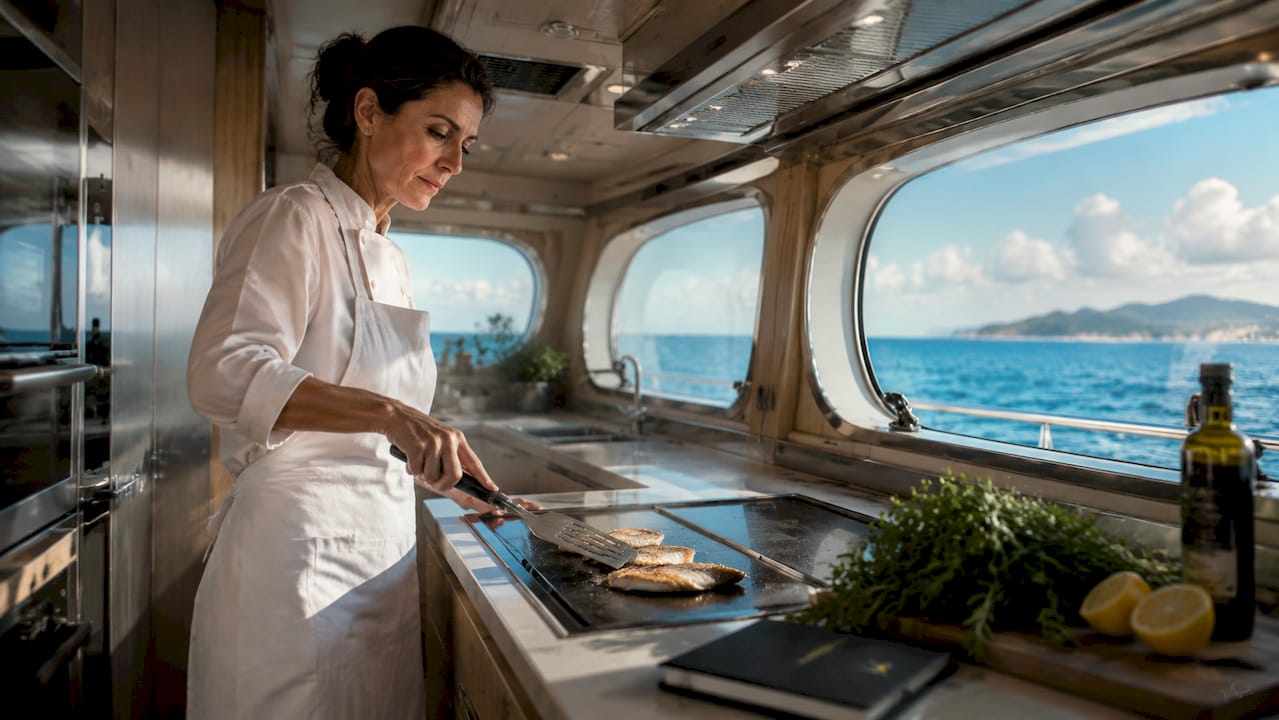
Zarzuela de Pescado is the single best example of a practical yet impressive dish. This Spanish seafood stew is prepared in one pan in roughly 45 minutes, combining white fish, prawns, clams, and mussels in a saffron and tomato base. One pan means one source of heat, minimal washing up, and a dish that holds well during service.
Plancha-seared fish and shellfish are equally well suited to the galley. A hot plancha or cast-iron griddle produces a clean, caramelised crust on sea bream fillets or scallops in under four minutes per side. The technique requires no sauce work during service and delivers restaurant-quality results with minimal equipment.
- Zarzuela de Pescado: single-pan Spanish seafood stew, saffron and tomato base, 45-minute preparation
- Plancha-seared sea bream: high heat, minimal oil, finished with lemon and fresh thyme
- Grilled octopus with smoked paprika: pre-boiled ashore, finished on the plancha at sea
- Mussels in white wine and garlic: five-minute dish, served with crusty bread
- Tuna carpaccio with capers and olive oil: no heat required, ideal for lunch at anchor
Local herbs and good olive oil do most of the work in every one of these dishes. A drizzle of Arbequina olive oil, a handful of fresh oregano, and a squeeze of lemon transform a simple fillet into something that tastes unmistakably Mediterranean.
Pro Tip: Select dishes that hold their quality at room temperature for at least 15 minutes. Plancha-seared fish and terrines are far more forgiving than soufflés or delicate emulsions when the boat is moving.
2. How does local sourcing and route shape your yacht menu?
Luxury Mediterranean charters use hyper-local menus that change daily based on where the vessel arrives and what the morning market offers. This is not a marketing claim. It is a practical reality driven by the fact that fresh restocking happens every 1–2 days, and over-reliance on frozen proteins is actively avoided by experienced yacht chefs.
The route itself becomes the menu. A week sailing from Barcelona to Menorca to Ibiza will produce entirely different plates than a route through the Greek islands or along the Turkish Aegean coast near Bodrum. Each port brings its own specialities.
Key provisioning stops and their signature ingredients:
- Barcelona and the Costa Brava: Catalan romesco sauce, fresh anchovies, calçots in season
- Balearic Islands (Mallorca, Menorca, Ibiza): Sobrasada, ensaimada pastries, local sea bass
- Greek islands (Santorini, Mykonos, Crete): Feta, Kalamata olives, fresh octopus, honey
- Italian coasts (Amalfi, Sicily, Sardinia): Burrata, bottarga, capers, Sicilian tuna
- Turkish Aegean (Bodrum, Göcek): Mezes, fresh figs, sea bream, pomegranate molasses
Chefs who map suppliers in advance maintain freshness without scrambling at each port. Coordinating with a local fishmonger or market vendor 24 hours ahead means the best catch is reserved before the boat arrives.
Pro Tip: Build a provisioning contact list before departure. A reliable fishmonger in each key port is worth more than any amount of onboard freezer space.
3. What practical cooking considerations matter most aboard?
Cooking aboard a yacht demands creativity with space and sea-induced challenges. The galley is rarely larger than a domestic kitchen, and it moves. Three practical factors shape every decision a yacht chef makes.
Sea air and humidity alter food chemistry. Salt air and humidity affect sauce reduction times and baking results. Wind accelerates evaporation, meaning a sauce that takes 10 minutes to reduce on land may take six at sea. Chefs compensate by using less added salt and leaning on acidity, fresh herbs, and citrus to balance flavours instead.
Motion affects plating and presentation. Dishes that require tall, architectural plating collapse when the vessel rolls. Flat presentations, shallow bowls, and dishes served in their cooking vessel are the practical choice. Terrines, carpaccios, and composed salads all travel well across a moving deck.
Oven use is limited. Most yacht galleys have a small oven that heats unevenly and consumes significant gas. Stovetop and plancha cooking are the workhorses. When oven use is necessary, choose dishes that are forgiving of temperature variation, such as slow-baked fish en papillote or roasted vegetables.
- Avoid dishes requiring last-minute assembly of multiple components
- Prepare sauces and marinades in advance and store in sealed containers
- Use wide, shallow serving dishes that sit stable on a moving table
- Chill plates before service to slow heat loss during outdoor dining
Pro Tip: Serve dinner at anchor whenever possible. A sheltered bay eliminates motion entirely, allowing more ambitious plating and a genuinely relaxed pace.
Ambience matters as much as the food itself. Lighting and décor significantly enhance the dining atmosphere, particularly during evening meals. Wind-protected candles, low lighting, and a well-set table signal to guests that the meal is an occasion worth slowing down for.
4. What are the best Mediterranean picnic and al fresco dining ideas?
Al fresco dining on deck is the defining meal format of any Mediterranean charter. The best approach treats it as a curated picnic rather than a simplified dinner. Light, shareable plates work better than plated individual courses when guests are in swimwear, the sun is high, and the mood is relaxed.
A well-assembled deck spread for four to six guests might include:
- A cheese board with Manchego, aged Pecorino, and local goat’s cheese, served with fig jam and honey
- Cured fish: smoked salmon, marinated anchovies, or bottarga shaved over toasted bread
- A seasonal salad of tomatoes, cucumber, Kalamata olives, and fresh mint dressed with lemon and olive oil
- Fresh bread from the morning market, still warm
- Cold sauces: tzatziki, romesco, and hummus in small bowls that guests can share
For drinks, a chilled Albariño or Vermentino pairs cleanly with seafood-forward spreads. A simple Aperol Spritz or a gin and tonic with Mediterranean botanicals works well as a pre-lunch aperitif. Both travel easily in a cooler and require no specialist equipment.
| Format | Best for | Key advantage |
|---|---|---|
| Cheese and charcuterie board | Lunch at anchor | No cooking, easy assembly |
| Composed salad platter | Hot afternoons | Light, refreshing, no heat required |
| Cured fish spread | Sundowner hour | Pairs directly with wine or cocktails |
| Warm meze selection | Early evening | Shareable, culturally authentic |
Table décor for al fresco meals sets the tone without effort. Blue and white linens, olive branches, and lemon zest accents create a visual identity that feels genuinely Mediterranean rather than generic. Wind-protected candles in low holders complete the setting for an evening meal on deck.
The food tourism connection is real here. Guests who eat local food in a local setting form a stronger emotional connection to the destination. A plate of Cretan feta eaten in a Cretan bay is a different experience from the same cheese eaten in a hotel dining room.
Key takeaways
The most effective Mediterranean yacht dining approach combines hyper-local sourcing, motion-resilient dishes, and unhurried meal pacing to create a genuinely memorable experience at sea.
| Point | Details |
|---|---|
| Prioritise single-pan dishes | Zarzuela de Pescado and plancha seafood suit galley constraints and hold well during service. |
| Source locally at each port | Fresh restocking every 1–2 days keeps menus authentic and avoids dependence on frozen proteins. |
| Adjust for sea conditions | Salt air reduces seasoning needs; wind accelerates sauces, so monitor reduction times closely. |
| Serve dinner at anchor | Sheltered bays eliminate motion, allowing better plating and a more relaxed dining pace. |
| Use décor to set the tone | Blue and white linens, olive branches, and wind-protected candles transform a deck into a dining room. |
What I have learned about cooking and eating at sea
The most common mistake I see on chartered yachts is ambition without adaptation. A chef or host plans a menu worthy of a land-based restaurant, then spends the entire service fighting the kitchen, the motion, and the clock. The meal arrives late, stressed, and slightly wrong.
The best meals I have experienced at sea share a different quality. They are built around the voyage itself, not imported onto it. A plate of grilled octopus sourced that morning in a Greek harbour, dressed with nothing more than lemon and oregano, eaten on deck as the sun drops behind the headland, is more memorable than a technically complex dish prepared from ingredients flown in from elsewhere.
Reading guest signals matters more than any fixed schedule. After an active morning of swimming and snorkelling, guests want something light and cold. After a long sail in open water, they want warmth and substance. Pacing the meal to match the day’s rhythm is the single skill that separates a good yacht dining experience from a great one.
Simplicity is not a compromise. It is the correct answer for this environment. The Mediterranean provides extraordinary raw ingredients. The chef’s job is to stay out of their way.
— YellowRock
Bespoke yacht dining experiences with Sphynxbcn
Sphynxbcn specialises in private yacht tours along the Mediterranean coast from Barcelona, with bespoke dining experiences built around the same principles covered in this guide: fresh local sourcing, expert provisioning, and menus crafted to match the route and the guests.
Every Sphynxbcn charter is designed around the specific preferences of the group on board. Whether you are planning a private celebration, a sunset dinner at anchor, or a private dining at sea experience for a special occasion, the team handles provisioning, menu curation, and table setting so that you can focus entirely on the meal and the view. Sphynxbcn operates from Barcelona with access to the full range of Mediterranean ports and seasonal ingredients that make this style of dining genuinely exceptional.
FAQ
What dishes work best in a yacht galley?
Single-pan dishes like Zarzuela de Pescado and plancha-seared seafood are the most practical choices. They require minimal equipment, hold well during service, and deliver strong flavour without complex last-minute assembly.
How do yacht chefs source fresh ingredients at sea?
Experienced yacht chefs map suppliers at key ports before departure and restock fresh produce every 1–2 days. Coordinating with local fishmongers 24 hours in advance secures the best catch before the vessel arrives.
Does sea air really affect how food tastes and cooks?
Yes. Salt air and humidity alter sauce reduction times and affect seasoning balance. Chefs at sea use less added salt and rely more on acidity, fresh herbs, and citrus to compensate for the altered cooking environment.
What is the best format for lunch on deck?
A shareable spread of cheese, cured fish, seasonal salad, and fresh bread is the most practical and enjoyable format. It requires no last-minute cooking, suits warm weather, and pairs directly with chilled white wine or a simple cocktail.
When is the best time to serve a formal dinner on a yacht?
Dinner at anchor in a sheltered bay is the ideal setting. The absence of motion allows more considered plating, a slower pace, and better ambience. Lighting and table décor matter significantly at this point in the day.