

TL;DR:
- Genuine luxury yacht charters adhere to strict international and Spanish compliance standards ensuring safety and trust.
- Proper contracts, crew qualifications, and regulatory checks protect clients from legal and financial risks.
- Exceptional service depends on motivated crew and attention to guest preferences beyond just compliance.
Not every yacht flying a luxury flag delivers a truly premium experience. Many clients assume that a high price tag guarantees legal compliance, professional crew, and seamless service, but that assumption can be costly. In reality, only charters operating under rigorous international and Spanish national standards consistently deliver what affluent guests and corporate clients actually expect: legal certainty, impeccable service, and zero unpleasant surprises. This guide walks you through the contracts, compliance frameworks, crew qualifications, guest etiquette, and emerging trends that define genuinely premium yacht charters in Barcelona and along the Mediterranean coast.
Table of Contents
- Why industry standards matter for luxury yacht charters
- Key contracts and regulatory compliance: What to check before you book
- Crew qualifications and yacht safety: Setting service benchmarks
- Client etiquette and the essentials for a seamless luxury experience
- Nuances, edge cases and future trends: Sustainability, force majeure, and evolving expectations
- Expert perspective: Why true luxury means going beyond compliance
- Secure your premium yacht charter in Barcelona
- Frequently asked questions
Key Takeaways
| Point | Details |
|---|---|
| Global contracts matter | The MYBA Charter Agreement ensures worldwide trust and legal protection for premium yacht charters. |
| Spanish laws are strict | Since August 2025, Barcelona charters require new licences, insurance, and crew documentation to avoid major fines. |
| Crew quality drives luxury | Professionally qualified crews and top safety standards define the true high-end yachting experience. |
| Etiquette sets the tone | Client behaviour, tipping, and advance preparation distinguish memorable Mediterranean charters. |
| Adapt to new trends | Forward-thinking charters now prioritise sustainability and protect clients with advanced cyber and event risk provisions. |
Why industry standards matter for luxury yacht charters
Having outlined what this guide delivers, let’s explore the real impact of industry standards in luxury yacht charters.
Standards in the luxury yachting world are not bureaucratic box-ticking. They are the invisible architecture that makes an extraordinary experience possible. When a charter operator adheres to established frameworks, you gain legal certainty, financial protection, and a consistent level of service that informal arrangements simply cannot guarantee. The yacht charter appeal for high-net-worth clients rests precisely on this foundation of trust.
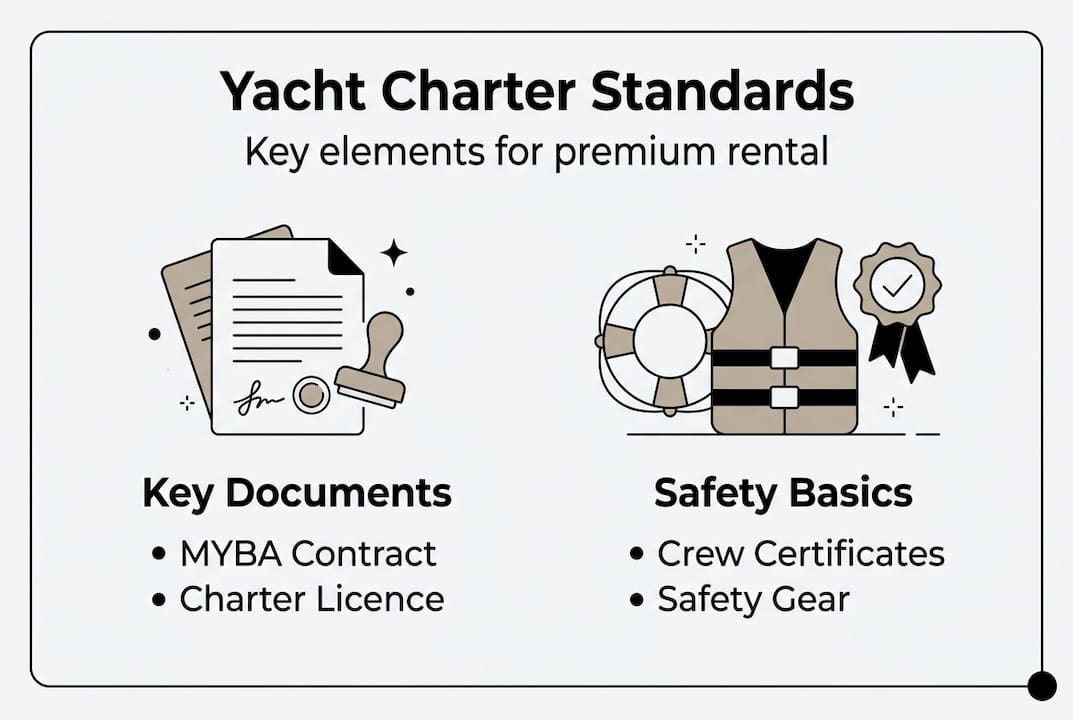
The single most important benchmark in premium yachting is the MYBA Charter Agreement. The MYBA Charter Agreement is the gold standard globally, with 2025 to 2026 updates addressing compliance gaps that older contracts left open. It governs everything from deposit structures and cancellation terms to liability allocation and force majeure clauses. Without it, you are navigating open water without a chart.
For the Barcelona and broader Mediterranean market, the regulatory landscape shifted significantly after 2025. Spain introduced stricter oversight of charter operators, meaning that what was acceptable practice two years ago may now expose both client and provider to legal risk. Understanding defining luxury in Barcelona now means understanding compliance as part of the luxury proposition itself.
Here is what rigorous industry standards actually deliver for you as a client:
- Legal protection: A compliant contract defines your rights, the operator’s obligations, and clear remedies if things go wrong.
- Financial security: Structured deposit and APA (Advance Provisioning Allowance) terms mean your money is handled transparently.
- Consistent service quality: Certified crew, inspected vessels, and documented safety procedures are non-negotiable under premium frameworks.
- Regulatory peace of mind: Compliant charters carry valid licences, insurance, and reporting obligations, so you are never at risk of a trip being detained by authorities.
“The MYBA charter contract is not simply a legal document. It is the shared language of trust between client and operator, and its evolution reflects the real risks the industry faces today.”
For corporate clients, this matters even more. A detained vessel or a contract dispute mid-charter is not just inconvenient. It is a reputational event.
Key contracts and regulatory compliance: What to check before you book
After understanding why standards matter, it is vital to know the key regulations and documents that protect your yacht charter.
Spain’s regulatory environment for yacht charters became considerably more demanding following Royal Decree 186/2023, which came into full force in August 2025. The decree mandates updated charter licences, stricter passenger insurance requirements, mandatory crew documentation, and detailed voyage reporting. Non-compliance carries penalties that can reach €200,000, and authorities have the power to detain a vessel mid-trip. The Spanish chartering risks are real, and they fall on both operator and, in some cases, the client.
The updated MYBA contract for 2025 to 2026 introduced several new clauses that clients booking luxury yacht contracts must understand. Force majeure, KYC/AML checks are now explicitly included, meaning your identity verification is part of the booking process, not an optional formality.
| Contract element | What to verify |
|---|---|
| Deposit structure | 50% on signing, 40% thirty days prior, 10% on board |
| APA terms | Typically 30 to 35% of base fee; unused balance returned |
| Cancellation policy | Sliding scale penalties; check force majeure scope |
| Insurance coverage | Liability and passenger cover must be current and verified |
| KYC/AML compliance | Identity checks now mandatory under MYBA 2025 updates |
| Licence validity | Spanish charter licence must be current and vessel-specific |
Pro Tip: Before signing any charter agreement in Barcelona, request a copy of the vessel’s Spanish charter licence and the operator’s current insurance certificate. A reputable provider will supply these without hesitation. If there is any reluctance, treat it as a serious warning sign.
The clauses that matter most for affluent clients are those governing cancellation, force majeure, and the APA reconciliation process. Read them carefully. A well-drafted contract protects you from unexpected costs and ensures that any unused provisioning funds are returned promptly after the charter.
Crew qualifications and yacht safety: Setting service benchmarks
With contracts and regulations covered, let’s examine the key people and safety benchmarks shaping your onboard experience.
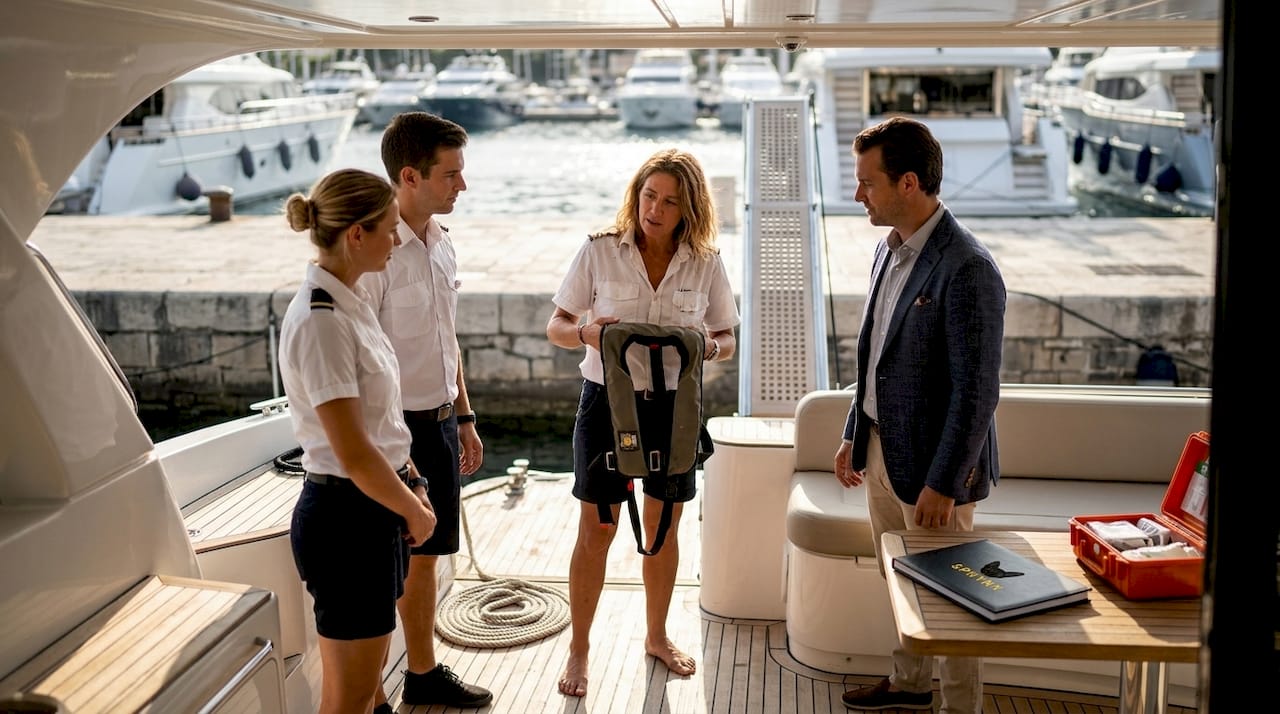
The quality of your charter experience is inseparable from the quality of the crew. A luxury vessel with an under-qualified team is not a luxury charter. It is a risk. Professional qualifications and safety certificates are mandatory for all crew operating commercially in Spanish waters, and this is not a technicality. It is the difference between a captain who can handle an unexpected squall and one who cannot.
The essential crew roles and safety framework for a premium Barcelona charter includes:
- Captain: Must hold a Yachtmaster Ocean, PER (Patrón de Embarcación de Recreo), or equivalent qualification recognised under Spanish maritime law.
- Deck crew: Safety training, first aid certification, and STCW (Standards of Training, Certification and Watchkeeping) compliance required for commercial vessels.
- Chef: Culinary qualifications and food hygiene certification are standard on premium charters.
- Hostess or steward: Guest service training and, on larger vessels, STCW certification.
Beyond qualifications, the vessel itself must carry mandatory safety equipment. This includes life rafts, EPIRBs (Emergency Position Indicating Radio Beacons), fire suppression systems, and up-to-date safety certificates issued by the relevant maritime authority.
| Safety requirement | Standard for premium charters |
|---|---|
| Life rafts | Certified and within service date |
| EPIRB | Registered and activated |
| Fire suppression | Engine room and galley systems |
| First aid kit | Fully stocked, accessible |
| Safety briefing | Mandatory for all guests before departure |
One often overlooked detail: the captain holds ultimate authority on board. This is not a courtesy title. Under maritime law, the captain’s decisions on safety, routing, and vessel operation are final. Understanding sailing terminology and the chain of command helps guests engage with the crew professionally and ensures the experience runs smoothly for everyone.
The “barefoot rule” is another practical standard worth knowing. Most premium yachts require guests to remove shoes or wear soft-soled deck shoes to protect the vessel’s surfaces and prevent slipping. It is a small detail that signals a well-run operation.
Client etiquette and the essentials for a seamless luxury experience
Moving from crew standards, the premium experience is also shaped by how clients engage with both staff and the unique yacht environment.
The most experienced yacht guests know that their conduct shapes the quality of the experience as much as the vessel or the crew. Onboard etiquette for premium charters covers everything from what you pack to how you interact with the team.
Practical preparation matters. Soft luggage, deck shoes, 10 to 20% tipping, and booking six to twelve months ahead for peak season are the hallmarks of a well-prepared guest. Hard-sided suitcases are a genuine problem on yachts because storage space is limited and shaped for flexible bags. Arrive ready.
Key etiquette principles for both leisure and corporate guests include:
- Respect the crew’s working space: Galleys and crew quarters are off-limits unless invited.
- Communicate preferences early: Dietary requirements, activity preferences, and schedule changes are best discussed before departure, not mid-charter.
- Tipping: A gratuity of 10 to 20% of the base charter fee is standard for excellent service, given directly to the captain for distribution.
- Flexible itinerary mindset: Weather, port availability, and maritime conditions can shift plans. Premium guests adapt gracefully.
Pro Tip: For corporate charters, brief your group on etiquette before boarding. A team that understands the environment will engage more confidently with the crew and with each other, making the experience genuinely productive rather than awkward.
The APA (Advance Provisioning Allowance) is a concept that surprises many first-time charter clients. It is a pre-paid fund, typically 30 to 35% of the base fee, used for fuel, food, beverages, and mooring fees during the charter. Any unspent balance is returned to you after the trip. Keeping an eye on provisioning costs during the charter avoids end-of-trip surprises. Review the Mediterranean etiquette guide for a fuller picture of what to expect.
Nuances, edge cases and future trends: Sustainability, force majeure, and evolving expectations
Finally, as industry standards and client expectations evolve, being informed on emerging trends and atypical scenarios gives you an edge.
The premium yachting world is not static. The MYBA 2025 updates signal a broader shift in how the industry manages risk and responsibility. Cyber attacks and port closures are now explicitly listed as force majeure events, reflecting a world where digital infrastructure failures and geopolitical disruptions can affect maritime operations as readily as a storm.
For clients planning executive retreats at sea, this has practical implications. Your contract should clearly define what happens to deposits and scheduled itineraries if a cyber incident disables port systems or a sudden closure affects your planned route.
The due diligence requirements are also expanding. KYC (Know Your Customer) and AML (Anti-Money Laundering) checks are now standard in MYBA-compliant contracts. This is not an intrusion. It is a signal that your operator is running a legitimate, professionally managed business.
Sustainability is reshaping client expectations at the premium end of the market:
- Hybrid and electric propulsion: Demand for low-emission vessels is growing among environmentally conscious clients.
- Eco-moorings: Marinas offering sustainable mooring systems that protect seabeds are increasingly preferred.
- Green provisioning: Locally sourced food, reduced single-use plastics, and responsible waste management are becoming baseline expectations.
- Carbon offsetting: Some operators now offer verified offset programmes as part of the charter package.
Sustainability in yacht charters is no longer a niche concern. It is becoming a core criterion for premium clients who want their charter trends in luxury to align with their broader values.
“The next generation of luxury yacht clients will not separate excellence from responsibility. Sustainability is not a trade-off with premium quality. It is part of the definition.”
Expert perspective: Why true luxury means going beyond compliance
You now understand the technical standards. So what really separates a good charter from a truly exceptional experience?
Compliance is the floor, not the ceiling. Every reputable operator in Barcelona meets the legal minimums. What distinguishes a genuinely memorable charter is something contracts cannot mandate: the ability to anticipate what a guest needs before they ask for it.
We have seen technically compliant charters that felt transactional and informal operations that felt genuinely extraordinary, simply because the crew cared. The difference is in the details. A captain who adjusts the route because the light is better for photography. A chef who remembers a dietary preference mentioned in passing. A hostess who has the right music playing before guests board.
The true luxury edge in Mediterranean yachting is not found in a checklist. It is found in the culture of a well-led, genuinely motivated crew operating on a vessel they are proud of. Regulations protect you. Exceptional people elevate you. When choosing your charter provider, look for both.
Secure your premium yacht charter in Barcelona
Ready to ensure your next Mediterranean charter surpasses expectation? Here is how to move forward with confidence.
At Sphynx BCN, every charter is built on full compliance with updated Spanish maritime law and the latest MYBA standards, so you never have to worry about licences, crew qualifications, or contract gaps. Our yacht private tours are crafted for clients who expect more than a boat and a view.
Whether you are planning a private celebration, a corporate event at sea, or a bespoke sailing day along the coast, our team handles every detail. Explore our ultimate luxury experience or browse our full range of Barcelona sailing tours to find the perfect charter for your group. Standards matter. So does the experience. With Sphynx BCN, you get both.
Frequently asked questions
What documents or licences must be checked before renting a yacht in Barcelona?
Always verify the yacht holds a valid Spanish charter licence, current liability and passenger insurance, and a MYBA-compliant or equivalent contract. Since August 2025 regulations under Royal Decree 186/2023, these are legally mandatory, not optional.
What is APA and how is it calculated for Mediterranean charters?
APA (Advance Provisioning Allowance) is a pre-paid fund covering fuel, food, and mooring costs, typically 30 to 35% of the base charter fee, with any unused balance returned to you after the trip.
Are there new risks or requirements for yacht charters in Spain in 2026?
Yes. Spanish law since August 2025 requires updated licences, mandatory KYC checks, detailed voyage reporting, and penalties reaching €200,000 for non-compliance, making operator due diligence essential.
What crew qualifications must be present on a luxury charter?
All crew must hold professional qualifications such as Yachtmaster, PER, or ICC, alongside mandatory safety certifications including STCW compliance for commercial operations in Spanish waters.
How should I prepare for etiquette and tipping on a high-end yacht charter?
Pack soft luggage, wear deck shoes or go barefoot on board, and budget a 10 to 20% gratuity on the base charter fee for excellent service, given to the captain for distribution among the crew.