

TL;DR:
- A professional skipper is responsible for navigation, safety, crew management, and guest experience.
- Skippers significantly enhance safety, personalise routes, and manage guest comfort on luxury charters.
- Choosing an expert skipper impacts overall yacht experience, safety, and memorable moments.
Most guests boarding a luxury yacht think of the skipper as a sophisticated chauffeur. That assumption costs them more than they realise. A professional skipper is simultaneously a licensed navigator, safety officer, hospitality director, and legal authority on board. Responsible for both safety and the overall guest experience, a truly skilled skipper transforms a pleasant afternoon on the water into something far more memorable. Whether you are planning a corporate event at sea or a private celebration along the Mediterranean coast, understanding what your skipper actually does is the single most important piece of knowledge you can bring aboard.
Table of Contents
- What does a skipper really do?
- The skipper’s impact: Safety, compliance, and experience
- How a skipper shapes your luxury journey
- Expert nuances: Skills that set elite skippers apart
- The reality behind the skipper’s reputation
- Elevate your next charter with expert skippers
- Frequently asked questions
Key Takeaways
| Point | Details |
|---|---|
| Skipper’s core responsibilities | Beyond navigation, a skipper ensures safety, legal compliance, and exceptional hospitality for luxury clients. |
| Safety and compliance leadership | A professional skipper minimises risk and keeps charters inside strict maritime rules. |
| Personalised guest experience | Elite skippers tailor every detail from itineraries to privacy for ultimate satisfaction. |
| Expert nuance matters | Proactive decision tools and leadership skills set the best skippers apart in high-stakes situations. |
| Choosing an elite skipper | Selecting a skilled skipper is key to a secure, seamless, and memorable yacht journey. |
What does a skipper really do?
The word “skipper” is often used interchangeably with “captain,” but there is a meaningful distinction in luxury yachting. A skipper typically commands smaller to mid-sized vessels and is hands-on with navigation, guest interaction, and daily operations. A captain on a superyacht may take a more managerial role, overseeing a full crew. On the luxury day charters and private sailing experiences most clients book, the skipper is your primary point of contact for everything that happens on board.
The core duties span navigation, weather monitoring, regulatory compliance, crew management, and guest hospitality. That is a remarkably wide remit. Before guests even step on deck, the skipper has already completed pre-departure safety checks, navigation planning, and compliance with maritime rules. Understanding the full scope of yacht crew roles helps clients appreciate why the skipper’s position carries such weight.
Here is a summary of what a professional skipper manages daily:
- Pre-departure vessel inspection and safety briefing
- Route planning and real-time weather assessment
- Navigation and manoeuvring in ports and open water
- Compliance with SOLAS, MARPOL, and local maritime regulations
- Guest welfare, comfort, and onboard hospitality
- Crew coordination and task delegation
- Emergency response and first aid readiness
Qualifications matter enormously. Elite skippers hold an RYA Yachtmaster certificate, VHF radio operator’s licence, and first aid certification as a baseline. Familiarising yourself with luxury sailing terminology before your charter helps you communicate more effectively with your skipper from the moment you step on board.
| Qualification | Purpose |
|---|---|
| RYA Yachtmaster | Navigation and seamanship authority |
| VHF Radio Licence | Emergency and port communications |
| First Aid Certificate | Medical response on board |
| STCW Basic Safety | International commercial vessel compliance |
Understanding skipper’s legal duties also matters for guests. The skipper holds ultimate authority on board and bears legal responsibility for the vessel and everyone on it. That is not a ceremonial title. It carries genuine weight.
The skipper’s impact: Safety, compliance, and experience
Beyond technical competency lies the impact a skipper has on every aspect of your journey. The numbers here are striking. Human error causes up to 96% of yachting accidents. That single statistic reframes everything. Your skipper is not a luxury add-on. They are the primary mechanism standing between a flawless experience and a serious incident.
Skippered charters are statistically safer than bareboat arrangements for novice and intermediate sailors. This is particularly relevant for corporate groups or families where sailing experience varies widely across guests.
| Charter type | Safety level | Recommended for |
|---|---|---|
| Skippered charter | High | All experience levels |
| Bareboat charter | Moderate to high | Experienced sailors only |
| Bareboat plus skipper | High | Mixed experience groups |
“The skipper’s role is not simply to steer the boat. It is to hold the entire experience together, from weather decisions to guest comfort, at every moment.”
International standards such as SOLAS (Safety of Life at Sea) and MARPOL (Marine Pollution regulations) govern what every commercial vessel must carry and how it must operate. A professional skipper knows these regulations intimately and ensures your charter meets every requirement without you needing to think about it. Reviewing yacht safety standards gives you a clearer picture of what responsible operators prioritise.
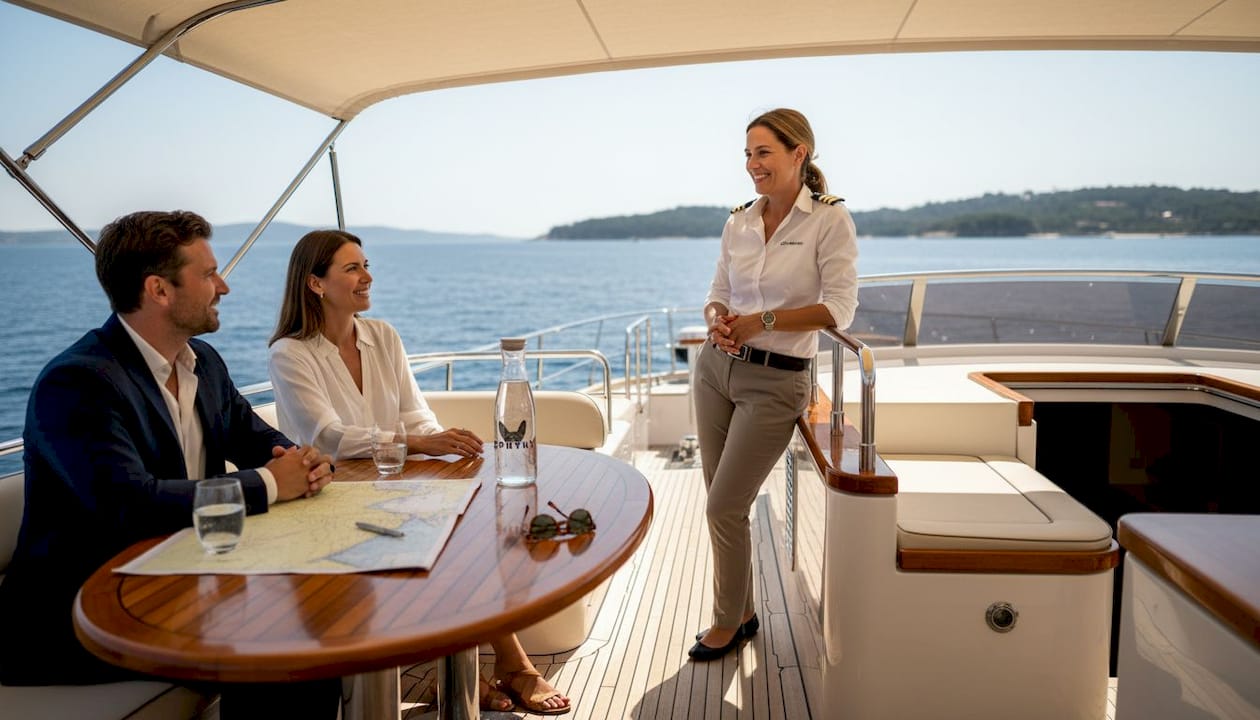
The skipper also manages the subtler aspects of guest experience: privacy, pacing, and atmosphere. They read the mood of the group, adjust the itinerary when needed, and ensure that luxury boat etiquette is maintained without ever making guests feel restricted.
Pro Tip: Before booking, ask your charter provider specifically about the skipper’s experience with your type of event. A skipper who regularly handles corporate groups brings a very different skill set to one who specialises in intimate private sailings.
How a skipper shapes your luxury journey
With an understanding of safety and compliance, see how skippers directly shape the experiences of luxury travellers and corporate guests. This is where the role becomes genuinely exciting.
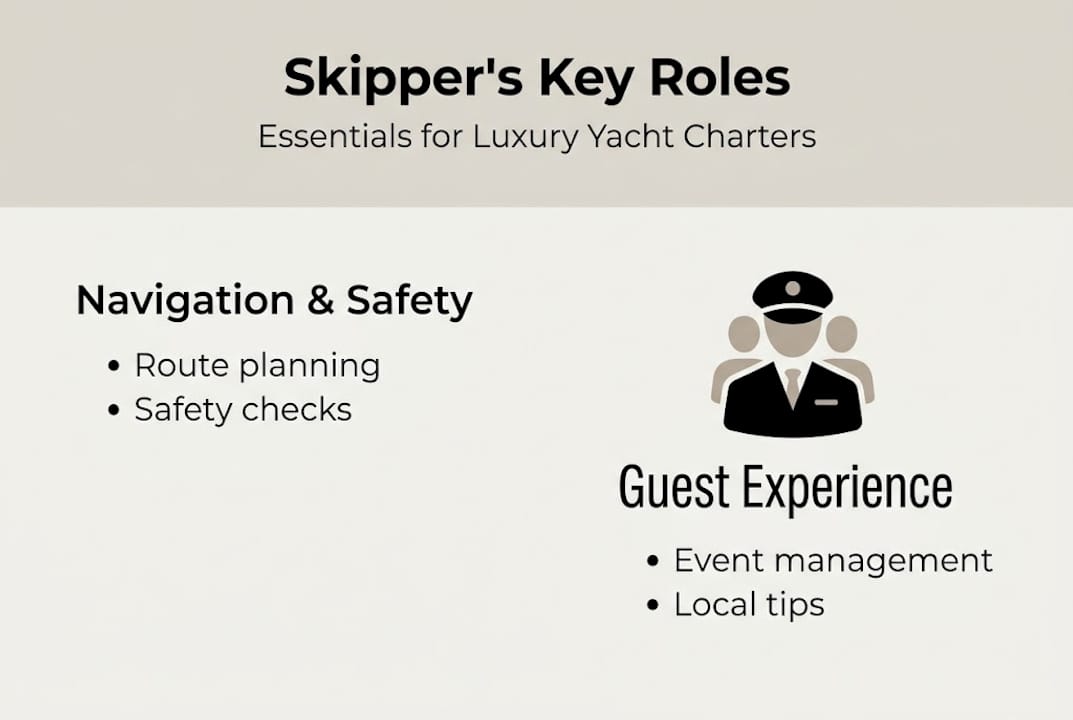
Skippers customise routes, ensure security, and co-ordinate guest activities from start to finish. On a practical level, that means your skipper is involved in decisions that directly affect how much you enjoy the day.
Here is how that plays out in sequence:
- Pre-charter consultation — The skipper reviews your preferences, group size, and objectives before departure.
- Itinerary design — Routes are planned around your interests, whether that means secluded coves, vibrant marinas, or open-water sailing.
- Activity co-ordination — Watersports, dining stops, and event logistics are managed by the skipper in real time.
- Privacy management — The skipper ensures the vessel stays clear of crowded areas when discretion matters.
- Pacing and atmosphere — Music, speed, anchoring spots, and timing are all adjusted to suit the group’s energy.
- Corporate event facilitation — For executive retreats at sea, the skipper co-ordinates with event organisers to ensure seamless transitions between activities.
Local knowledge is one of the most underrated assets a skipper brings. Knowing which anchorage offers the best shelter at a particular time of year, or which beach is quiet on a Saturday afternoon, is not information you find in a guidebook. It comes from years on the water.
Pro Tip: Share your group’s priorities with the skipper in advance. The more context they have, the more precisely they can shape a personalised yacht experience that feels genuinely tailored rather than generic.
For those planning a corporate sailing day or a milestone celebration, the skipper is effectively your event manager at sea. They hold the entire operational picture and ensure every element connects smoothly. Exploring an exclusive sailing guide beforehand helps you arrive with the right expectations.
Expert nuances: Skills that set elite skippers apart
Once the basics are clear, it is the finer details and expert approaches that elevate a good journey to an exceptional one. The gap between a competent skipper and a truly elite one is not always visible to guests. But you feel it.
On larger yachts, the captain operates more like a senior manager, delegating navigation and deck work to crew members. On the luxury day charters and private sailing experiences common in Barcelona, the skipper is fully hands-on. That means their personal skill level directly determines your experience.
Elite skippers rely on proactive decision matrices, jackline systems, and fatigue management to reduce risk before it materialises. These are not reactive measures. They are built into how elite professionals plan every departure.
Key characteristics that distinguish the best from the rest:
- Situational awareness — Reading weather shifts, sea state changes, and guest behaviour simultaneously
- Calm under pressure — Handling marina manoeuvres, unexpected squalls, or guest emergencies without visible stress
- Communication clarity — Briefing guests in plain language without technical jargon
- Fatigue and alcohol risk management — Recognising and addressing risks before they escalate
- Emergency drill leadership — Conducting safety briefings that are thorough but never alarming
Skipper training addresses 75 to 96% of potential maritime incidents. That figure underlines why the quality of your skipper is not a secondary consideration. It is the primary one.
Edge cases matter too. Singlehanded sailing scenarios, complex marina assistance, and guest liability questions all fall within the skipper’s domain. An elite professional has thought through these situations long before they arise.
The reality behind the skipper’s reputation
After exploring the nuances that separate great skippers from the rest, here is what few articles will tell you about their true impact.
Most clients booking a luxury charter focus on the yacht itself. The size, the design, the amenities. That is understandable. But the vessel is just the setting. The skipper is the experience.
We have seen this repeatedly. Two groups, identical yachts, very different outcomes. The difference is always the person at the helm. A skipper who combines technical mastery with genuine human empathy creates moments that guests talk about for years. One who is merely competent delivers a pleasant afternoon. There is a significant gap between those two outcomes.
The realities of yacht crews are rarely discussed openly in the charter industry. Skippers carry enormous responsibility while often remaining invisible to guests who are focused on the scenery and the champagne. That invisibility, when done well, is itself a form of excellence.
Luxury is not simply hired. It is made. And it is made by the people who lead the experience with skill, discretion, and genuine care. Choosing the right skipper may be the most consequential decision you make for your charter, not just for safety, but for the quality of every moment on board.
Elevate your next charter with expert skippers
At Sphynx BCN, every charter is built around the belief that the skipper defines the experience. Our team selects only the most experienced, discreet, and client-focused skippers to lead our luxury sailing experiences along the Mediterranean coast.
Whether you are planning corporate yacht events for a senior leadership team or seeking extraordinary Mediterranean yacht experiences for a private celebration, our skippers bring the expertise and personal attention that transforms a good day into an exceptional one. Explore our full range of luxury Mediterranean yacht tours and discover how the right skipper changes everything.
Frequently asked questions
What qualifications must a luxury yacht skipper have?
A professional skipper typically holds an RYA Yachtmaster or equivalent, alongside VHF radio certification and first aid training. These credentials are the baseline for operating commercially on luxury charters.
Can guests influence the yacht itinerary with a skipper on board?
Absolutely. Skippers work closely with clients to customise itineraries and schedules based on guest preferences, always balancing personalisation with safety considerations.
Who is liable for damages on a bareboat charter with a skipper?
On bareboat plus skipper arrangements, the charterer remains liable for any vessel damage, even when a professional skipper is on board. Always clarify insurance terms before departure.
Are skippered charters safer than bareboat for inexperienced groups?
Yes. Skippered charters are statistically safer than bareboat arrangements, particularly for groups with limited or mixed sailing experience. The skipper’s expertise significantly reduces the risk of human error.