

TL;DR:
- Nautical terms create a precise language that ensures clear and safe communication at sea. They include fixed directional words like port and starboard, which prevent ambiguity during high-stakes operations. Understanding ship parts, measurement units, and operational jargon enhances maritime safety and connects learners to seafaring tradition.
Nautical terms for a ship are the specialised words used to describe its parts, directions, and operations, forming a precise language that makes communication at sea both clear and safe. Without this shared vocabulary, a simple instruction like “secure the line on the left” becomes dangerously ambiguous when a vessel is turning. The International Regulations for Preventing Collisions at Sea depend on this standardised maritime vocabulary to function. Whether you are a language enthusiast, a student of maritime culture, or someone planning their first luxury sailing experience, understanding ship terminology transforms how you read, speak, and think about the sea.
What are the key directional nautical terms for a ship?
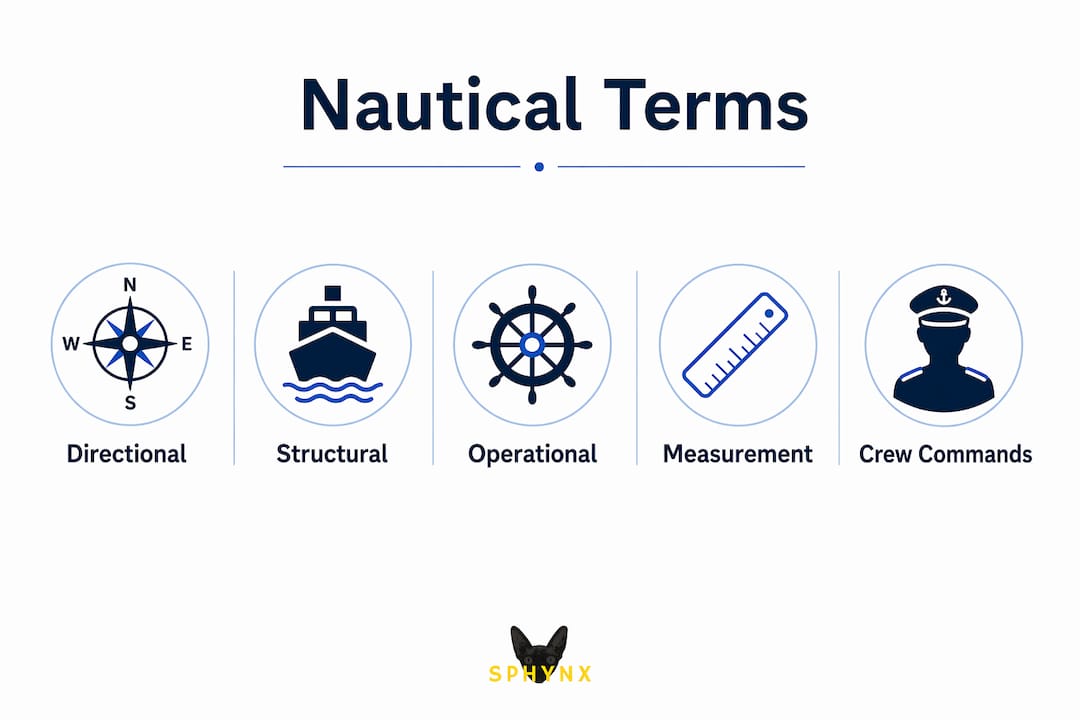
Directional ship terminology is the foundation of all maritime communication. Nautical terms can be organised into three functional categories: location on the hull, relative movement and position, and operational jargon. Starting with direction gives you the clearest mental map of any vessel.
Port and starboard are the two most important directional terms aboard any ship. Port is the left side and starboard is the right side when you face forward toward the bow. These terms are fixed to the ship itself, not to the observer’s position. That distinction matters enormously. If you are standing at the stern looking forward, port is still the ship’s left. If you are below deck facing aft, port remains the ship’s left. The reference never shifts.
The reason for this rigidity is safety. Port and starboard remove ambiguity during fast, high-stakes communication when a misunderstood “left” could cause a collision. Collision avoidance protocols rely entirely on these fixed conventions. A crew member shouting “obstacle to port” conveys an absolute position, not a relative one.
Here are the core directional terms every learner should know:
- Bow: The front of the ship, the point that cuts through the water first.
- Stern: The rear of the ship, where the rudder and propeller are typically located.
- Fore or forward: Toward the bow, used to describe position or movement in that direction.
- Aft: Toward the stern. A cabin described as “aft” sits toward the rear of the vessel.
- Abaft: At or toward the stern relative to another object. “Abaft the mast” means behind the mast when facing forward.
- Amidships: The middle section of the ship, both lengthwise and widthwise.
Many of these terms overlap in everyday usage, which is why professional maritime communication pairs them with a specific object or area. “The life raft stowage aft of the bridge” is precise. “The life raft at the back” is not.
Pro Tip: When learning directional terms, always anchor them to the bow. Every direction on a ship is defined relative to the front of the vessel, so knowing where the bow is solves every other orientation question instantly.
Which nautical terms describe the main parts of a ship?
Ship parts terminology gives you the vocabulary to describe what you see and where things are located aboard any vessel. These terms cover both the structural elements of the hull and the functional areas crew and guests use daily.

The hull is the watertight body of the ship, everything from the keel at the bottom to the deck at the top. The keel runs along the centreline of the hull’s underside and acts as the ship’s structural backbone. Without a keel, a sailing vessel cannot maintain directional stability. The deck is the horizontal surface that forms the floor of the open areas above, and most ships have multiple decks stacked vertically.
The mast is the vertical spar rising from the deck, traditionally used to carry sails and now also used for navigation equipment and communication aerials. The bridge is the command centre of the ship, where the captain and officers control navigation and speed. The bilge is the lowest internal section of the hull, where water that seeps aboard collects before being pumped out.
Foundational ship parts such as the hull, keel, deck, mast, bridge, bilge, and fender form the core structural vocabulary for understanding any vessel’s design. A fender is a buffer, usually made of rubber or foam, hung over the side of the ship to prevent damage when docking alongside a pier or another vessel.
| Term | Location on Ship | Function |
|---|---|---|
| Hull | Entire body of the vessel | Provides buoyancy and structural integrity |
| Keel | Centreline of the hull’s underside | Structural backbone and stability |
| Deck | Horizontal surface above the hull | Floor for crew and passenger movement |
| Mast | Vertical spar rising from the deck | Carries sails, aerials, and navigation equipment |
| Bridge | Elevated forward section | Navigation and command centre |
| Bilge | Lowest internal section of the hull | Collects and drains water ingress |
| Fender | Outer sides of the hull | Protects the hull when mooring |
Two more spatial terms clarify position relative to the ship’s structure. Topside refers to the parts of the hull above the waterline, visible when the ship is afloat. Below deck describes any space beneath the main deck, including cabins, engine rooms, and storage. Inboard means toward the centreline of the ship, while outboard means toward or beyond the outer edges of the hull.
How do nautical terms define speed and distance at sea?
Navigation measurement in maritime contexts relies on two precisely defined units: the nautical mile and the knot. A nautical mile is exactly 1,852 metres, and one knot equals one nautical mile per hour. These are not approximations. They are internationally agreed values used by every commercial and naval fleet on earth.
The reason for this precision is practical. Nautical measurement units are mathematically tight so that watch officers can calculate estimated time of arrival and distance without converting between unit systems. If a vessel travels at 10 knots for 3 hours, it covers exactly 30 nautical miles. No conversion required. That simplicity reduces calculation errors during long watches at sea.
The nautical mile itself is derived from the circumference of the Earth. One nautical mile corresponds to one minute of arc of latitude, which is why charts and navigation instruments align so naturally with this unit. It is a measurement built into the geometry of the planet.
Two related operational terms complete the navigation picture. ETA stands for Estimated Time of Arrival, the calculated moment a vessel is expected to reach its destination. ETD stands for Estimated Time of Departure, the planned time a vessel leaves port. Both appear constantly in voyage planning, port communications, and passenger briefings.
Pro Tip: If you hear a captain say a destination is “20 miles away,” ask whether they mean nautical miles or statute miles. At sea, the default is always nautical miles, which are roughly 15% longer than the land miles used in road navigation.
What operational nautical jargon is used aboard ships?
Operational ship terminology describes what a vessel is doing and what the crew is doing aboard it. Terms like underway, aboard, adrift, mooring, and anchoring are the everyday working language of any crew, from a small sailing yacht to a large commercial vessel.
Understanding these terms helps you follow conversations aboard and read safety briefings accurately. Here is a breakdown of the most common operational terms:
- Underway: The vessel is moving through the water under its own power or sail. A ship is underway even if it is drifting, as long as it is not anchored or moored.
- Adrift: Floating without propulsion or control, carried by wind or current. Adrift carries a negative connotation, implying a loss of control.
- Aboard: On or within the vessel. “All passengers aboard” means everyone is on the ship.
- Mooring: Securing the vessel to a fixed structure such as a buoy, dock, or pier using lines. Mooring is a controlled, deliberate act.
- Anchoring: Lowering the anchor to the seabed to hold the vessel in position. Unlike mooring, anchoring does not require a fixed structure.
- Berth: This term has two distinct meanings. As a noun, it describes a sleeping space aboard the vessel. As a verb, it means to bring the ship into a dock or mooring position.
- Heave to: A sailing manoeuvre where the sails and rudder are set to slow or stop the vessel’s forward progress, often used in heavy weather.
The overlap between nautical jargon and everyday English creates genuine confusion for learners. “Adrift” in casual speech means disorganised or without direction. At sea, it has a specific technical meaning with safety implications. Context always determines which meaning applies, and aboard a vessel, the nautical meaning takes precedence.
Operational language also governs crew commands. “Cast off” means to release the mooring lines and prepare to depart. “Make fast” means to secure a line firmly. These short, direct commands work precisely because every crew member shares the same definitions. You can explore more of this sailing boat vocabulary to build a fuller picture of how the language works in practice.
Key takeaways
Mastering nautical terminology requires learning directional terms first, then structural vocabulary, then operational language, because each layer builds directly on the one before it.
| Point | Details |
|---|---|
| Directional terms are fixed | Port and starboard never change relative to the ship, regardless of where you stand aboard. |
| Organise terms by function | Group vocabulary into location, relative position, and operational jargon to learn faster. |
| Measurement units are precise | A nautical mile is exactly 1,852 metres; a knot is one nautical mile per hour, with no conversion needed. |
| Operational terms have dual meanings | Words like “berth” and “adrift” carry specific nautical meanings that differ from everyday usage. |
| Pair terms with objects | Professional crews always combine directional terms with a specific location to eliminate ambiguity. |
Why nautical language rewards the effort to learn it
I have spent years around boats, harbours, and the people who work on them, and the single observation that holds true every time is this: the moment you learn the language, the sea stops being a backdrop and starts being a place you understand.
Most learners make the mistake of treating maritime vocabulary as a list to memorise. It is not. It is a system. Port and starboard exist because “left” and “right” fail the moment two people face different directions. The nautical mile exists because the Earth’s geometry demanded a unit that worked with charts and compasses. Every term has a reason, and knowing the reason makes the term stick.
The cultural dimension is equally significant. Maritime vocabulary has shaped English more than most people realise. “Taken aback,” “above board,” “at a loose end,” and “by and large” all originate from sailing ship terminology. Learning these terms connects you to centuries of seafaring tradition that runs through British history, literature, and trade.
My honest advice for anyone starting out: spend time aboard an actual vessel before you try to memorise definitions from a page. Even a short luxury sailing experience in the Mediterranean will do more for your retention than an hour with a glossary. When a crew member tells you to move forward of the mast, and you do it correctly, the word “fore” is yours for life.
The learners who struggle are those who treat nautical jargon as exotic decoration. The ones who succeed treat it as a functional tool, which is exactly what it is.
— YellowRock
Put your nautical knowledge to work on the water
Reading about ship terminology is one thing. Hearing it used in real time, by an experienced crew, while the Mediterranean passes by, is something else entirely.
Sphynxbcn offers private yacht tours and luxury charter experiences along the Barcelona coastline, where every detail of the onboard experience reflects the precision and care that good maritime practice demands. You will hear the correct terms used naturally, see the parts of the vessel described in this guide, and understand the operational language as it happens around you. For those who want to go further, Sphynxbcn’s curated Mediterranean sailing experiences are designed to make that knowledge feel lived in, not just learned.
FAQ
What does “port” mean on a ship?
Port is the left side of a ship when facing forward toward the bow. This term is fixed to the vessel and does not change based on where an observer is standing.
What is the difference between a nautical mile and a regular mile?
A nautical mile is exactly 1,852 metres, making it roughly 15% longer than a statute mile used on land. It is the standard unit of distance in maritime and aviation navigation worldwide.
What does “underway” mean in nautical terms?
Underway means the vessel is moving through the water and is not anchored, moored, or aground. A ship can be underway even if it is drifting without engine power.
Why do ships use knots instead of miles per hour?
A knot equals one nautical mile per hour, which aligns directly with nautical charts and the Earth’s coordinate system. This unit precision allows navigators to calculate time and distance without converting between measurement systems.
What is the difference between “aft” and “stern”?
Stern is a noun describing the rear section of the ship as a fixed location. Aft is an adverb or adjective describing direction or position toward the stern, as in “the cabin is aft of the bridge.”