

TL;DR:
- The history of sailing reflects humanity’s long relationship with wind-powered technology, shaping exploration, trade, and cultures over millennia. Early vessels relied on innovative designs, rig types, and regional techniques, which evolved into global exploration tools during the Age of Sail, with maritime traditions influencing modern navigation and racing. Understanding this history reveals how local ingenuity and cultural diversity have driven maritime advances that still impact contemporary sailing practices.
The history of sailing is the story of humanity’s most consequential technological relationship with nature, spanning over five millennia of wind-powered ambition. Sailing history traces a direct line from Egyptian papyrus boats on the Nile to the carbon-fibre hulls of the America’s Cup. Along that line, civilisations rose, continents connected, and entire cultures formed around the sea. Understanding this progression is not merely academic. It reveals why modern sailors, scholars, and maritime enthusiasts still speak a language forged thousands of years ago.
What were the earliest sailing techniques in history?
The earliest known sailing boats were built by Egyptians around 3,100 BC, constructed from papyrus reeds bundled tightly together. These vessels were functional but severely limited. Early Egyptians relied on rowing against the wind because their boats could sail in only one direction. That single constraint shaped the entire trajectory of ancient shipbuilding.
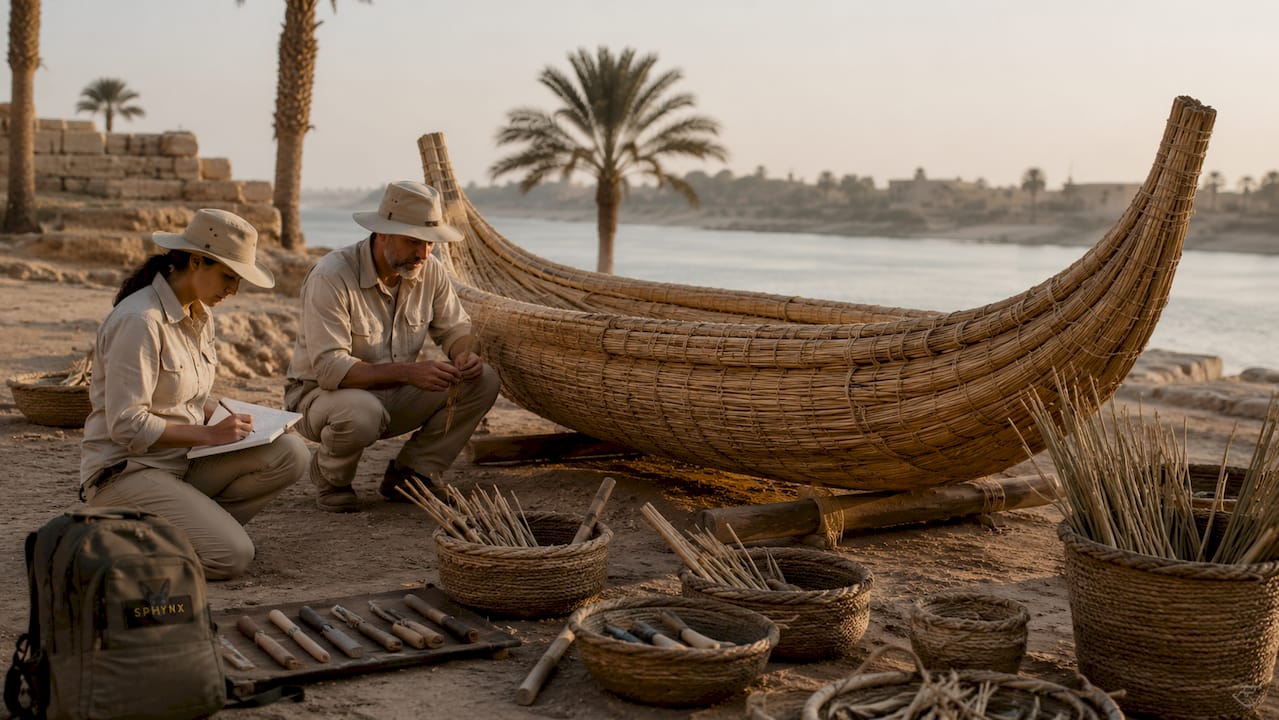
Alongside reed boats, dugout canoes hollowed from whole trees were among the earliest boat types used across the Pacific, Africa, and the Americas. Pacific cultures added outriggers for stability, enabling open-water crossings that European vessels would not attempt for centuries. These were not primitive experiments. They were precise engineering solutions to specific environmental challenges.
How ancient shipbuilders constructed their vessels
Ancient shipbuilding followed two primary structural philosophies: shell-first and frame-first construction. Shell-first methods built the outer hull first, then added internal supports. This approach dominated most ancient cultures and produced vessels well suited to coastal and river navigation. The frame-first technique, which built an internal skeleton before attaching the hull, originated in the Mediterranean and appeared in Southeast Asia by 500 AD. Its spread was slow but its structural advantages were decisive, providing superior rigidity for ocean-going vessels.
Between these two extremes, builders used sewn-plank and lashed-plank methods, stitching hull sections together with rope or plant fibre. The clinker technique, where planks overlapped like roof tiles, gave Viking longships their characteristic flexibility in rough northern seas.
Comparing early sailing rig types
The type of sail a culture adopted determined what waters it could reach and how efficiently it could travel.
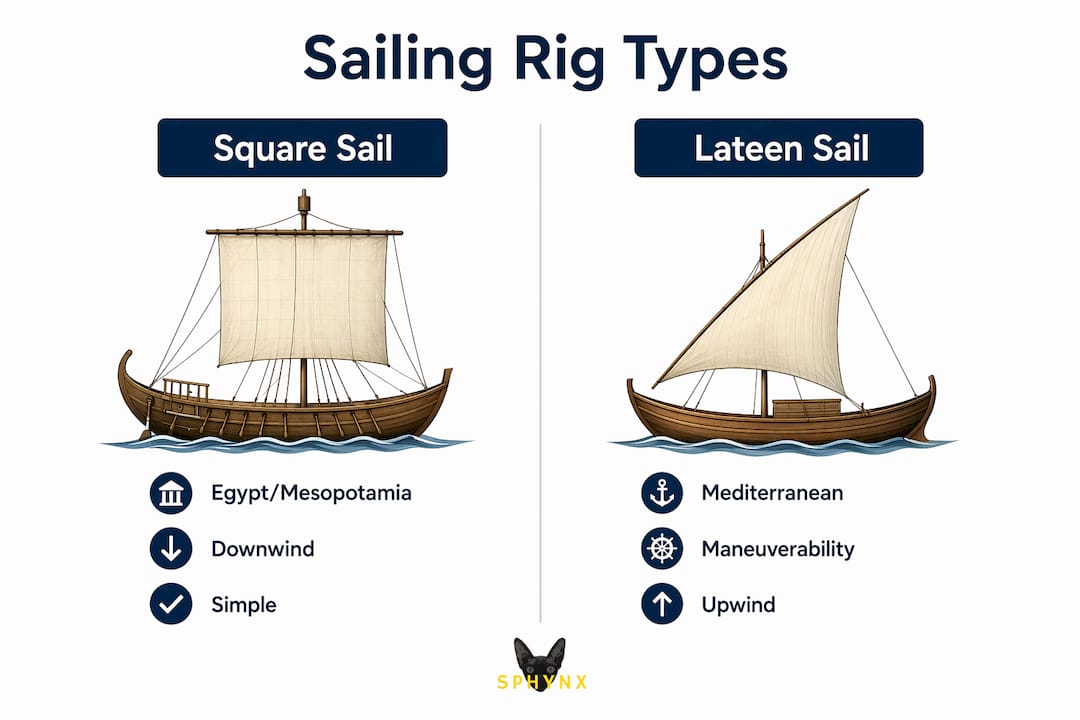
| Rig Type | Origin | Key Advantage |
|---|---|---|
| Square sail | Ancient Egypt and Mesopotamia | Effective downwind in steady trade winds |
| Lateen sail | Mediterranean, 2nd century AD | Allowed sailing at angles against the wind |
| Crab claw sail | Polynesia | Optimised for Pacific trade wind conditions |
| Lug sail | East Asia and Northern Europe | Versatile in variable coastal winds |
The lateen sail, invented in the 2nd century AD, was the single most transformative rig in Mediterranean history. It allowed ships to sail against the wind at different angles, a capability that square-rigged vessels simply could not match. Without the lateen, the Age of Exploration would not have been possible.
Pro Tip: When studying ancient vessels, focus on the sail plan before the hull shape. The rig type reveals far more about a culture’s navigational ambitions and trade routes than the hull construction alone.
How did the age of sail shape maritime exploration?
The Age of Sail, spanning roughly the mid-1400s to the mid-1800s, connected continents through wind-powered ships vital for exploration, trade, and migration. This was the period when sailing ceased to be a regional activity and became a global force. The caravel, a Portuguese vessel combining square sails with lateen-rigged masts, gave explorers the ability to sail into the wind and then run before it on the return voyage.
The famous sailing expeditions of this era reshaped the world’s political and economic geography. Key milestones in the sailing history timeline include:
- 1000 AD: Viking longships, using clinker construction and square sails, reached North America under Leif Eriksson, predating Columbus by nearly five centuries.
- 1492: Christopher Columbus crossed the Atlantic using a caravel fleet, opening sustained contact between Europe and the Americas.
- 1498: Vasco da Gama rounded the Cape of Good Hope and reached India, establishing a direct sea route that broke the Ottoman monopoly on overland spice trade.
- 1519–1522: Ferdinand Magellan’s expedition completed the first circumnavigation of the globe, proving the world’s oceans were connected.
- 1768–1771: James Cook’s first voyage aboard HMS Endeavour charted the Pacific with unprecedented precision, combining exploration with scientific observation.
The Age of Sail also powered the transatlantic slave trade and colonial exploitation. This is the uncomfortable complexity at the heart of maritime history. The same technological advances that enabled Cook’s scientific voyages also enabled the forced transportation of millions of Africans across the Atlantic. Any serious study of the history of maritime exploration must hold both realities simultaneously.
Pro Tip: When tracing famous sailing expeditions, examine the vessel type alongside the voyage. The caravel’s lateen rig was not incidental to Columbus’s success. It was the reason he could return home against prevailing winds.
How did sailing transform from necessity to sport?
The evolution of sailing ships from working vessels to racing machines is one of the most dramatic transitions in maritime history. The America’s Cup, started in 1851, is the oldest active sailing competition in the world. It began when an American schooner named America won a race around the Isle of Wight against 15 British vessels. That single race marked the moment sailing became a competitive spectacle rather than purely a means of transport.
The shift from working sail to sport sail accelerated through the 19th and 20th centuries as steam and then diesel engines took over commercial shipping. Freed from commercial necessity, sailors began optimising for speed and performance rather than cargo capacity. Hull designs became narrower. Rigging grew more complex. Materials shifted from wood and canvas to aluminium, fibreglass, and eventually carbon fibre.
Key sailing competitions and their historical roots
| Competition | Founded | Historical Connection |
|---|---|---|
| America’s Cup | 1851 | Originated from a race around the Isle of Wight |
| Fastnet Race | 1925 | Traces offshore racing traditions to working coastal vessels |
| Vendée Globe | 1989 | Draws on solo circumnavigation heritage from the Age of Sail |
| Sydney to Hobart | 1945 | Rooted in Australian colonial maritime culture |
The Vendée Globe and America’s Cup rely on extraordinary technological innovation, yet the fundamental principles of wind management, course strategy, and crew cohesion remain constant across centuries. These traditions trace directly back to ancient explorers who had no instruments beyond the stars and the feel of the wind on their skin.
Pro Tip: Understanding the historical origins of a sailing competition gives you a sharper lens for reading race tactics. The Vendée Globe’s solo format is not arbitrary. It deliberately echoes the solitary endurance of the great circumnavigators.
How did regional cultures shape distinct sailing traditions?
The evolution of sailing was never a single linear story. Different cultures and geographies produced radically different solutions to the same fundamental challenge of moving across water using wind. The Pacific Islanders developed some of the most sophisticated early sailing traditions on earth, using double-hulled canoes and outrigger designs that achieved remarkable stability in open ocean conditions.
The shunting manoeuvre used by Pacific Islanders is the clearest example of this divergence. Rather than turning the bow through the wind as Western tacking requires, shunting reverses the sail and the sailing direction entirely, with the stern becoming the new bow. This technique reflects a fundamentally different understanding of how a vessel interacts with wind and water.
Key regional sailing traditions that shaped the broader history of maritime exploration include:
- Polynesian navigation: Used star paths, wave patterns, and bird behaviour to cross thousands of miles of open Pacific without instruments.
- Torres Strait Islander vessels: Double outrigger canoes designed for the specific tidal and wind conditions of the strait between Australia and Papua New Guinea.
- Arab dhow sailing: The dhow’s lateen rig allowed Arab traders to exploit seasonal monsoon winds across the Indian Ocean, establishing trade routes centuries before European expansion.
- Viking longships: Shallow-draught clinker-built vessels that could navigate both open seas and shallow rivers, enabling raids and settlements from Newfoundland to Constantinople.
- Chinese junk rigs: Battened sails that could be reefed quickly in changing conditions, reflecting the demands of the South China Sea’s unpredictable weather.
The shunting technique exemplifies how distinct maritime cultures engineered unique solutions to shared sailing challenges. European tacking and Polynesian shunting both solve the problem of sailing against the wind, but through entirely different mechanical principles. That diversity is one of the great intellectual riches of studying sailing history.
What lasting impacts has sailing history left on modern maritime practice?
Studying historic maritime successes and failures is the foundation for understanding modern navigation and global trade. The trade routes established by Portuguese and Spanish navigators in the 15th and 16th centuries still broadly correspond to major shipping lanes today. The logic of wind and current that drove those choices has not changed, even if the vessels have.
Navigational techniques follow a similar lineage. Celestial navigation, refined by Arab astronomers and adopted by European explorers, remained the primary method of open-ocean positioning until GPS became widely available in the late 20th century. Many naval academies still teach celestial navigation as a core skill, precisely because electronic systems can fail.
“The sea, once it casts its spell, holds one in its net of wonder forever.” This sentiment, widely attributed to Jacques Cousteau, captures what every serious maritime scholar recognises: the relationship between human beings and the ocean is not merely technological. It is cultural, psychological, and deeply historical.
Sailing culture and terminology used today stem directly from traditions established during the Age of Exploration. Words like “starboard,” “port,” “knot,” and “fathom” carry centuries of accumulated meaning. For maritime scholars, this linguistic inheritance is a living archive. For nautical tourism, it provides the cultural depth that transforms a boat trip into a genuinely meaningful experience.
The Mediterranean, where so much of this history unfolded, remains one of the world’s most historically layered sailing environments. Its routes connect Barcelona, Genoa, Carthage, Alexandria, and Constantinople, cities whose maritime histories are inseparable from the broader story of Western civilisation.
Key takeaways
The history of sailing is the cumulative record of how wind, wood, and human ingenuity built the connected world we inhabit today.
| Point | Details |
|---|---|
| Origins date to 3,100 BC | Egyptian papyrus reed boats were the first known sailing vessels, limited to downwind travel. |
| The lateen sail changed everything | Invented in the 2nd century AD, it enabled sailing against the wind and made global exploration possible. |
| The Age of Sail had dual consequences | It connected continents through trade and exploration but also powered colonial exploitation and the slave trade. |
| Sport sailing preserves ancient principles | The America’s Cup, founded in 1851, shows that wind management and course strategy remain constant despite technological change. |
| Cultural diversity enriched sailing | Pacific, Arab, Viking, and Chinese traditions each produced distinct engineering solutions that broadened the global sailing repertoire. |
Why sailing history deserves more than a timeline
Most treatments of sailing history reduce it to a sequence of famous voyages and famous ships. That approach misses the deeper story. What genuinely fascinates me, after years of reading maritime history and spending time on the water, is how consistently the sea has forced human beings to solve the same problems in radically different ways.
The Pacific Islander who developed shunting and the Portuguese shipwright who refined the caravel were both responding to specific wind conditions, specific coastlines, and specific cultural pressures. Neither solution was superior in the abstract. Each was precisely calibrated to its environment. That is the real lesson of the sailing history timeline: ingenuity is always local before it becomes universal.
The other thing that strikes me is how poorly the Age of Sail is often taught. The great voyages of Columbus, da Gama, and Magellan are presented as triumphs of exploration. They were also the opening chapters of colonial violence on a continental scale. Serious maritime scholarship cannot separate these threads. The same vessel that carried spices carried enslaved people. Acknowledging that complexity does not diminish the technological achievement. It makes the history honest.
For those who sail today, whether competitively or for pleasure, this history is not background noise. It is the reason the terminology you use exists, the reason the routes you follow were charted, and the reason the sea still carries a weight of meaning that no other environment quite matches. Explore Barcelona’s maritime heritage and you will find that weight concentrated in one extraordinary coastal city.
— YellowRock
Sail the routes that history built
The Mediterranean is not merely a beautiful sea. It is the water on which Phoenician traders, Roman galleys, Arab dhows, and Venetian merchant fleets all left their mark. Sphynxbcn brings that heritage into the present through private yacht tours that follow coastlines shaped by millennia of maritime activity.
Whether you are a maritime scholar wanting to trace the routes of the Age of Exploration or a history enthusiast seeking a more vivid connection to the past, Sphynxbcn’s luxury sailing experiences along the Barcelona coast offer exactly that context. Every voyage departs from a city whose port has been active since Roman times. For those drawn to luxury Mediterranean sailing, the history is not separate from the experience. It is the experience.
FAQ
When did the history of sailing begin?
The history of sailing begins around 3,100 BC with Egyptian papyrus reed boats on the Nile. These were the earliest known wind-powered vessels, though dugout canoes with simple sails likely predate written records.
What was the most important innovation in early sailing techniques?
The lateen sail, developed in the Mediterranean during the 2nd century AD, was the most consequential early innovation. It allowed vessels to sail at angles against the wind, which made long-distance ocean exploration possible.
What defines the age of sail in maritime history?
The Age of Sail spans roughly the mid-1400s to the mid-1800s, defined by wind-powered ships as the primary means of global transport, trade, and military power. It produced famous sailing expeditions by Columbus, da Gama, Magellan, and Cook.
How did the america’s cup begin?
The America’s Cup started in 1851 when an American schooner named America defeated 15 British vessels in a race around the Isle of Wight. It remains the oldest active international sailing competition in the world.
How does sailing history influence modern maritime navigation?
Historical sailing established the trade routes, navigational techniques, and maritime terminology still in use today. Celestial navigation, developed and refined over centuries, remains a taught skill in naval academies as a backup to electronic systems.