

TL;DR:
- A private yacht used as a floating boardroom offers secure, distraction-free environments for high-stakes corporate meetings at sea. It provides superior privacy, acoustic security, and tailored facilities that enhance confidentiality and decision-making compared to traditional venues. Proper planning, security checks, and early booking are essential to maximize the benefits of this innovative format.
A private board meeting yacht is a luxury vessel chartered exclusively to serve as a floating boardroom, giving corporate executives a secure, distraction-free environment for confidential strategic discussions. Unlike hotel conference rooms or office suites, this format places your entire meeting group on open water, physically separated from competitors, journalists, and the general public. The concept has moved well beyond novelty. Corporate yacht events are now viewed as thoughtful investments in focus and decision quality, not extravagance. For event planners and C-suite executives weighing their next high-stakes gathering, understanding what a private board meeting yacht actually delivers is the starting point.
What is a private board meeting yacht?
A private board meeting yacht is a professionally crewed vessel fitted with dedicated conference facilities, hired exclusively by one corporate group for the duration of their meeting. The industry term most operators use is floating boardroom or corporate yacht charter. Both phrases describe the same core product: a vessel where the entire guest list, crew, and itinerary are controlled by the hiring organisation.
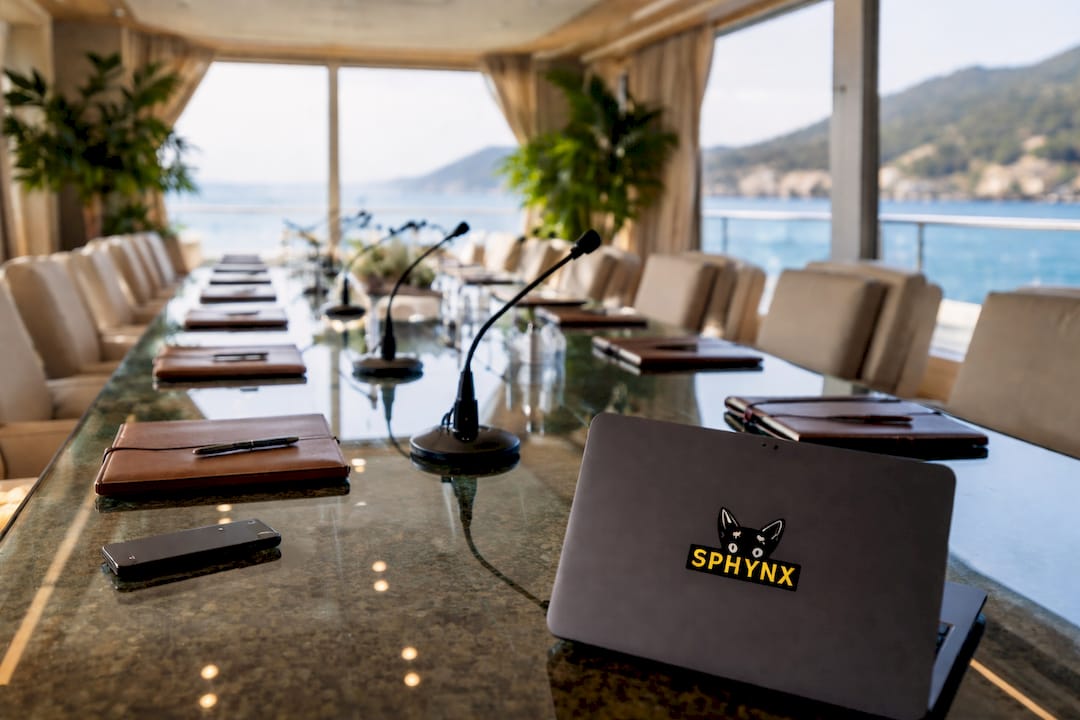
Boutique vessels typically accommodate 10–12 guests, making them ideal for boards of directors or senior leadership teams. Larger event yachts handle 20 to over 500 guests, which suits wider executive conferences or investor days. The size you choose shapes everything from the meeting dynamic to the catering format, so matching vessel capacity to your actual headcount is the first real decision you will make.
What separates a corporate charter from a standard private hire is the operational intent. The yacht is configured around your agenda, not a leisure itinerary. That means AV equipment is pre-installed, crew members sign confidentiality agreements, and the schedule is built around your session timings rather than scenic stops.
What facilities define the yacht boardroom experience?
The physical setup of a well-specified corporate yacht charter rivals a mid-tier conference centre on most technical criteria and surpasses it on privacy.
Core facilities you should expect:
- A dedicated conference saloon or boardroom with fixed seating for your full group, typically arranged around a central table
- High-definition presentation screens or projectors with HDMI and wireless casting inputs
- Satellite broadband connectivity via VSAT systems, providing stable internet access regardless of your position at sea
- Acoustic insulation in the main meeting space, preventing sound from carrying to crew quarters or deck areas
- Bespoke catering served between sessions, from working lunches to formal dinners, prepared by an onboard chef
- Private breakout areas for smaller sub-group conversations or one-to-one discussions
Pro Tip: Before confirming any charter, ask the operator to specify the VSAT bandwidth allocation and confirm whether the system uses end-to-end encryption. Digital security on yachts depends entirely on satellite capacity and encryption standards. A vessel with weak VSAT provision is a liability for any meeting involving sensitive financial or strategic data.
The quality gap between operators is significant. A vessel marketed as “conference-ready” may offer nothing more than a flat-screen television and a Wi-Fi router. Request a full AV specification sheet and, where possible, arrange a vessel inspection before signing the charter agreement.
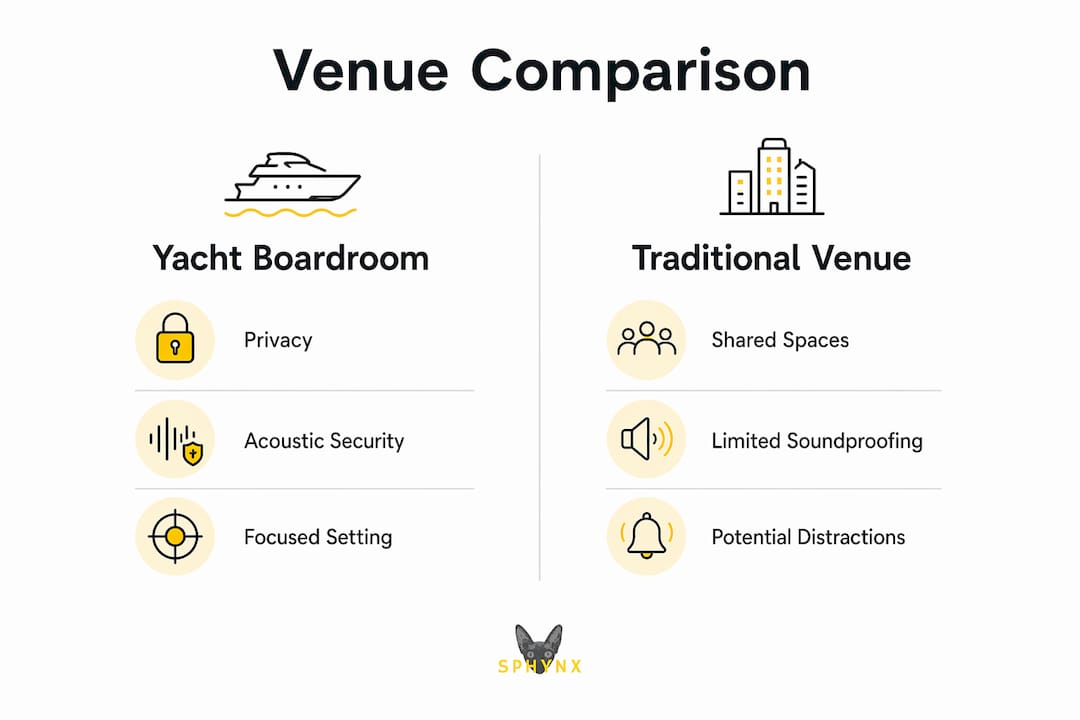
Yacht boardroom vs traditional venue: what are the real differences?
The case for hosting private meetings at sea is not purely atmospheric. There are structural advantages that directly affect the quality of discussion and the security of your information.
| Aspect | Yacht Boardroom | Traditional Venue |
|---|---|---|
| Privacy | Physical isolation at sea; no external foot traffic | Shared corridors, lobbies, and staff |
| Acoustic security | Enclosed saloon; no adjacent rooms | Thin walls; neighbouring conference rooms |
| Distraction level | No external interruptions once underway | Hotel guests, phone signal, walk-ins |
| Attendee focus | Captive environment; no easy exit | Attendees can leave between sessions |
| Perceived prestige | Signals significant investment in guests | Standard expectation for senior meetings |
| Flexibility | Itinerary and schedule fully bespoke | Venue rules, time slots, and catering packages |
Acoustic security at sea is one of the most underrated advantages. Confidential conversations remain private in a way that no hotel venue can guarantee. A boardroom on the 14th floor of a city hotel shares walls, ventilation shafts, and corridors with dozens of strangers. A yacht saloon shares nothing with anyone outside your group.
Chartering a yacht also sends a non-verbal signal that the organisation values its guests’ time enough to remove every possible distraction. That signal matters in high-stakes negotiations, investor relations meetings, and board strategy days where trust and candour are the outputs you are paying for.
How to plan a private yacht meeting for corporate executives
Effective planning separates a productive floating boardroom from an expensive afternoon on the water. Follow these steps to organise a charter that delivers on its promise.
Set your lead time. Peak season charters require several months of advance notice for premium vessels. In Mediterranean markets like Barcelona, the summer window from june through september books out early. Start your search at least four to six months before your preferred date.
Define your group size and objectives. A board of eight needs a different vessel from a 40-person investor briefing. Clarify whether the primary output is a formal resolution, a strategy workshop, or a relationship-building event. This shapes your vessel choice, layout, and catering format.
Budget accurately. Service fees typically run 15–18% on top of the base charter rate, with tax adding approximately 7%. That means a €10,000 charter day costs closer to €12,200–€12,700 all-in before catering upgrades. Payments above $5,000 generally require wire transfer, with the balance due ten days before the event.
Inspect the vessel layout and AV capabilities. Request a full specification document covering screen size, connectivity, seating configuration, and catering capacity. If possible, visit the vessel in person before committing.
Brief the crew on your agenda. Share a session-by-session running order with the captain and chief steward at least 48 hours in advance. This allows the crew to time catering service, manage noise from deck operations, and anticipate when you need the space cleared for sensitive discussions.
Build your programme around sea conditions. Rhythmic programming places intense working sessions during stable morning hours and moves to relaxed networking in the afternoon. Morning seas are typically calmer, which keeps attendees comfortable and focused during your most demanding agenda items.
Pro Tip: Coordinate with your caterer to schedule meal service at natural agenda breaks rather than fixed clock times. Flexibility here prevents the frustration of a productive discussion being interrupted by a lunch trolley.
What security and operational considerations apply to yacht meetings?
Security on a corporate yacht charter operates on two levels: physical and digital. Both require deliberate attention before you sign any agreement.
Physical security:
- The vessel’s isolation at sea is your primary physical perimeter. Once underway, no uninvited party can access the meeting space.
- All crew members should sign confidentiality agreements specific to your event before departure. Standard crew contracts do not include corporate NDA provisions.
- Verify that the operator holds a valid commercial operating licence and that the vessel meets all maritime safety regulations for your charter jurisdiction.
Digital security:
- VSAT bandwidth and encryption are as critical as the physical perimeter. Confirm the encryption standard in writing before the event.
- Establish a clear policy on personal device use during sessions. Unsecured personal hotspots can undermine the vessel’s own secure network.
Insurance and liability:
- Marine insurance frequently excludes liability for corporate events held onboard. You need either a specific corporate liability rider or a standalone event liability policy covering the charter period.
- Ask the operator directly whether their insurance includes corporate liability cover for business meetings. If it does not, arrange your own cover before the event date.
Verifying these points takes less than an hour but protects you from significant legal and reputational exposure. Treat the operator’s credentials with the same rigour you would apply to any professional services supplier.
Who attends yacht board meetings and how does the setting help?
The typical attendee profile for a private yacht meeting is a group of 10–20 senior decision-makers: boards of directors, C-suite leadership teams, strategic working groups, or key investor relations parties. The intimacy of the vessel format is not incidental. It is the mechanism through which the setting produces better conversations.
Physical isolation creates psychological safety. Attendees know the conversation cannot be overheard, which encourages candour that a hotel boardroom rarely produces. Senior executives who guard their words carefully in office environments often speak more directly when the group is genuinely alone.
The informal elements of a yacht day also do real work. A shared lunch on deck, a brief coastal sail between sessions, or an evening sundowner creates social context that accelerates trust. These moments break down hierarchy in ways that a formal agenda cannot. A CFO who has spent an afternoon on deck with the CEO’s direct reports enters the evening session with a different relational baseline.
Practical recommendations for balancing formal and informal elements:
- Schedule no more than two formal working sessions per day to preserve energy and engagement
- Use deck time and meal breaks as deliberate networking periods, not dead time
- Assign a facilitator to manage transitions between formal sessions and social periods
- Keep the formal agenda visible to all attendees so informal conversations stay anchored to the meeting’s objectives
The yacht corporate events format works precisely because it combines the rigour of a structured agenda with an environment that makes people genuinely comfortable. That combination is difficult to replicate on land.
Key takeaways
A private board meeting yacht delivers privacy, acoustic security, and attendee focus that no hotel venue can match, making it the most controlled environment available for high-stakes corporate discussions.
| Point | Details |
|---|---|
| Vessel size matters | Match capacity to your group: boutique yachts suit 10–12 guests; larger vessels handle 20 to 500+. |
| Budget for full costs | Add 15–18% service fees and approximately 7% tax to the base charter rate for accurate budgeting. |
| Book months in advance | Peak season charters require several months’ lead time; start your search at least four to six months early. |
| Verify digital security | Confirm VSAT bandwidth and encryption standards in writing before signing any charter agreement. |
| Insurance gaps are real | Marine insurance rarely covers corporate events; arrange a specific liability rider or standalone policy. |
The floating boardroom is not a trend. it is a format shift.
I have observed corporate hospitality from both sides of the planning table for long enough to recognise when something represents a genuine shift rather than a passing fashion. The private board meeting yacht is the latter.
What strikes me most is not the luxury. It is the operational logic. Every structural feature of a well-run corporate charter solves a problem that traditional venues cannot. You cannot accidentally walk into the wrong meeting room on a yacht. You cannot be overheard through a partition wall. You cannot have your most important session derailed by a fire alarm in the hotel lobby. The environment enforces the conditions that good decision-making requires.
The executives I see gravitating toward this format are not doing it for the photographs. They are doing it because they have sat through too many supposedly confidential strategy days in hotel suites where the walls are thin and the catering staff rotate every 45 minutes. The yacht removes those variables entirely.
My honest view is that the executive retreats at sea format will become the standard for any board discussion where the output genuinely matters. The cost premium over a five-star hotel is real but modest relative to the value of a single well-executed strategic decision. If you are still defaulting to a conference centre for your most sensitive meetings, you are optimising for familiarity rather than outcomes.
— YellowRock
Plan your private yacht charter with Sphynxbcn
Sphynxbcn specialises in private yacht charters along the Mediterranean coast from Barcelona, with bespoke configurations for corporate board meetings and executive retreats. Every charter includes a dedicated crew, flexible catering, and full itinerary control so your agenda runs on your terms.
Whether you need a focused half-day session for a board of ten or a full-day programme for a wider leadership group, Sphynxbcn builds the experience around your objectives. Vessels are available with conference-grade AV setups and secure connectivity. Booking is straightforward, and the Sphynxbcn team handles all operational logistics from crew briefing to catering coordination. Explore the full range of corporate yacht events in Barcelona and request a tailored proposal for your next meeting.
FAQ
What is a private board meeting yacht?
A private board meeting yacht is a luxury vessel chartered exclusively by one corporate group, fitted with conference facilities and crewed for confidential business meetings at sea. The format is also called a floating boardroom or corporate yacht charter.
How many people can attend a yacht board meeting?
Boutique vessels typically accommodate 10–12 guests, while larger yachts handle groups of 20 to over 500. Most board-level meetings use smaller vessels to preserve the intimacy and confidentiality of the discussion.
How far in advance should i book a corporate yacht charter?
Peak season charters require several months of advance notice. For Mediterranean destinations like Barcelona, booking four to six months ahead is the standard recommendation for premium vessels.
Is a yacht meeting more private than a hotel boardroom?
Yes. Physical isolation at sea means no shared corridors, adjacent rooms, or external foot traffic. Acoustic security on a yacht is structurally superior to any hotel venue, making it the preferred format for genuinely confidential discussions.
What insurance do i need for a corporate yacht meeting?
Standard marine insurance typically excludes liability for corporate events. You should arrange a specific corporate liability rider or a standalone event liability policy covering the full charter period before your event takes place.