

TL;DR:
- Using the correct French term for ‘sailboat,’ which is voilier, enhances communication during luxury charters and showcases cultural respect.
- Voilier* is preferred in formal contexts like contracts, marinas, and crew briefings, while bateau à voiles is more general and casual.
Even seasoned yacht travellers who have spent years exploring the Mediterranean coast are often caught off guard when they realise they have been using the wrong French word for ‘sailboat’. The confusion is understandable. French has more than one accepted term, and the nuances between them matter considerably when you are booking a luxury charter, speaking with a French marina concierge, or browsing high-end sailing brochures along the Côte d’Azur. This guide cuts through the ambiguity, equipping you with the right vocabulary and the cultural intelligence to use it confidently.
Table of Contents
- What does ‘sailboat’ mean in French?
- How ‘voilier’ shapes French sailing and cultural experience
- Where you’ll encounter ‘voilier’ on your luxury journey
- Related vocabulary for yachting and sailing in France
- Why mastering nautical French unlocks richer travel experiences
- Ready to embark on your luxury ‘voilier’ experience?
- Frequently asked questions
Key Takeaways
| Point | Details |
|---|---|
| Voilier is the key term | ‘Voilier’ is the most accurate French word for ‘sailboat’, especially in luxury sailing contexts. |
| Using correct terms matters | Employing proper vocabulary can improve communication and unlock better service from French providers. |
| Cultural context counts | Understanding these terms helps enhance your yachting and hospitality experiences in France. |
| Practical application advised | Use this knowledge when booking, aboard your charter, and interacting with local crews and concierges. |
What does ‘sailboat’ mean in French?
With that common confusion in mind, let us clarify the correct terminology once and for all.
The word you need is voilier. WordReference lists “sailboat” as “voilier,” and Cambridge defines “voilier” as “sailboat (American)” or “sailing boat (British),” while FrenchDictionary also recognises “bateau à voiles” as an accepted equivalent. So in practical terms, you have two options, but they are not interchangeable in every situation.
“In French, ‘sailboat’ is most commonly translated as voilier, though bateau à voiles is also entirely accepted in everyday and formal contexts.”
Here is a quick reference for clarity:
| French term | Direct translation | Typical context |
|---|---|---|
| Voilier | Sailing boat / sailboat | Luxury charters, marinas, formal booking |
| Bateau à voiles | Boat with sails | General conversation, informal description |
| Yacht à voiles | Sailing yacht | High-end or racing context |
| Voilier de croisière | Cruising sailing boat | Extended charter or blue-water voyages |
Voilier carries a certain elegance. It is the term you will see printed on charter contracts, posted on marina whiteboards at Saint-Tropez, and spoken by captains briefing guests before departure. Bateau à voiles, by contrast, is more descriptive and general. Think of it as the difference between saying “motor car” and “automobile.” Both are correct, but one signals a more refined familiarity with the subject.
For those wanting to go deeper into the language of the sea before their next voyage, exploring essential sailing terms is an excellent starting point.
How ‘voilier’ shapes French sailing and cultural experience
With an understanding of what ‘voilier’ means, let us explore why this term matters for your travel and luxury charter experience.
According to the Cambridge Dictionary, the word “voilier” refers specifically to a sailing boat, and French dictionaries commonly gloss it as “bateau à voiles.” But beyond the definition, the word carries real cultural weight in France.
France has one of the most storied maritime cultures in Europe. From the rocky harbours of Brittany to the glamorous marinas of Cannes and the rugged coastlines of Corsica, sailing is not simply a leisure activity. It is part of the national identity. When you use voilier correctly in conversation with a French captain or charter broker, you signal that you understand and respect that tradition. That matters more than most visitors realise.
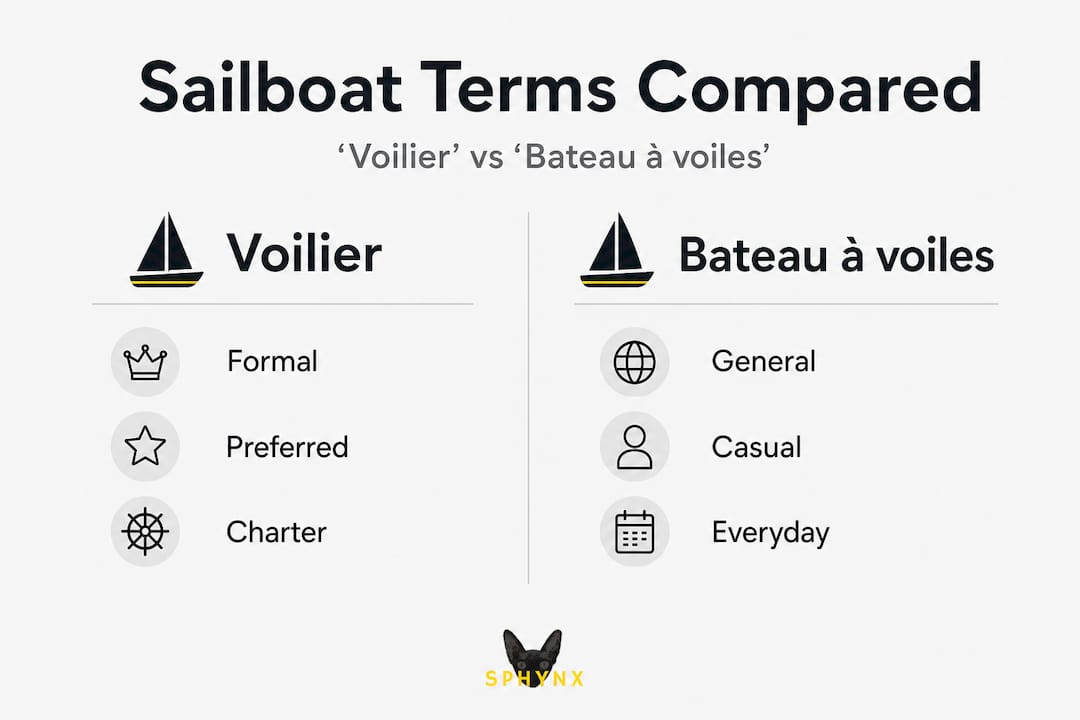
Here is how voilier compares to related terms in a luxury context:
| Term | Register | Best used when… |
|---|---|---|
| Voilier | Formal, preferred | Booking, contracts, marina signage, crew briefings |
| Bateau à voiles | Neutral | Casual conversation or describing a vessel |
| Voilier de luxe | Elevated | Requesting premium or superyacht services |
| Catamaran | Specific | When referring to a twin-hulled sailing vessel |
When you are researching premium options, many boat rental agencies in Corsica list their fleets using voilier as the primary category. Knowing this saves time and prevents miscommunication at the point of enquiry.
A few cultural pointers worth noting:
- Marinas and harbours: Signage in French ports consistently uses voilier to denote the sailing boat berth category, as distinct from moteur (motorboat) sections.
- Charter brochures: High-end operators in the south of France categorise their fleets under voiliers de croisière (cruising sailing boats) to signal comfort and range.
- Concierge conversations: A hotel concierge at a five-star property in Nice or Marseille will immediately understand your preference and match you to the right provider when you use voilier rather than a vague descriptor.
- Onboard experience: French crew members often use voilier when explaining the vessel’s qualities, rigging, and performance to guests.
Pro Tip: Before calling a French charter company, look up whether they specialise in voiliers de croisière or voiliers de régate (racing sailing boats). These distinctions will tell you immediately whether the experience will be relaxed and scenic or performance-focused.
If you want to master sailing terminology across the full Mediterranean region, investing a little time before departure pays enormous dividends once you are aboard.
Where you’ll encounter ‘voilier’ on your luxury journey
Now that we understand the importance of voilier in context, here is how and where you will see and want to use the term during your luxury travels.
The Cambridge Dictionary confirms that voilier is the standard reference for sailing boat across formal French sources, and this consistency means you will encounter it at every stage of a luxury sailing holiday in France. Here is a practical walkthrough:
During online research and booking. French charter platforms and luxury travel agencies categorise sailing vessels under voilier. Searching this term in French-language travel sites surfaces fleets that might not appear in English-language results, including boutique providers along the Atlantic coast or in the Calanques near Marseille.
On arrival at the marina. Most French marinas display category signage in French. Voiliers and bateaux à moteur (motorboats) are kept in separate pontoon areas. Knowing this terminology helps you navigate efficiently and avoids the awkward moment of wandering into the wrong section with your luggage.
During the captain’s welcome briefing. French captains typically begin their safety and orientation briefing using standard nautical vocabulary. Recognising voilier, pont (deck), cockpit, and cabine (cabin) helps you follow the briefing properly and ask informed questions rather than nodding politely.
When speaking with your concierge. Whether at a hotel or aboard a charter, the concierge is your gateway to curated experiences. Asking specifically about excursions en voilier (sailing excursions) or a croisière en voilier (sailing cruise) signals exactly what you want and avoids being steered towards a motorboat trip instead.
At waterfront restaurants and yacht clubs. Many prestigious yacht clubs and waterfront restaurants in France offer apéritifs en voilier or post-sail dining packages branded around the sailing lifestyle. Recognising these descriptions means you spot the right opportunities rather than skimming past them.
In communication with crew. If you are aboard a crewed charter, the crew will refer to the vessel as le voilier in conversation. Responding in kind, even briefly, builds rapport and often results in noticeably more attentive service.
Pro Tip: When requesting upgrades or special arrangements onboard, phrase your request with the correct vessel terminology. Saying “je préférerais rester sur le voilier ce soir” (I would prefer to stay on the sailing boat this evening) rather than a vague English phrase signals cultural fluency, and French hospitality professionals genuinely respond to that warmth and effort.
For an in-depth look at making the most of your time aboard, reviewing yacht hospitality best practices before your trip is time well spent. You might also explore Barcelona sailing tour options if you are beginning or ending your French voyage from the Spanish coast.
Related vocabulary for yachting and sailing in France
Beyond voilier, a few additional terms will set you apart as a sophisticated yachting guest.
As confirmed by multiple French dictionaries, voilier and bateau à voiles cover the core meaning of ‘sailboat’, but the lexicon of French yachting extends much further. Here is a curated glossary of terms you are likely to hear or see during a luxury sailing experience in France:
- Skipper: Used identically in French, meaning the captain or lead sailor responsible for the vessel. You will see this on charter documents and hear it constantly onboard.
- Équipage (ay-kee-pahj): The crew. Knowing this word helps when discussing staffing arrangements or making special requests directed to the team rather than just the captain.
- Pont (pohn): The deck. A fundamental term for navigating the boat’s layout and giving or receiving directions onboard.
- Cockpit: Again borrowed directly into French, referring to the outdoor helm and seating area at the stern. The social heart of the sailing experience.
- Cabine (kah-been): The cabin. Essential for discussing sleeping arrangements, stowage, or privacy.
- Galley / Cuisine de bord (kwee-zeen duh bor): The onboard kitchen. Relevant if you are planning a catered experience or specifying dietary preferences to the crew.
- Régate (ray-gaht): A regatta or sailing race. France hosts world-class regattas, particularly in Brittany and on the Mediterranean, and knowing this term helps you plan your calendar.
- Charter / Affrètement (ah-fret-mahn): The formal term for chartering or hiring a vessel. You may see this on contracts or in communications with high-end brokers.
- Mouillage (moo-yahj): Anchorage. A key term when planning where to stop for a swim or overnight stay in a secluded bay.
- Capitainerie (kah-pee-ten-ree): The harbour master’s office. This is where you check in, pay berth fees, and get local information. Knowing this word means you find the right place instantly.
For a broader understanding of the sector and its vocabulary, nautical tourism explained offers context that goes well beyond language alone.
Why mastering nautical French unlocks richer travel experiences
Here is an opinion that surprises many of our guests: language ability is not the primary reason that knowing voilier and its companion terms improves a luxury sailing holiday. The real reason is signal value.
French maritime culture is built on tradition, precision, and a quiet pride in craft. When a guest steps aboard and uses the correct terms, even casually, the crew reads that as respect. They are not assessing your grammar. They are gauging whether you are someone who cares about the experience or someone who simply booked the most expensive option on the list. The former receives considerably more thoughtful service.
We have seen this pattern play out repeatedly in conversations with French captains and charter operators. A guest who asks to visit a particular mouillage rather than “a nice bay for swimming” is immediately categorised differently. That guest gets a recommendation for the secluded cove that does not appear on any public map. The guest who uses generic language gets the standard itinerary.
There is also a practical dimension that people rarely consider. Miscommunication at sea is not merely inconvenient. It can cause genuine logistical problems. If you request a voilier de croisière and receive a bateau à moteur (motorboat), the experience is fundamentally different. Getting the terminology right from the first point of enquiry ensures that what arrives at the dock matches what you envisioned.
The contrarian insight worth sitting with is this: in a world where everyone is upgrading their technology and their wardrobe before a luxury trip, almost nobody upgrades their vocabulary. That gap is your opportunity. A small investment of time learning sailing terminology for charters before departure puts you in a genuinely rare category of guest, one that French sailing professionals remember and treat accordingly.
Ready to embark on your luxury ‘voilier’ experience?
If you are ready to put your newly honed vocabulary and understanding to use, here is how to start planning your journey.
At Sphynx BCN, we design experiences for guests who care about the details. Whether you are planning a private sailing voyage along the Mediterranean coast or seeking an intimate charter that combines cultural immersion with exceptional comfort, our team speaks your language, both figuratively and literally.
Explore our private yacht tour options to find the right vessel and itinerary for your vision. For inspiration and guidance on the broader Mediterranean region, our exclusive Mediterranean sailing guide walks you through the finest routes and seasonal considerations. When you are ready to compare fleet options and pricing, our premium yacht rentals page provides full details. Your voilier awaits.
Frequently asked questions
What is the primary French word for ‘sailboat’?
The main French word for ‘sailboat’ is voilier, as confirmed by WordReference, though bateau à voiles is also fully accepted and widely understood.
Is there a difference between ‘voilier’ and ‘bateau à voiles’?
Voilier refers specifically to a sailing boat or yacht and carries a more formal, precise register; bateau à voiles is more literal and general, meaning any boat with sails rather than a dedicated sailing vessel.
Where might I use the word ‘voilier’ while travelling in France?
You will find voilier on marina signage, charter brochures, booking platforms, and in conversation with yacht crew or concierges throughout the French coast.
Are there other nautical terms I should know for luxury charters?
Absolutely. Words like équipage (crew), skipper (captain), pont (deck), mouillage (anchorage), and capitainerie (harbour master’s office) will make your onboard experience noticeably smoother and more connected.