

TL;DR:
- VIP yacht transfers must comply with SOLAS passenger limits and ensure guests never handle their luggage from aircraft to cabin. Proper planning includes confirming guest numbers, appointing a single point of contact, circulating flight data, and pre-booking contingencies for adverse sea conditions. Exceeding 12 guests requires a SOLAS-certified vessel or tandem charter, with clear security, legal, and operational protocols in place.
A VIP yacht transfer succeeds on two conditions: it is legally compliant under SOLAS passenger rules and it is executed as invisible luxury, meaning guests never touch their own luggage from aircraft door to cabin. Before anything else, confirm your final guest count against the SOLAS 12-person threshold, appoint a single point of contact (a concierge or charter manager), and circulate flight numbers, private-jet tail numbers, and ETAs to your FBO, port agent, and captain.
Three immediate actions for any planner:
- Confirm guest count vs crew. Every guest, including infants, counts toward the SOLAS limit. Crew do not.
- Appoint one point of contact. This person owns the shared comms thread and is the only one who calls the captain.
- Circulate flight data now. Tail number, flight number, ETA, and passenger list go to FBO, chauffeur, port agent, and captain in a single message.
Pro Tip: Share a green/amber/red ETA status system with all suppliers from day one. Green means on time, amber means a delay under 30 minutes, red means a significant change. Suppliers act on colour, not on a phone call to the guest.
Table of Contents
- Your at-a-glance checklist for organising VIP yacht transfers
- What legal requirements govern a VIP yacht transfer?
- How do you plan the arrival and monitor it in real time?
- Which transfer method works best for your group?
- How do you deliver invisible luxury from aircraft to gangway?
- What are your options when the group exceeds 12 guests?
- How do you protect VIP guests’ security and privacy?
- What does a VIP yacht transfer cost, and how do you handle tipping?
- Sample day-of timeline and communications script
- Sphynxbcn handles the entire transfer so you don’t have to
- Key takeaways
- What experienced planners always check before sign-off
- Useful sources for planners
- FAQ
Your at-a-glance checklist for organising VIP yacht transfers
Copy this into your supplier brief and assign an owner to each item.
- Guest list and SOLAS check — Owner: charter manager. Confirm total guest count (including infants) against the 12-person threshold before any vessel is contracted.
- Flight and tail numbers — Owner: concierge. Collect airline or private-jet tail number, flight number, and ETA at booking. Share immediately with FBO, chauffeur, port agent, and captain.
- FBO booking and PPR — Owner: concierge. Confirm Prior Permission Required slot and FBO handling at least 48 hours before arrival.
- Chauffeur and luggage vehicle — Owner: ground transport lead. Confirm vehicle class, driver name, and a separate luggage van if group exceeds six bags.
- Port agent and berth or tender slot — Owner: port agent. Confirm berthing or tender schedule 24 hours before arrival.
- Captain sea-state check — Owner: captain. Assess swell forecast at T-2 hours and confirm Plan B pier if tender comfort is marginal.
- Luggage plan — Owner: head of service. Tag all bags at FBO: soft bags to cabins, hard cases to lazarette.
- CIQ manifest filing — Owner: port agent or FBO lead. File passenger manifest and APIS data before arrival.
- Contingency pier — Owner: charter manager. Name and pre-book the alternative berthing before departure day.
What legal requirements govern a VIP yacht transfer?
The SOLAS passenger threshold is the single most important legal constraint in yacht transfer planning. Any vessel carrying more than 12 paying passengers is classified as a passenger ship and must meet significantly stricter construction, safety, and certification standards. Crew are excluded from this count, but every guest, including infants, counts in full.
In practice, this means a yacht licensed for private charter can legally carry up to 12 guests. Exceed that number and you need either a SOLAS-certified passenger vessel (rare and expensive) or a tandem charter arrangement. UK port authorities and the Maritime and Coastguard Agency enforce these rules; non-compliance can result in the vessel being detained.
Required documentation for UK arrivals and international legs:
- Passenger manifest filed with the port authority before arrival
- APIS (Advance Passenger Information System) data for international arrivals, submitted to UK Border Force
- PPR (Prior Permission Required) for private aviation arrivals at controlled aerodromes
- Port authority notification of berthing time and vessel details
- CIQ (Customs, Immigration, and Quarantine) pre-clearance or fast-track arrangement at the FBO
Pro Tip: Embed the SOLAS passenger count as a contractual condition in your charter agreement. The captain and broker must both sign off on the confirmed guest list before the vessel departs. A last-minute addition on the day is a legal liability, not a hospitality upgrade.
How do you plan the arrival and monitor it in real time?
Collect this flight data at the point of booking, not the day before:
- Airline or private-jet tail number
- Flight number and scheduled arrival time
- Full passenger list with names matching travel documents
- Special baggage or oversized equipment (diving gear, sports kit, musical instruments)
- Any accessibility requirements affecting vehicle or gangway choice
Set four timeline checkpoints and assign who sends the update on each:
- T-24 hours: Charter manager reconfirms all bookings (FBO, chauffeur, port agent, captain) and circulates the final ETA.
- T-2 hours: Captain checks sea state and confirms tender or Plan B pier. Port agent confirms berth slot.
- T-30 minutes: Chauffeur confirms position at terminal. FBO lead confirms CIQ status.
- T-10 minutes: Head of service confirms yacht is ready, welcome drinks poured, luggage team at gangway.
Collecting tail numbers at booking lets providers monitor arrivals in real time and trigger chauffeur and port agent movements proactively, which eliminates scramble moments at busy ports. Use a dedicated FBO feed or a flight-tracking app and feed rolling ETAs into the shared comms thread.
Pro Tip: Pre-arrange CIQ fast-track at the FBO so guests clear customs before they reach the vehicle. A quayside handoff, where the guest steps from car to gangway without entering a terminal building, is the gold standard.
Which transfer method works best for your group?
| Method | Best for | Weather sensitivity | Privacy level | Key consideration |
|---|---|---|---|---|
| Quayside docking | Large groups, heavy luggage | Low | High | Requires available berth |
| Tender transfer | Anchored yachts, remote bays | High | High | Check swell forecast first |
| Helicopter | Ultra-fast, high-profile arrivals | Medium | Very high | Permits and helipads required |
| Chauffeur to protected pier | Bad weather contingency | Low | High | Pre-book alternative pier |
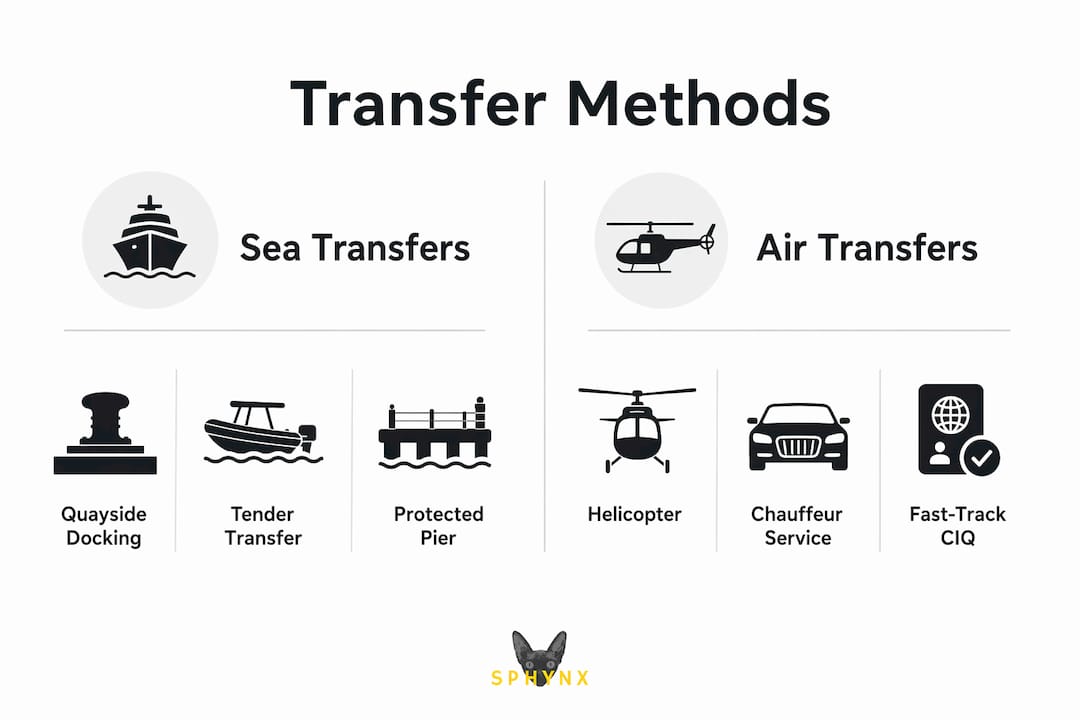
Sea state is the most common transfer failure point. Always decide Plan B before departure: name a protected pier or alternative marina and pre-book it so the captain and port agent can act without delay. A tender transfer in 1.5-metre swell is not a luxury experience.
Pro Tip: If the swell forecast is marginal at T-24 hours, activate Plan B automatically rather than waiting to reassess on the day. Pre-booking costs almost nothing; a delayed or unsafe tender transfer costs the entire guest experience.
How do you deliver invisible luxury from aircraft to gangway?
The invisible luxury standard means guests never handle luggage after the aircraft door. Achieving it requires clear role assignments and a documented luggage chain of custody.
Role assignments:
- Charter manager / concierge: single point of contact, owns the comms thread, never delegates guest communication
- FBO lead: meets guests at the aircraft, manages CIQ escort, hands off to chauffeur
- Chauffeur: collects guests and delivers to quayside; separate luggage vehicle if required
- Port agent: confirms berth, manages quayside access and any port authority formalities
- Head of service / lead steward: receives guests at gangway, oversees luggage split to cabins and lazarette
Luggage plan: Tag every bag at the FBO with cabin assignment. Soft bags go directly to cabins; large hard cases go to the lazarette to keep gangways clear. A separate luggage vehicle for oversized items prevents delays at the quayside.
Service rider essentials: meet and greet script for FBO lead, chilled welcome drinks in the vehicle, safety brief on boarding, and refreshments ready in the saloon before guests step aboard.
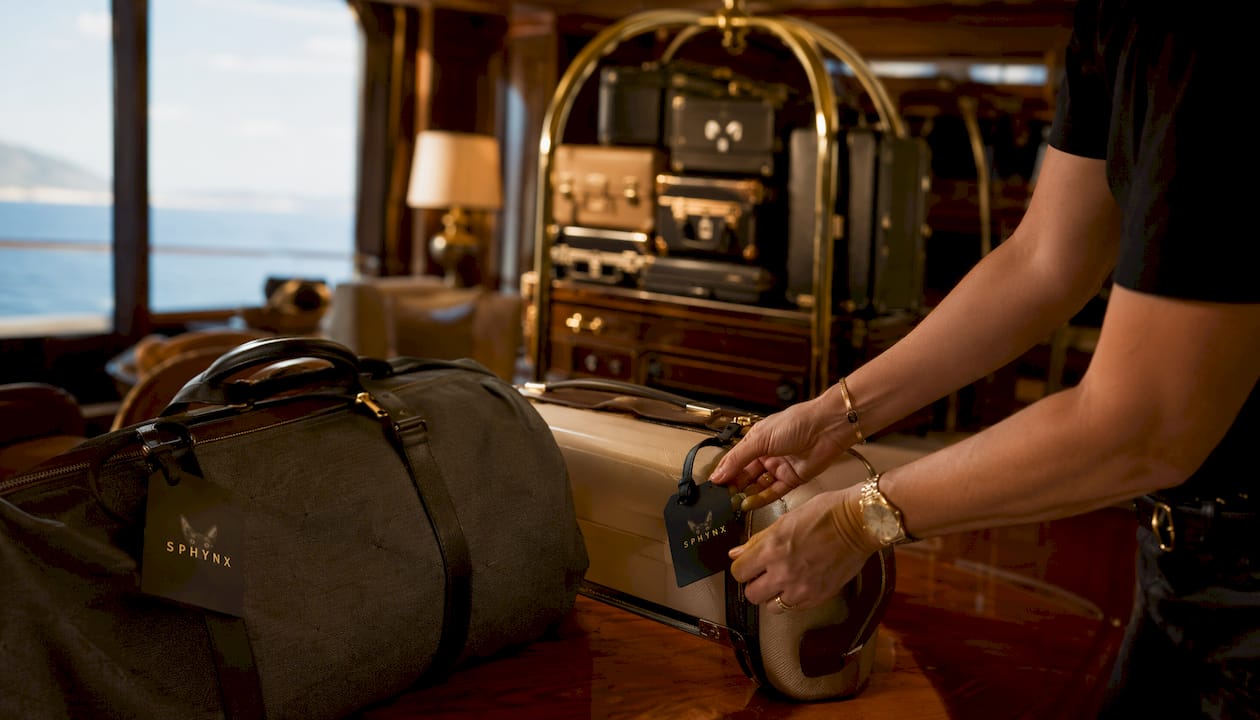
Pro Tip: Assign one comms thread (WhatsApp or Signal) and enforce the green/amber/red ETA scheme. Suppliers update the thread; nobody calls the guest.
What are your options when the group exceeds 12 guests?
Three paths exist, and only one is genuinely practical for most events.
- Reduce the guest list to 12 or fewer. Straightforward but often not an option for corporate or celebration events.
- Source a SOLAS passenger yacht. These vessels meet the stricter construction and safety standards required for more than 12 paying passengers. They exist, but they are rare and command significant premium pricing.
- Run a tandem charter. Two matched yachts, coordinated operationally, each carrying up to 12 guests. This is the standard solution for groups of 13–24.
Tandem charters require a lead yacht, matched interiors and crew-to-guest ratios across both hulls, and a single agency briefing both crews together. Centralising the booking with one operator prevents a tiered guest experience where guests on the second yacht feel like an afterthought. Contracts are legally separate per vessel, but operational command sits with one charter manager.
Pro Tip: For 13–24 guests, price a tandem charter before approaching SOLAS passenger vessel brokers. The cost difference is usually substantial, and the guest experience on two well-matched private yachts often exceeds a single larger vessel.
How do you protect VIP guests’ security and privacy?
Privacy starts before the guest arrives. A significant proportion of affluent travellers cite privacy as their primary reason for choosing private charter over other options.
Guest privacy checklist:
- Pre-arrival NDA for crew and ground staff where the guest profile requires it
- No signage at quayside bearing the guest’s name; use a code name or vessel name only
- Controlled meet and greet: FBO lead meets guests airside, not in a public terminal
- Restricted quayside access: port agent manages who enters the berthing area
Security measures:
- Manifest control: crew and port agent hold the only copies; not shared digitally beyond the comms thread
- Escorted CIQ: guests never queue in a public immigration hall
- Luggage chain of custody: documented handover from FBO lead to chauffeur to head of service, with high-value items noted separately
VIP cabin considerations: Reserve the owner’s cabin or a designated VIP cabin before the guest list is finalised. Brief the lead steward on lighting preferences, temperature, and any provisioning requests. The cabin should be ready, lit, and provisioned before the guest boards.
Pro Tip: Use a code name for the booking across all supplier communications. The guest’s real name appears only on the official manifest and travel documents.
What does a VIP yacht transfer cost, and how do you handle tipping?
Budget these line items in your transfer estimate:
- FBO handling and PPR fees (varies by aerodrome and aircraft type)
- Chauffeur vehicle and, where required, a separate luggage van
- Tender fuel and port agent fees
- Helicopter uplift permits and landing fees if used
- CIQ escort costs where the FBO does not include this
- Contingency vehicle pre-booked but not charged unless activated
For tipping, industry guidance follows MYBA conventions. The standard recommendation is to present tipping as an optional item in the pre-arrival documentation rather than leaving guests to calculate it on the day. Including a suggested tip within the APA (Advance Provisioning Allowance) or as a pre-collected line item keeps the guest experience clean and removes any awkwardness at disembarkation.
Include tipping guidance in the guest briefing pack sent 48 hours before departure. State the suggested amount, confirm it is discretionary, and explain how it will be distributed to crew.
Sample day-of timeline and communications script
| Time | Action | Owner | Status trigger |
|---|---|---|---|
| T-24h | Reconfirm all bookings; circulate final ETA to all suppliers | Charter manager | Green confirmed |
| T-2h | Sea-state check; confirm tender or activate Plan B pier | Captain | Amber if swell marginal |
| T-30min | Chauffeur confirms position; FBO lead confirms CIQ status | FBO lead / chauffeur | Green or amber |
| T-10min | Head of service confirms yacht ready; luggage team at gangway | Head of service | Green |
| Arrival | FBO lead meets guests airside; CIQ escort begins | FBO lead | Live update to thread |
| Quayside | Chauffeur delivers to gangway; luggage handover documented | Chauffeur / head of service | Green confirmed |
| Boarding | Welcome drinks, safety brief, luggage split to cabins and lazarette | Lead steward | Complete |
Sample comms thread messages:
- T-24h: “All confirmed. [Guest code name] ETA [time]. FBO: [name]. Chauffeur: [name/plate]. Port agent: [name]. Berth: [number]. Status: GREEN.”
- T-2h: “Sea state checked. Swell [X]m. Tender confirmed / Plan B pier activated. Status: [GREEN/AMBER].”
- Contingency trigger: “Swell exceeds tender comfort. Activating Plan B: [pier name]. Chauffeur rerouting. ETA adjusted to [time]. Status: AMBER.”
Sphynxbcn handles the entire transfer so you don’t have to
For planners who want a single operator to own every step from FBO to gangway, Sphynxbcn delivers exactly that for private yacht experiences in Barcelona and along the Mediterranean coast. The team handles FBO liaison, curated chauffeur fleet, port agent coordination, luggage handling, and the onboard welcome, so the checklist above becomes their responsibility, not yours.
Sphynxbcn’s local port relationships in Barcelona mean berth slots, CIQ arrangements, and tender schedules are confirmed through established channels rather than cold calls. For corporate groups and Mediterranean events, the team coordinates multi-vessel logistics and matched service standards across the fleet. The result is a transfer experience where the guest’s only job is to arrive.
Request a bespoke transfer quote directly through the yacht private tour page and specify your guest count, arrival airport, and preferred transfer method. The team will confirm availability and return a detailed proposal within 24 hours.
Key takeaways
A VIP yacht transfer requires legal compliance under the SOLAS 12-person rule, a single point of contact owning all supplier communications, and a documented luggage plan that keeps guests hands-free from aircraft door to cabin.
| Point | Details |
|---|---|
| SOLAS 12-person rule | Every guest, including infants, counts toward the limit; crew do not. Exceed 12 and you need a tandem charter or a SOLAS passenger vessel. |
| Single point of contact | One charter manager owns the comms thread and all supplier updates; guests are never contacted directly by individual suppliers. |
| Luggage chain of custody | Tag bags at the FBO: soft bags to cabins, hard cases to lazarette. Document every handover. |
| Plan B is mandatory | Name and pre-book a protected pier or alternative marina before departure day; activate automatically if swell is marginal at T-2 hours. |
| Sphynxbcn as turnkey operator | Sphynxbcn owns FBO liaison, chauffeur fleet, port agent booking, and onboard welcome for Barcelona and Mediterranean transfers. |
What experienced planners always check before sign-off
The gap between a good transfer brief and a flawless one usually comes down to three things that get skipped under time pressure.
The first is guest parity against crew. Planners confirm the headline guest number but forget to recount after late additions. One extra guest added the night before can push a charter into illegal territory. The fix is a contractual cut-off: no additions after T-48 hours without written sign-off from the charter manager and captain.
The second is CIQ slots. Filing the passenger manifest late, or assuming the FBO will handle it, is the most common cause of quayside delays. The port agent must confirm manifest submission and CIQ clearance status by T-2 hours, not on arrival.
The third is luggage resourcing. Under-resourced luggage handling, where two crew members are expected to move twelve guests’ bags while also preparing the vessel, creates visible chaos at the gangway. A dedicated luggage team, even if it is just one additional person from the ground transport company, makes the difference between a clean boarding and a cluttered one.
Common pitfalls to avoid: late PPR slot requests (submit at least 48 hours before arrival), unfiled APIS data for international arrivals, and no named contingency pier in the brief. Each of these has a simple fix, but only if the checklist is completed before the day.
Useful sources for planners
- SOLAS passenger threshold explained — Vital Charters: the 12-person rule, passenger counting, and vessel classification
- Jet-to-yacht transfer playbook — CVAY: invisible luxury operations, single point of contact, and green/amber/red ETA system
- Group and event yacht charter planning — Vital Charters: tandem charter mechanics and SOLAS options for groups over 12
- VIP transport add-ons for yacht guests — Crown Yachts Miami: tail number monitoring and real-time arrival coordination
- Yacht charter tipping guidance — Worldwide Boat: MYBA tipping conventions and APA billing
- Luxury transfer service inclusions — Cannes Transfer: CIQ escort, chilled vehicles, and separate luggage van options
- Tandem yacht charter guide — Yaloou: lead yacht, matched service standards, and centralised booking
- Sphynxbcn yacht private tour — Sphynxbcn: turnkey transfer and arrival services in Barcelona
- Premium yacht rental industry standards — Sphynxbcn: legal constraints and industry standards for planners
- Luxury yacht experiences in Phuket — Qbic Travel: premium transfer and service parallels in resort destinations
FAQ
What is the 12-person rule on a yacht?
Under SOLAS, any vessel carrying more than 12 paying passengers is classified as a passenger ship and must meet stricter safety and construction standards. Crew are excluded from the count, but every guest, including infants, is included.
How much should you tip the crew on a private yacht charter?
Industry guidance follows MYBA conventions; the standard approach is to include a suggested tip as an optional line item in the APA or pre-arrival documentation rather than leaving guests to calculate it at disembarkation.
How do operators transfer guests to a yacht?
The four main methods are quayside docking, tender transfer, helicopter, and chauffeur to a protected pier. The choice depends on sea state, berth availability, guest mobility, and privacy requirements; a pre-decided Plan B pier is always recommended when swell is forecast.
What is a VIP cabin on a yacht?
A VIP cabin is a designated guest cabin, typically the owner’s cabin or the largest secondary cabin, reserved for a principal guest and provisioned in advance with their preferences for lighting, temperature, and refreshments before boarding.