

TL;DR:
- Sustainable yacht travel emphasizes careful planning, eco-friendly technology, and responsible waste management to protect fragile marine environments. Key practices include optimizing routes for fuel efficiency, using mooring balls instead of anchors, and choosing local, seasonal provisions. Responsible choices enhance the luxury experience without compromising comfort or environmental integrity.
Yacht travel puts you directly in some of the world’s most fragile environments. The same turquoise waters and rich marine life that make a sailing trip extraordinary are precisely what irresponsible boating threatens. These sustainable yacht travel tips are designed for travellers who refuse to treat “eco-friendly” as a box-ticking exercise. You will find practical, specific guidance drawn from captain expertise, marine science, and real onboard experience. The aim is straightforward: help you enjoy a genuinely luxurious time at sea without leaving the ocean worse off than you found it.
Table of Contents
- Key takeaways
- 1. Plan your itinerary with fuel efficiency in mind
- 2. Choose yachts with sustainable technologies
- 3. Manage waste responsibly onboard
- 4. Reduce onboard energy consumption
- 5. Protect sensitive marine ecosystems when anchoring
- 6. Provision sustainably and practise mindful guest behaviour
- My honest perspective on sustainable yacht travel
- Experience sustainable luxury on the water with Sphynxbcn
- FAQ
Key takeaways
| Point | Details |
|---|---|
| Plan smarter itineraries | Reducing unnecessary mileage cuts fuel consumption more than most onboard technology changes. |
| Lock the Y-valve | Within 3 nautical miles of land, the Y-valve must be secured in the holding tank position to comply with No Discharge Zone rules. |
| Replace anchors with mooring balls | Using mooring balls in coral reef areas prevents irreversible seabed damage to already-fragile ecosystems. |
| Cut hotel load energy use | Onboard lighting, climate control, and refrigeration account for the bulk of superyacht energy consumption and are easy to reduce. |
| Choose local, seasonal provisions | Provisioning from nearby markets reduces the carbon footprint of every meal served on the water. |
1. Plan your itinerary with fuel efficiency in mind
The single most effective sustainable yacht travel tip you will ever receive has nothing to do with solar panels or biodiesel. Smart itinerary planning is the most effective way to reduce a yacht’s environmental footprint, outperforming technology upgrades in many cases. Captain Kelly Gordon reinforces this point: routing decisions made before you even step aboard shape emissions for the entire voyage.
Reducing unnecessary mileage means choosing destinations that cluster well geographically rather than zig-zagging across a coastline. On a Mediterranean charter, for example, sailing from Barcelona up to the Costa Brava and back is far more efficient than doubling back repeatedly to cover the same stretch of water.
Cruising speed matters enormously too. Fuel consumption does not scale linearly with speed. Dropping from 10 knots to 8 knots on a motor yacht can reduce fuel burn by 30 to 40 per cent per nautical mile. Ask your charter provider or skipper to plan routes at optimal cruising speeds rather than pushing the engines.
Pro Tip: Request a printed or digital route plan before departure and discuss fuel-saving speed profiles with your skipper. It takes five minutes and can meaningfully lower the trip’s carbon output.
- Choose destinations within a sensible geographic cluster
- Avoid doubling back on routes unnecessarily
- Sail during daylight hours to use natural light rather than generators
- Opt for marinas with shore power connections so generators stay off overnight
2. Choose yachts with sustainable technologies
Not all yachts are built equally when it comes to environmental impact. When selecting a vessel for your trip, ask specific questions about onboard technology rather than accepting vague “eco-friendly” branding.
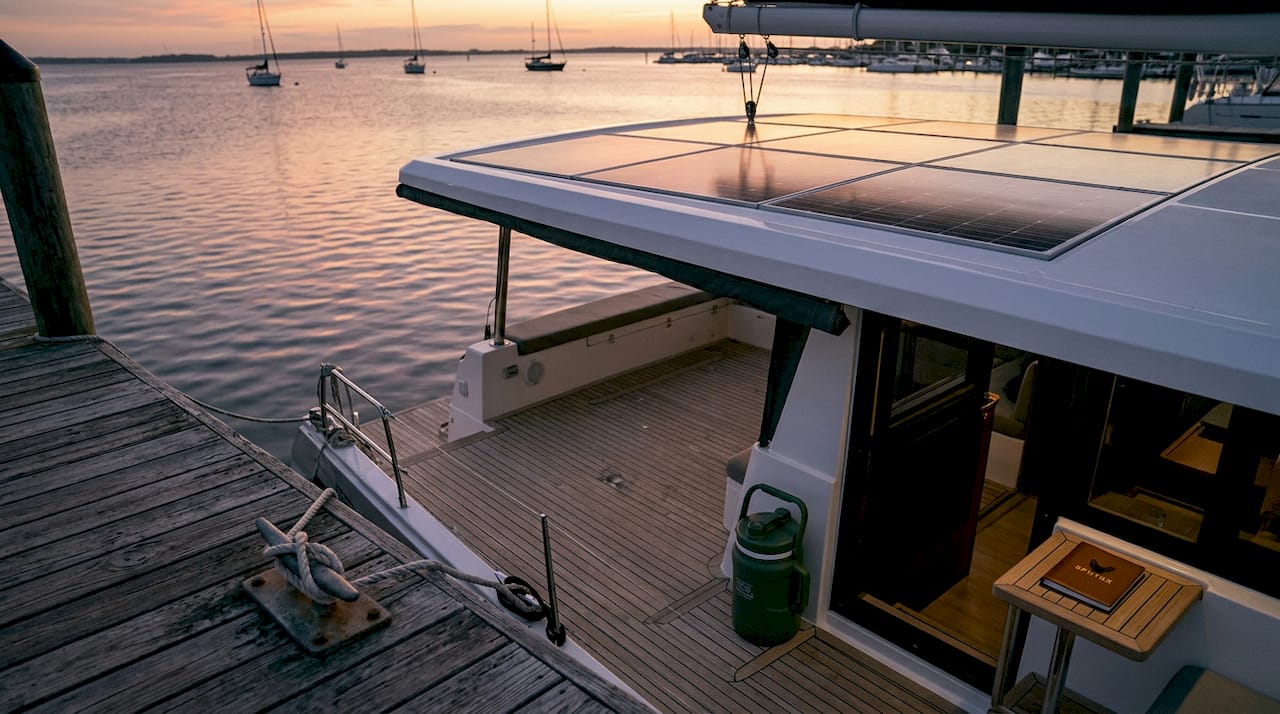
Hybrid propulsion systems, solar panels, and lithium battery banks are now increasingly available on charter yachts. A yacht equipped with solar charging can often run hotel loads, including lighting, refrigeration, and navigation systems, without burning a drop of diesel during daylight hours at anchor. That is a substantial saving across a week-long charter.
Shore power converters are another technology worth asking about. Shore power converters accommodate different global voltages and frequencies, letting the yacht plug into marina electricity and shut down the generator entirely while in port. For travellers spending several nights in marinas, this alone removes a significant source of unnecessary emissions and noise.
Look for charter providers who can demonstrate actual fuel monitoring systems rather than simply claiming sustainability credentials. Quantified data, such as litres per nautical mile or CO₂ per charter day, signals genuine commitment.
3. Manage waste responsibly onboard
Responsible yacht travel starts with a simple rule: nothing goes overboard. Not a bottle cap, not a plastic bag, not food scraps. This sounds obvious, but the practicalities of managing waste on a working vessel require real thought and preparation.
Begin with a sustainable yacht travel checklist focused on waste:
- Replace all single-use plastic bottles with reusable alternatives. A quality stainless steel bottle, as found in sustainable personal accessories guides, eliminates hundreds of single-use plastics over a week-long charter.
- Use biodegradable cleaning agents and personal care products. Graywater containing detergents and food scraps causes oxygen depletion in harbour waters, so the chemistry of what you wash with genuinely matters.
- Set up clearly labelled recycling stations below deck. Separating glass, plastic, and organic waste before arriving in port makes disposal vastly simpler.
- Never discharge black water (sewage) overboard within 3 nautical miles of land. The Y-valve must remain locked in the holding tank position in No Discharge Zones. Use pump-out stations at marinas.
- Request that the yacht is provisioned with minimal packaging, opting for loose produce and reusable containers wherever possible.
Pro Tip: Pack a small mesh bag for personal use and ask your crew to store one near the cockpit. Any debris that blows or falls near the water has a better chance of being caught before it goes in.
4. Reduce onboard energy consumption
Energy efficiency on a yacht is not a comfort sacrifice. It is mostly a matter of habit. Hotel loads account for 50 to 80 per cent of superyacht energy use, which means your thermostat, lighting, and fridge settings matter more than most guests realise.
The following comparison illustrates where onboard energy actually goes and what adjustments have the greatest impact:
| Energy source | Typical share of total use | Reduction method |
|---|---|---|
| Climate control (air conditioning) | 35–45% | Set to 24°C rather than 19°C; use natural ventilation at anchor |
| Refrigeration | 15–20% | Keep fridge doors closed; avoid over-stocking; defrost regularly |
| Lighting | 10–15% | Switch to LED fittings; turn off lights in unoccupied cabins |
| Entertainment and electronics | 10–15% | Unplug devices when not in use; avoid leaving screens on standby |
| Water heating | 5–10% | Use solar heating where available; take shorter showers |
Underwater lighting at anchor is worth a specific mention. It looks spectacular, but it disrupts the behaviour of fish, invertebrates, and other marine species that depend on natural light cycles. Switching it off, or at minimum reducing its duration, is one of the more overlooked eco-friendly yacht practices available to any guest or crew member.
5. Protect sensitive marine ecosystems when anchoring
Between 30 and 50 per cent of global coral reefs have already been lost, which makes anchoring decisions far more consequential than most travellers appreciate. A single anchor dragged across a coral formation can destroy decades of growth in seconds.
Wherever mooring balls are provided, use them. Mooring balls are installed specifically to protect the seabed beneath them, and using one costs nothing beyond the small mooring fee. In areas without mooring balls, ask your skipper to anchor in sand or mud rather than over seagrass meadows or rocky reef habitats.
Some of the most popular Mediterranean sailing areas now have strict regulations around anchoring. The Balearic Islands, for instance, prohibit anchoring over Posidonia oceanica seagrass in many zones, and fines are substantial. Knowing the rules before you arrive is both responsible and practical.
| Situation | Recommended action | Action to avoid |
|---|---|---|
| Coral reef area | Use designated mooring ball | Dropping anchor directly |
| Seagrass meadow | Anchor in adjacent sandy patch | Dragging anchor through meadow |
| Marine protected area | Follow all local regulations | Exceeding speed limits or entering restricted zones |
| Open anchorage | Choose sand or mud substrate | Anchoring on rocky or biologically active seabed |
Beyond anchoring, reduce engine speeds when passing through marine protected areas and encourage water activities that do not disturb wildlife. Paddleboarding and swimming near a reef causes far less disruption than a jet ski or a tender running at speed.
6. Provision sustainably and practise mindful guest behaviour
The food and supplies you bring aboard contribute to your overall environmental footprint, yet this is one of the most overlooked areas in any sustainable yachting practices list. Local, seasonal provisioning reduces food miles, supports coastal communities, and often results in fresher, better-tasting meals.
When planning provisions, work with your charter manager or skipper to source produce from local markets rather than large supermarket chains. In Barcelona, the Boqueria market and local neighbourhood markets offer excellent seasonal produce with minimal packaging.
For personal care products, choose biodegradable options. Sunscreen, for example, is a genuine concern around coral reefs. Oxybenzone and octinoxate, chemicals found in many conventional sunscreens, are toxic to coral at very low concentrations. A reef-safe mineral sunscreen is a direct marine conservation tip you can act on before the trip even starts. Consider browsing zero-waste personal care options to replace single-use or chemical-heavy products.
Pro Tip: Before your charter, ask the provider for a provisioning list. Add a column for “local alternative” next to each item and work through it with whoever is managing catering. You will be surprised how many swaps are simple.
- Choose reef-safe, mineral-based sunscreen
- Buy loose produce from local markets rather than pre-packaged supermarket goods
- Decline unnecessary branded merchandise or single-use welcome gifts
- Minimise food waste by planning meals with portion sizes in mind
- Respect wildlife at all times: no feeding fish, no removing shells or sea creatures
My honest perspective on sustainable yacht travel
I’ve watched the conversation around responsible yacht travel shift considerably over the past decade. When eco-friendly yacht travel first entered the mainstream charter discussion, it mostly meant a recycling bin in the galley and a vague commitment to “minimising impact.” That was not enough then, and it certainly is not enough now.
What I’ve found from working closely with the yachting world is that guests hold more power than they realise. When someone books a charter and specifically requests solar-assisted power, low-emissions routing, and reef-safe provisioning, that request lands. Charter operators respond to what clients ask for. The market shifts because individual travellers decided their preferences were worth stating.
I’ve also noticed a misconception that sustainability and luxury are in tension. They are not. Sailing at a slower, more efficient speed means you spend more time at anchor in beautiful bays. Using shore power means less engine noise at night. Local provisioning means genuinely exceptional food. The luxury yacht experience is not diminished by responsible choices. It is often improved by them.
Carbon offsetting is useful, but treat it as a last step rather than a first resort. Reduce first, then offset what you cannot yet eliminate. The travellers who take that approach are the ones genuinely moving the industry forward.
— YellowRock
Experience sustainable luxury on the water with Sphynxbcn
If these eco-friendly yacht practices resonate with you, the next step is finding a provider that shares your values without compromising on quality.
Sphynxbcn offers private yacht tours along the Barcelona coastline with an emphasis on curated, thoughtful experiences. The team works with guests to personalise every aspect of the voyage, from provisioning and routing to onboard practices that respect the Mediterranean’s extraordinary marine environment. For travellers who want to combine the finest sailing experiences with a genuine commitment to the sea, Sphynxbcn’s Mediterranean sailing experiences are designed with exactly that balance in mind. Get in touch to plan a charter that you will feel good about long after you step ashore.
FAQ
What are the most effective sustainable yacht travel tips?
The most impactful steps are planning fuel-efficient itineraries, using mooring balls instead of anchors near coral, switching to shore power in port, and eliminating single-use plastics onboard. Operational decisions made before departure typically have a greater effect than any single piece of technology.
How do I reduce waste during an eco-friendly yacht tour?
Use reusable containers and biodegradable products, set up labelled recycling stations below deck, and never discharge waste overboard. Within 3 nautical miles of land, the Y-valve must be locked in the holding tank position to comply with No Discharge Zone regulations.
Is anchoring harmful to marine ecosystems?
Yes, anchoring on coral or seagrass can cause serious irreversible damage. Between 30 and 50 per cent of global coral reefs have already been lost, and a single anchor drag can destroy decades of reef growth. Always use designated mooring balls where available and anchor on sand or mud substrates otherwise.
How does onboard energy use affect the environment?
Hotel loads including climate control, refrigeration, and lighting account for 50 to 80 per cent of superyacht energy consumption. Adjusting thermostat settings, switching to LED lighting, and unplugging unused electronics can meaningfully cut fuel burn and emissions without affecting guest comfort.
Can sustainable yachting still be a luxury experience?
Absolutely. Slower, more efficient cruising speeds mean longer time at anchor in secluded bays. Local, seasonal provisioning produces better-quality meals. Shore power eliminates generator noise overnight. Responsible choices and high-end experiences are fully compatible, and the best charter operators will help you achieve both.